Skokie Epoxy Flooring brings more than 20 years of work to epoxy flooring in Winnetka, and the first question we ask about any floor is what sits underneath it. A garage slab poured on compacted ground behaves one way. A concrete deck carrying cars over open air or occupied rooms behaves another, and the coating has to match. We look at that before we look at colors or flake blends.
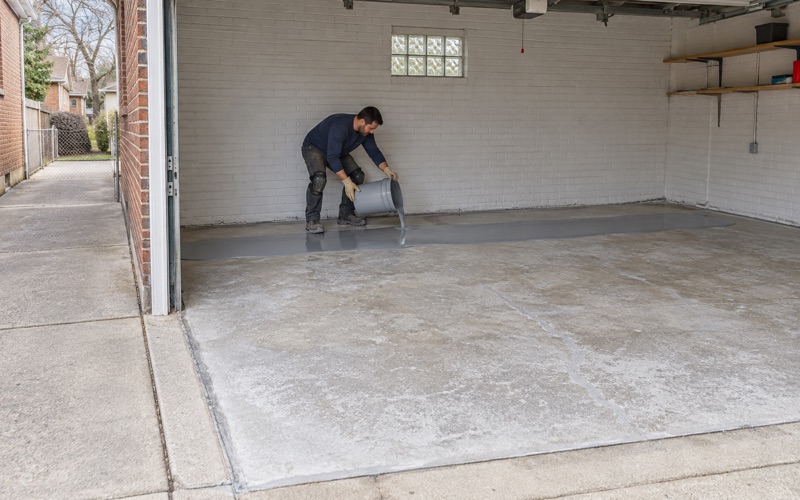
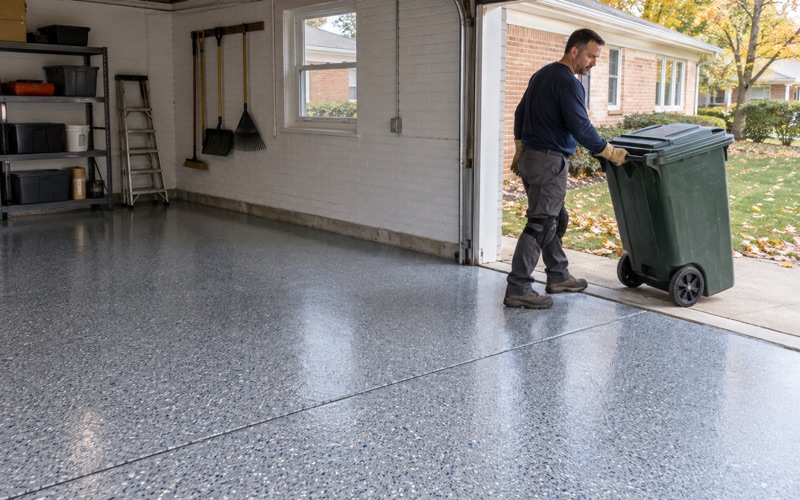
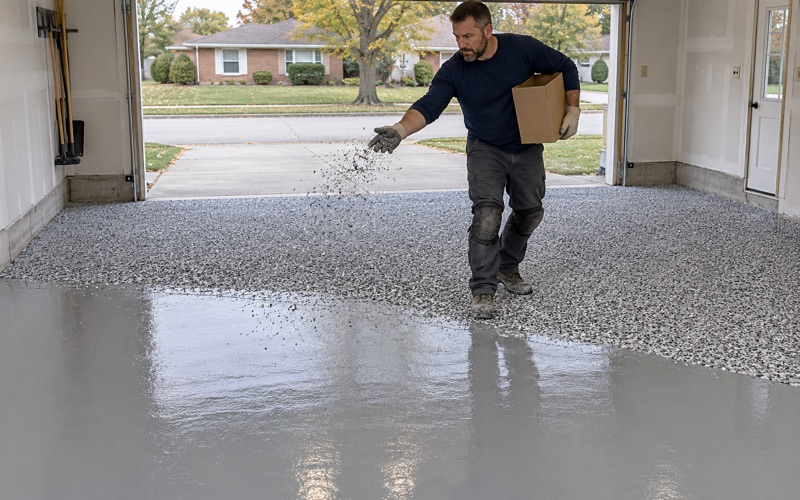
Most of the floors we coat here are attached and detached home garages sitting directly on the ground. That is where a 100% solids epoxy, broadcast with vinyl flake or quartz aggregate and sealed with a polyaspartic topcoat, earns its keep. Before any price is final, the slab is tested for moisture and the proposal lists the product line, the coat count and the finished thickness. The finished floor can then be checked against the quote.
What we do not do is sell a floor coating as waterproofing or as structural repair. A parking deck with worn joints and a damaged membrane needs an engineer and a membrane specialist, and the clearest local example of that difference sits in the village’s own business district. It shows, in public records, where our kind of work stops.
The Hubbard Woods Parking Garage and Its Repair List
Two Levels, Built in 1990
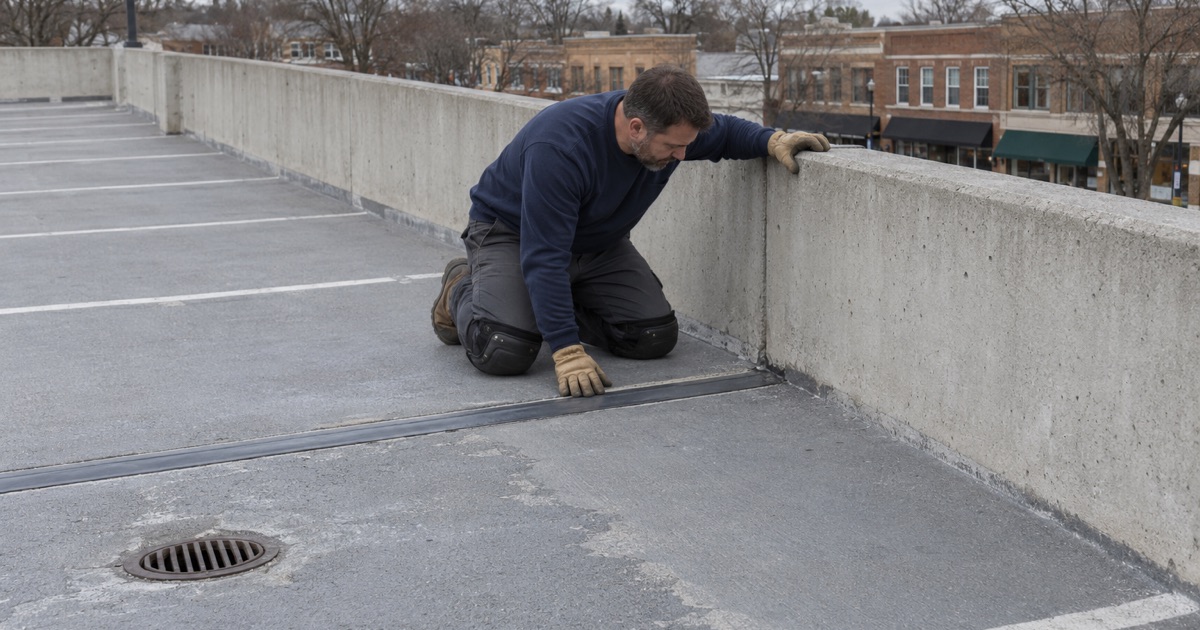
The Hubbard Woods parking garage in the business district is a village-owned, two-level structure built in 1990. Village parking maps label an upper deck with two-hour parking after 10:30 a.m. and a lower deck that is unrestricted after the same hour, close to the Metra station. Its last significant renovation came in 2014, at a cost of $215,000. The structure has no published street number, so we refer to it by its district.
An engineer’s inspection turned up urgent items that were repaired in 2025. According to The Record North Shore in February 2026, the remaining intensive work is estimated at $800,000, of which $635,500 is classed as critical and structural and $164,500 as aesthetic. A project listing refers to the work as Hubbard Woods Parking Structure 2026 Repairs.
What the Engineer Found
The list reads like a catalog of how a parking deck ages. It includes broken and corroded shear connections that have led to concrete deterioration, damage to the waterproof membrane on the parking deck, expansion joint and bearing pad replacements, cracks to seal and deteriorated floor drains, along with floor, column, beam and wall repairs and tuckpointing. Almost every item on it is a structural or water-management issue, not a surface finish issue.
None of that is cause for alarm. Structural engineer Bob Tober called the garage definitely repairable and said it is not in danger, and on January 6, 2026, trustees directed staff to finish the structural work before anything cosmetic. A formal bidding process followed, with no timeline set. That ordering, structure before appearance, is the right instinct on any floor.
Why a Floor Contractor Reads This List
We have no role in that project and have not bid on it. We point to it because it is a public, documented case of a structure where the topping is a membrane rather than a floor coating, and the reasons carry straight into the choices a homeowner makes about a garage. No contractor or award for it has been reported.
Notice what the repair list does not say. It does not call for a new coat of paint, because a decorative finish is not what protects a deck from water. The damage is at the joints, the drains and the membrane, which are the parts built to handle movement and water. Those are the same three details we look at first on any floor that is not on the ground.
Looking for epoxy-flooring closer to Norridge? See Norridge Epoxy-Flooring.
A Slab on the Ground Versus a Deck Over Open Air
What Holds Up a Home Garage Floor
A slab-on-grade garage floor is supported along its whole underside by soil and stone. It still shrinks, curls and cracks, but most of those cracks settle into a stable width once the concrete has finished curing. A rigid coating bonded to that slab moves with it as one piece, which is exactly what epoxy is designed to do. Hairline shrinkage cracks are normal and do not rule out a coating.
The ground also buffers the slab against temperature swings. Its underside never faces wind or open sky, and that shelter is part of why a well-prepared epoxy system lasts on a home garage floor in this village. Hot tire pickup, the classic complaint about thin garage kits, is usually a bond problem, and a properly profiled slab is how we avoid it.
What Changes on an Elevated Deck
A parking deck spans between columns and beams, so it flexes under every car and expands and contracts as air reaches it from above and below. Its cracks open and close through the day and across the seasons. Nothing underneath steadies it. On a two-level structure like the one in Hubbard Woods, the upper level also sits fully exposed to sun, rain and snow.
That combination is why deck designers specify membranes rather than floor coatings. Corroded shear connections and worn bearing pads, both on the Hubbard Woods list, are reminders that a deck is a structural assembly first. The membrane is the layer that keeps water off that structure. Whatever goes on top has to protect it, not just look good.
Choosing by What Is Under the Slab
Our first site visit maps cracks, spalls and any old coating, and we note whether the floor rests on grade or spans open air. If it is a suspended slab, we say plainly that the job belongs to a deck waterproofing specialist working with an engineer. A garage built over a finished room counts as a suspended slab too. If it rests on grade, the next step is a moisture test written into the scope.
That test might be an ASTM F2170 in-situ relative humidity probe, an ASTM F1869 calcium chloride test, or an ASTM D4263 plastic sheet check as a first screen. The readings decide whether a moisture-mitigation primer goes down first, and the warranty discussion opens with moisture as the exclusion we name before anything else. We report the numbers to the homeowner, not just a pass or fail.
Why a Moving Crack Needs a Membrane, Not a Rigid Coating
What ASTM C957 Describes
ASTM C957 covers high-solids, cold liquid-applied elastomeric waterproofing membranes with an integral wearing surface, made for building decks that carry pedestrian and vehicle traffic and are not under hydrostatic pressure. The membrane is meant to stay flexible, so it stretches across a crack as the deck moves instead of splitting along it. That is the property a parking deck needs most.
The standard sets no specific skid resistance or fire retardance, so those have to be specified separately. Aggregate can be added to the wearing surface for grip and wear, and installers often zone the system by level, with heavier aggregate on ramps and turns where tires scrub hardest. Those choices belong to the deck’s designer, not to a floor crew.
What Rigid Epoxy Does on a Deck
Epoxy is hard and stiff, which is its strength on a slab that stays put. On a deck whose cracks keep opening and closing, a rigid film tends to telegraph each crack straight through to the surface. Once the film splits, water reaches the concrete beneath it, the condition a membrane is there to prevent. Patching the split later rarely fixes the reason it opened.
Sunlight adds a second problem. Most epoxies amber under UV exposure, which is why membrane systems for an exposed top deck finish with a UV-stable topcoat. A garage floor indoors never faces that test, and an open upper level faces it every clear day. Inside an attached garage we still use a polyaspartic or polyurea topcoat where daylight from an open door reaches the floor.
Where That Leaves a Homeowner
None of this means epoxy is a weak product. It means a home garage on grade and a parking deck are different assignments, and a contractor who quotes the same system for both has skipped the question that matters. We would rather turn down a suspended slab than coat one with the wrong material. Saying so up front costs us a few jobs and saves a lot of floors.
The village’s housing is overwhelmingly detached houses, with 4,018 detached units counted by the census, and the garages that come with them are usually slabs on grade. Those are floors where a 100% solids epoxy with a flake or quartz broadcast makes sense, as long as the moisture readings agree.
Drains, Joints and Where Epoxy Belongs in Winnetka
Expansion Joints and Deck Drains
Expansion joints exist so a long deck can move without cracking at random, and the joint seal is a wear item. On the Hubbard Woods list, expansion joint replacement sits beside deteriorated floor drains, and the two are linked: water that cannot leave the deck through a drain finds the joints and cracks instead. Bearing pads under the deck do a related job, letting the structure shift on its supports.
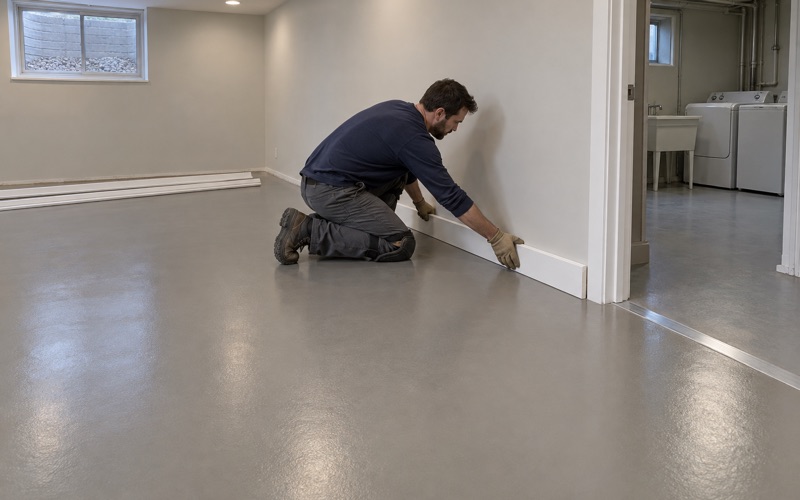
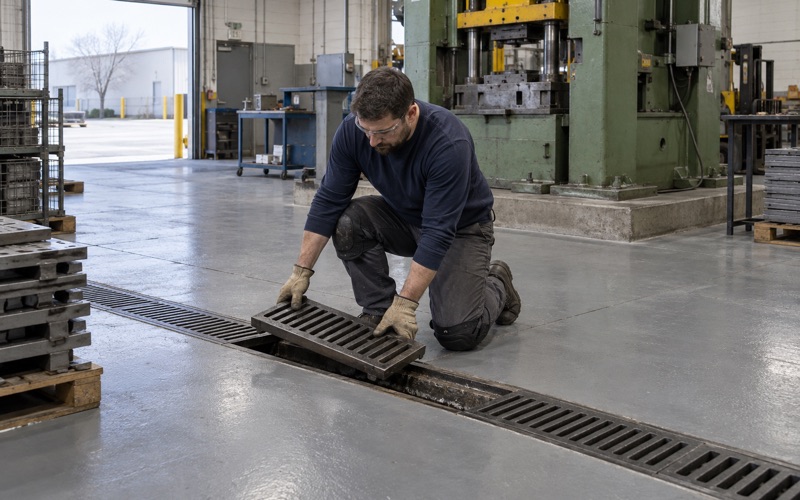
A floor coating should never bridge an expansion joint. On a home garage floor we leave the isolation joint at the foundation wall free to move and keep the coating clear of the floor drain grate, so both keep doing their jobs. On a basement floor the same rule applies around the sump pit.
Grinding, Not Etching
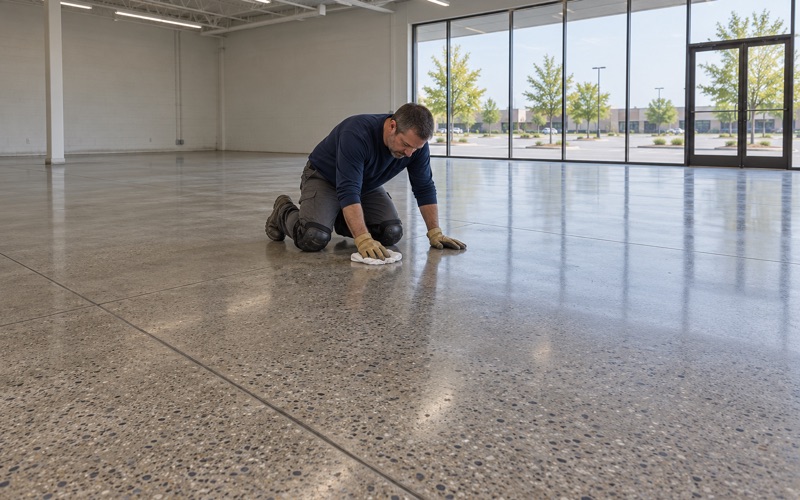
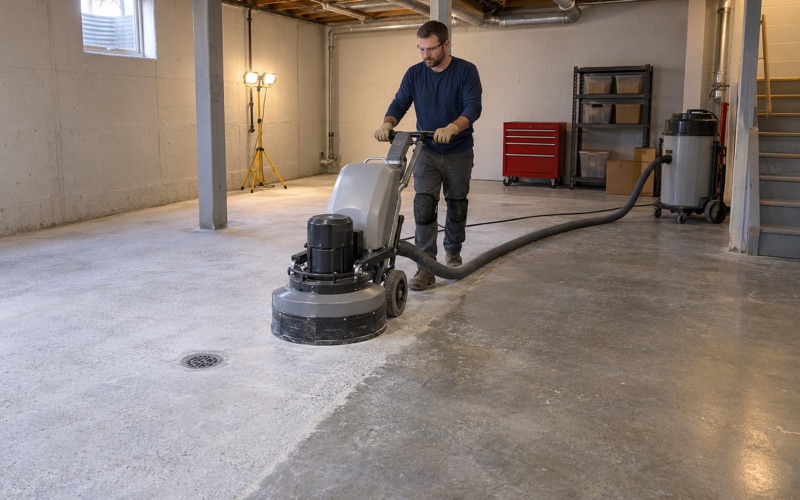
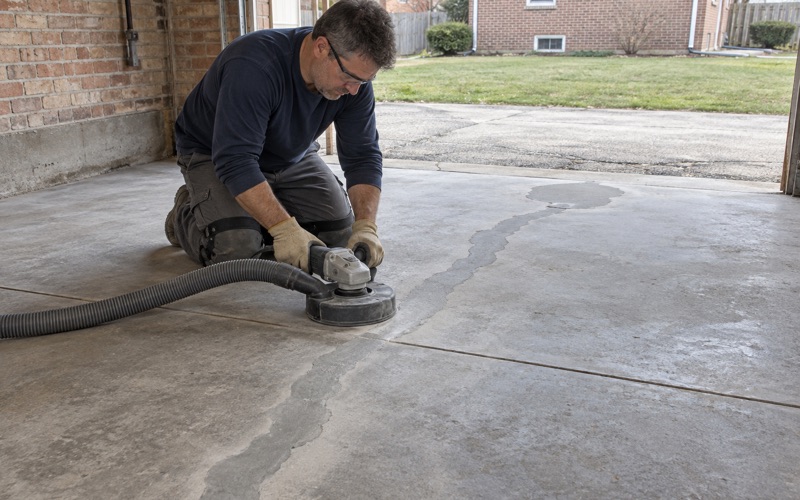
On a slab that is right for epoxy, we open the surface with a diamond grinder or a shot blaster to a measured ICRI concrete surface profile, never an acid etch. That profile is what gives the epoxy something to grip. Grinding dust is pulled into a vacuum at the machine instead of being washed toward a drain.
Cure timing follows slab temperature and the dew point spread at the surface rather than a fixed calendar. An unheated detached garage in the middle of winter is told to wait, because a coating that cures cold can develop amine blush and lose its bond. A heated attached garage usually has a wider window.
The Paperwork Before the Grinder Starts
Illinois has no state flooring license, so we check the village’s own contractor and insurance requirements before a Winnetka job is booked. Here that check runs through the Village of Winnetka Department of Community Development, the local building authority. If a slab needs repair or replacement before it should be coated, we say so in writing at the same visit.
For home projects over the state threshold, the homeowner gets a written contract and the Home Repair: Know Your Consumer Rights pamphlet before any grinding starts, as the Illinois Home Repair and Remodeling Act requires. Products are chosen inside the Illinois VOC limits for floor coatings, which bind whoever applies them. A floor coating is never offered as radon reduction or flood protection.
- 20+ Years on Concrete
- Moisture Tested First
- Free Written Estimates