Skokie Epoxy Flooring brings more than 20 years of work to epoxy-flooring in Western Springs, and the first question we ask here is which floors should not be coated at all. A grinder and a 100% solids epoxy are the right tools for a basement slab or a boiler room. They are the wrong tools for a floor that carries a building’s original character, and sorting one from the other comes before any price.
That sorting is a preservation habit as much as a coating one. The work we do on service floors is mechanical and permanent: we open the slab with a diamond grinder or a shot blaster, never an acid etch, so the coating has a real profile to grip. Anything that permanent belongs on concrete that was always meant to be utilitarian, not on a finish someone chose to be seen.
So every job here starts with a walk-through, a moisture test and a written scope that names which rooms get coated and which are left alone. The proposal lists the product line, the number of coats and the finished thickness, so the result can be checked against the quote. The sections below explain why that line matters in this village in particular.
First Congregational Church and the Standards Behind It
Elmslie’s 1929 Sanctuary and Its 2005 Restoration
The clearest example of a floor decision as a preservation decision in Western Springs stands at 1106 Chestnut Street. First Congregational Church was designed by George Grant Elmslie, and its Sanctuary was completed in 1929, with the Education Building following in 1930. The exterior is Lannon stone under a shallow slate roof, and the style mixes Late Gothic Revival, Arts and Crafts and Prairie School.
In 2005 the Sanctuary was extensively renovated, and original details including the oak string course, oak paneling, stencils and wall colors were restored to their 1929 appearance. The building was listed on the National Register of Historic Places in August 2006. The church’s architectural guide describes none of its floors, and we have not seen them, so nothing here should be read as a claim about what they are made of.
What 36 CFR 68.3 Says About Treatments
The Secretary of the Interior’s Standards for Rehabilitation, at 36 CFR 68.3, set out the principles behind work of that kind. The historic character of a property is to be retained and preserved, and removing distinctive materials or altering the features that characterize it is to be avoided. Deteriorated historic features are repaired rather than replaced, and a replacement matches the old in design, color, texture and, where possible, materials.
The line that matters most to a floor contractor is the seventh: chemical or physical treatments, if appropriate, are undertaken using the gentlest means possible, and treatments that cause damage to historic materials are not used. A diamond grinder is not a gentle means. Neither is a coating that cannot come off without taking the surface with it.
What the Listing Does and Does Not Do
National Register listing by itself does not restrict what a private owner does with private funds. The Standards govern federally assisted and tax-credit rehabilitation, and no local preservation commission or ordinance for Western Springs turned up in our research; preservation here is carried by the private Western Springs Historical Society.
We bring the Standards up anyway because they are a sound test for any old building, listed or not. They ask what gives a place its character and how to protect it while the rest of the building keeps working. That is the same question we ask before we quote a coating on any floor that was built to be looked at.
Looking for epoxy-flooring closer to Hinsdale? See Epoxy-Flooring Services in Hinsdale.
Finish Floors Versus Service Floors
Where a Coating Does Not Belong
A finish floor is one the building’s designers expected people to see: a wood floor in a meeting room, a decorative surface in an entry hall, an original material that ties a room together. If it is worn, the Standards point toward repair by the gentlest means, and a resinous coating rarely fits that. Epoxy bonds by mechanical grip, and getting it off later means grinding away whatever sat underneath.
When a property owner asks us to coat a floor like that, we tell them it is the wrong product and suggest the right trade for repair instead. Turning down a room costs us a line on the proposal. Coating it costs the building something it cannot get back.
Basements, Boiler Rooms and Tunnels
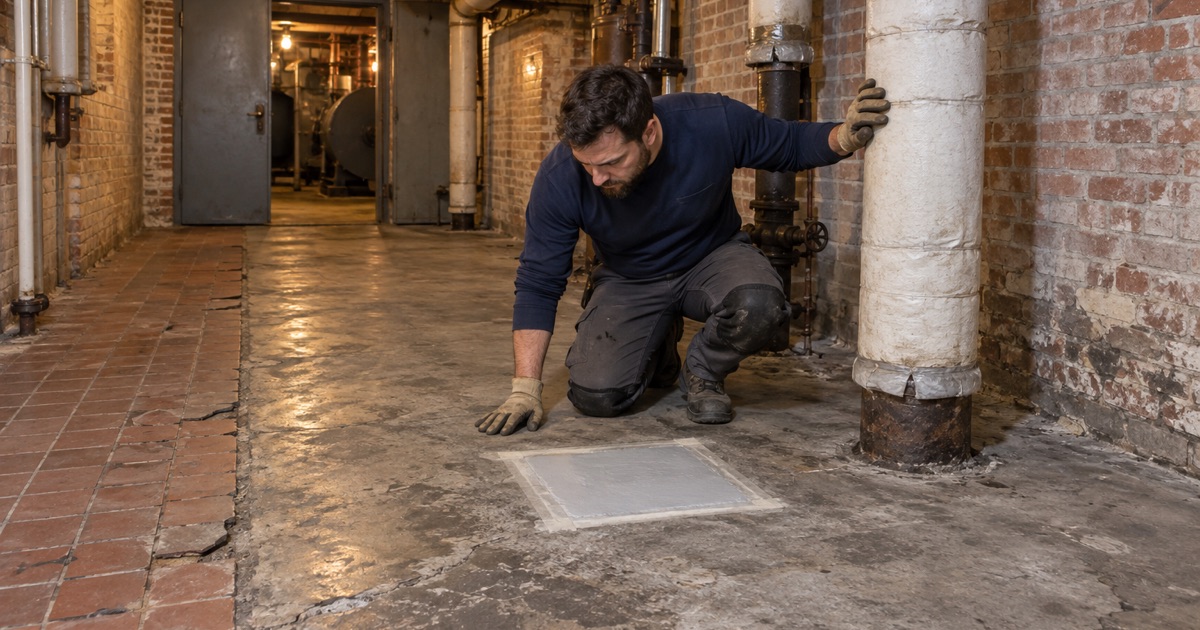
Service floors are a different matter. Basements, boiler and mechanical rooms, storage areas and connecting tunnels on an older campus were built to be worked in, not admired. First Congregational’s campus is one example: a recorded $2.5 million renovation there included work in underground tunnels connecting its buildings. Spaces like those are where a coating can earn its place, because their value lies in what they do.
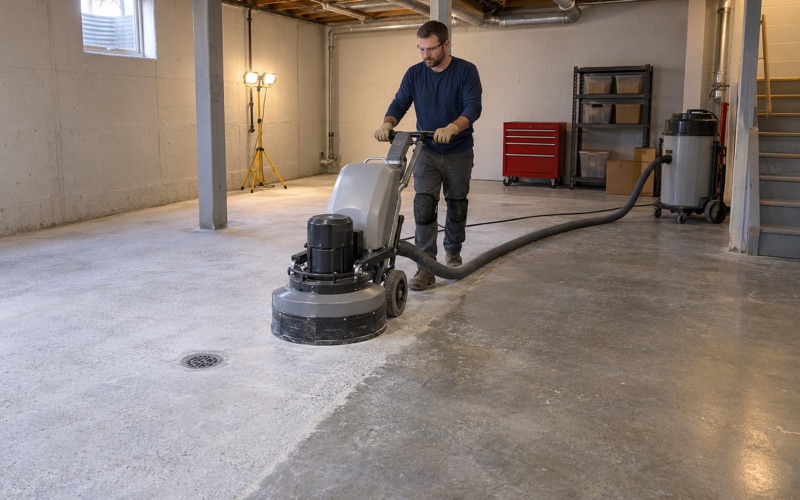
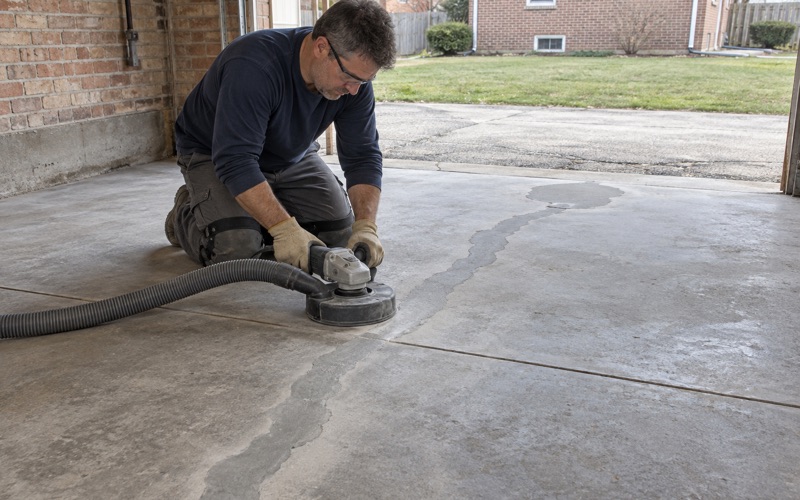
On those floors the job looks like any careful commercial coating. We map cracks, spalls and old coatings first, test for moisture, open the surface within the ICRI CSP 1 to 3 range for a thin-film system, and capture grinding dust at the machine with a vacuum rather than rinsing it toward a floor drain. Work in a building that stays open is phased around its hours.
The Edge Between the Two
The hardest line to draw is the threshold where a service floor meets a finish floor, such as a basement stair landing or a corridor that runs from a boiler room toward finished space. We stop the coating at a clean, straight termination on the service side, and the grinder never crosses onto the original surface. Taping and shielding that edge is part of the written scope, not an afterthought.
Where a stair or doorway has no natural break, we would rather end the coating a few inches short on plain concrete than run it up against an original material. A small strip of bare slab is easy to explain; a coating fused to an original threshold is not easy to undo.
Test Patches, Reversibility and a Written Plan
Why the Test Patch Comes First
Before any grinder runs on a floor in an older building, we prepare and coat a small test area in an inconspicuous corner of the service space. It shows how the concrete responds to preparation, whether the primer wets out evenly, and whether old sealers or contamination will keep the system from bonding. On a slab that has seen decades of use, that answer is rarely obvious from looking.
The patch also lets the owner see the finished color and texture before committing a whole room. If a quartz aggregate broadcast reads too industrial next to an original stair, or a vinyl flake looks out of place, it is far cheaper to learn that on a few square feet.
Moisture Before Money
Old basements and tunnels often sit on slabs with no modern vapor retarder beneath them, so the moisture test is part of the written scope before the price is final. We use ASTM F2170 in-situ relative humidity probes where we can drill, and an ASTM D4263 plastic sheet test as a quick first read. High readings change the system, usually to a moisture-mitigation primer, or end the conversation.
Moisture is also the first exclusion we name when we explain what a coating warranty does not cover. A slab that keeps driving moisture upward will lift a coating no matter how well it was applied, and an owner deserves to hear that before signing, not after.
What Reversibility Really Means
Owners of older buildings sometimes ask for a coating that can be removed later. On concrete, no bonded resinous system comes off cleanly; removal is grinding, and grinding takes a layer of the slab with it. That is acceptable on a basement floor that was plain concrete to begin with, and it is the reason we keep these systems off anything original.
Where an owner wants less than a full coating, a lithium silicate densifier on bare concrete is a lighter step. It adds no film on top and leaves the slab looking like concrete, though it will not hide stains or fill cracks.
Keeping Original Floors in Older Western Springs Houses
Which Floors to Keep
The same thinking applies at home, on a smaller scale. In an older Western Springs house, the finish floors are usually upstairs and the plain concrete is below, and only the concrete is a candidate for us. An original oak floor that is scuffed is a refinishing job for a wood flooring trade, and we will say so rather than quote a coating that does not belong there.
Mudrooms and back entries are the usual gray area. If the floor there is original tile or wood, repair is the better path; if it is a later concrete addition, it can be coated like any service floor, with a clean edge where it meets the older house.
Basements Done Around What Is Already There
When a basement is the right floor, we coat around the sump pit, the floor drain and any overhead sewer line, not over them, so every access stays usable. We also do not sell a coating as radon reduction, waterproofing or flood protection, because it is none of those things.
Cure times follow slab temperature and the dew point spread at the surface rather than the calendar. A cool basement in early spring can take longer to cure than the label suggests, and we schedule to the reading on the floor, not to a promised date.
Contracts, Registration and Products
Illinois has no statewide credential for floor coating, so we check the Village of Western Springs registration and insurance requirements before a job is booked. Home jobs over the state threshold get a written contract and the Home Repair: Know Your Consumer Rights pamphlet under 815 ILCS 513 before any grinding starts.
Products are chosen inside the Illinois VOC limits for floor and industrial coatings under 35 Ill. Adm. Code Part 223, which bind the person applying them. In a closed basement or a tunnel with limited air movement, a lower-odor system is often the more practical pick as well.
- 20+ Years on Concrete
- Moisture Tested First
- Free Written Estimates