Skokie Epoxy Flooring has spent more than 20 years on epoxy flooring in Schiller Park and the rest of our service area, and the floors here that ask the hardest questions are the ones where metal gets cut and welded. A coating that looks perfect on handover day can collect a constellation of tiny burn marks within a couple of years if nobody planned for hot work. We plan for it from the first walk-through.
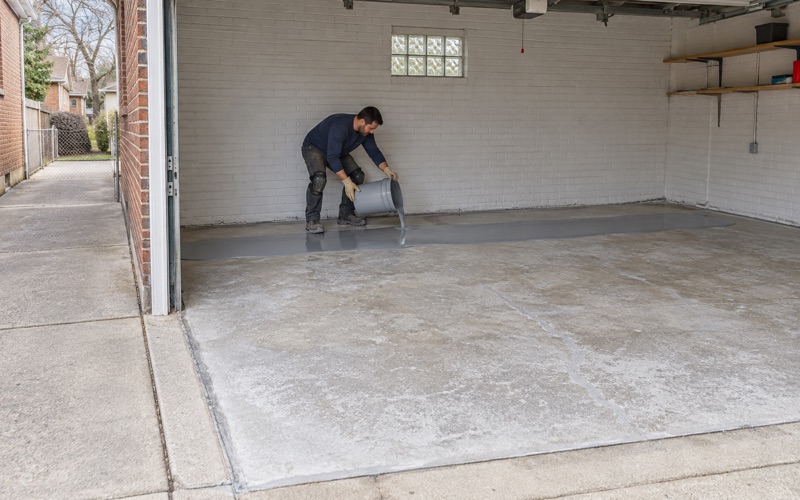
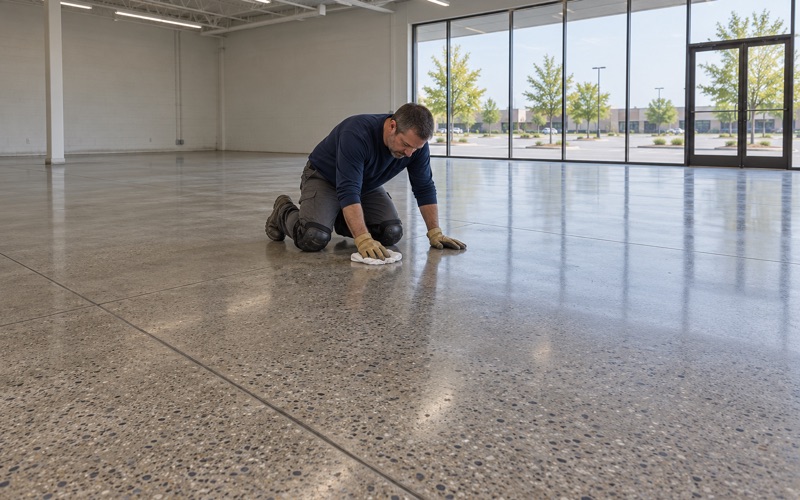
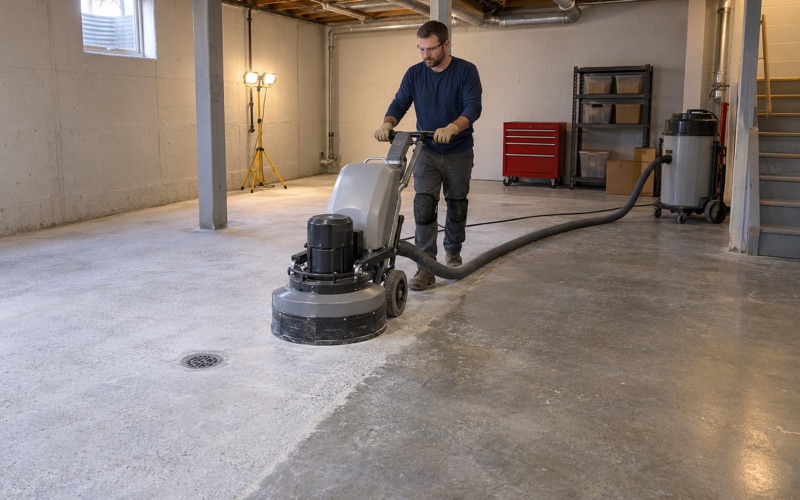
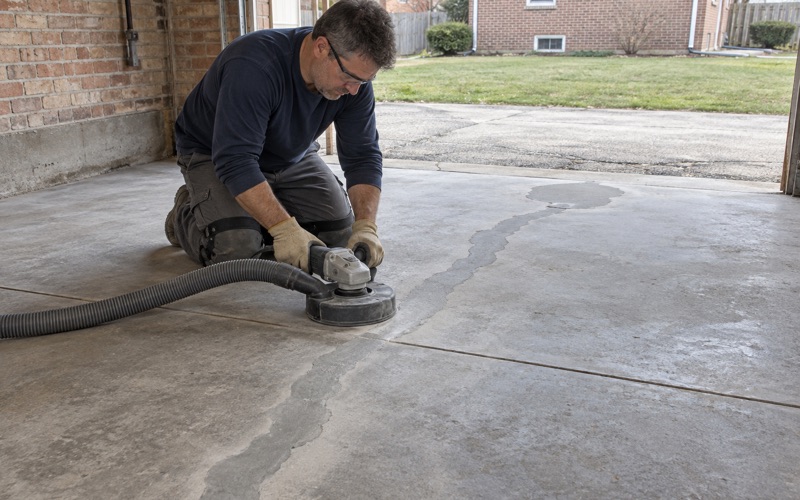
That planning starts with the slab itself. Every floor we coat is opened with a diamond grinder or a shot blaster rather than an acid etch, so the resin has a measurable profile to bond to, and a moisture test sits in the written scope before the price is final. Cracks, spalls and old coatings get mapped first, and if a slab needs repair before it should be coated, we say so.
On an industrial floor the proposal goes further. It names the product line, the number of coats and the finished thickness for each zone, so a plant manager can hold the finished floor up against the quote. Where welding happens, it also names which zone is expected to wear and how that zone gets renewed. That way the hot-work area is budgeted as maintenance, not discovered as a defect.
Stamping, Lasers and a Robotic Weld Cell on Wesley Terrace
What One Schiller Park Plant Shows About Local Floors
Schiller Park is a village in Leyden Township, Cook County, and commercial property makes up 55 percent of its 2023 equalized assessed value. The village’s own description of its businesses runs from travel and hospitality to machine shops. MJ Celco, which the village’s 2024 principal-employer table lists at 225 employees, gives 3900 Wesley Terrace as its corporate headquarters and stamping plant, with a separate fabrication facility elsewhere in the village.
The company’s published process list reads like a tour of what happens to sheet metal: progressive, compound and blanking dies, fiber lasers, turret presses and press brakes, then a Fanuc robotic weld cell, spot welding, assembly and kitting. It states that all its locations are ISO 9001 and IATF 16949 certified, and it lists appliance, automotive, commercial, electronics and telecom among its markets.
Why a Stamping Plant Ends Up With More Than One Floor
We have not seen the floors at 3900 Wesley Terrace and have no relationship with the company, so nothing here describes its plant. What the process list does show is how one building can hold very different floor demands. A press line sees die changes and coil handling, a laser and brake area sees sheet stacks and forklift traffic, and a weld cell sees heat.
Treating all of that as one uniform floor is how coatings fail early. We lay the building out by zone, and the zone around a robotic weld cell or a row of spot welders gets its own system choice, its own color and its own maintenance plan, written into the proposal. That plan names who on the plant side flags a damaged patch and how soon we come back to it.
In practice the weld zone is usually smaller than people expect, often a ring a few feet beyond the cell guarding plus any bench where welds are touched up by hand. Drawing it tightly keeps the specialized system where it earns its cost and lets the rest of the plant carry a simpler, cheaper build.
Looking for epoxy-flooring closer to River Grove? See Epoxy-Flooring Services in River Grove.
Sparks Versus Slag: What Actually Marks a Resin Floor
Sparks Cool, Slag Does Not
Practitioners who coat shop floors draw a clear line here. Sparks are fine, as one put it, but slag is not, because it will burn-mark the coating. A spark is a tiny particle that sheds its heat in the air before it lands. Spatter and slag are larger beads of molten metal and flux that arrive hot and sit where they fall.
A resin floor is a polymer, and a bead of hot metal resting on it scorches a small permanent pit. On one epoxy-painted shop floor described in the trade press, every spot where flying sparks had hit showed as a tiny burn mark after a couple of years. No resinous coating handles slag, and we will not tell a plant otherwise.
Robotic Cells and Spot Welders Behave Differently
A robotic MIG cell runs the same weld path over and over, so its spatter tends to land in a predictable ring around the fixture and the cell guarding. Spot welding throws expulsion when a weld blows out, which scatters hot metal less often but less predictably. Both patterns are worth mapping with the plant’s own people before the zone boundaries are drawn.
Grinding and manual torch cutting are the harshest cases, because they aim a stream of hot particles straight down. On bare concrete, slag left to sit can pop out little divots; on a coating it leaves a burn mark at every bead. Those are the spots where a cover belongs, not a thicker topcoat.
What We Will and Will Not Promise
No floor system on the market is proof against molten metal, and any quote that claims otherwise should be read with suspicion. What a good system can do is limit the damage, hide it well enough and renew cheaply enough that the weld zone stays serviceable between recoats. That is a more honest target than a heavier system sold as indestructible.
We also explain what the coating warranty leaves out before the job is sold. Burn marks from hot work are something we discuss in that conversation, and moisture coming up through the slab is the first exclusion we name on any floor, which is why the moisture test happens before anyone commits to a system.
Planning and Recoating the Weld-Cell Wear Zone
Color and Texture That Hide Specks
A showroom-gloss solid light gray is the worst choice around a weld cell, because every dark speck reads from across the aisle. A mid-tone color with a vinyl flake or quartz aggregate broadcast breaks up the surface so small burn marks blend in, and the texture adds traction where operators stand at the cell.
Quartz is usually the better fit in a plant because it holds up to steel-wheeled carts and forklift traffic better than flake. We often carry the same body coat across the whole floor and change only the broadcast and topcoat inside the hot-work zone, so the plant reads as one floor while the weld area is built to be renewed.
A Topcoat Built to Be Scuffed and Recoated
The sacrificial layer in a weld zone is the topcoat. A 100% solids epoxy body coat gives the build and the bond, and a polyaspartic or urethane topcoat on top takes the scuffing and the specks. When the topcoat in that zone gets tired, it can be abraded and recoated without grinding back to bare concrete.
That only works if the original proposal planned it. We record the product line, coat count and finished thickness for the wear zone separately, so a recoat years later matches what is already down rather than guessing at it. A burn deep enough to reach the body coat gets spot-patched before the zone is topcoated again.
Recoating One Zone Without Shutting Down the Plant
A plant running welded assemblies for automotive customers cannot close for a week of floor work. We phase recoats around production, often a single cell at a time over a weekend or a planned maintenance window, with the cell locked out and the zone taped and screened off from the running line next to it.
Fast-curing polyaspartic topcoats suit that window, but cure still follows slab temperature and dew point rather than the clock. Abrading the old topcoat is done with vacuum-shrouded equipment, so the dust is captured at the machine instead of drifting into the next cell or getting rinsed toward a drain.
Welding in a Schiller Park Home Garage or Small Shop
Covers Where the Sparks Are Aimed
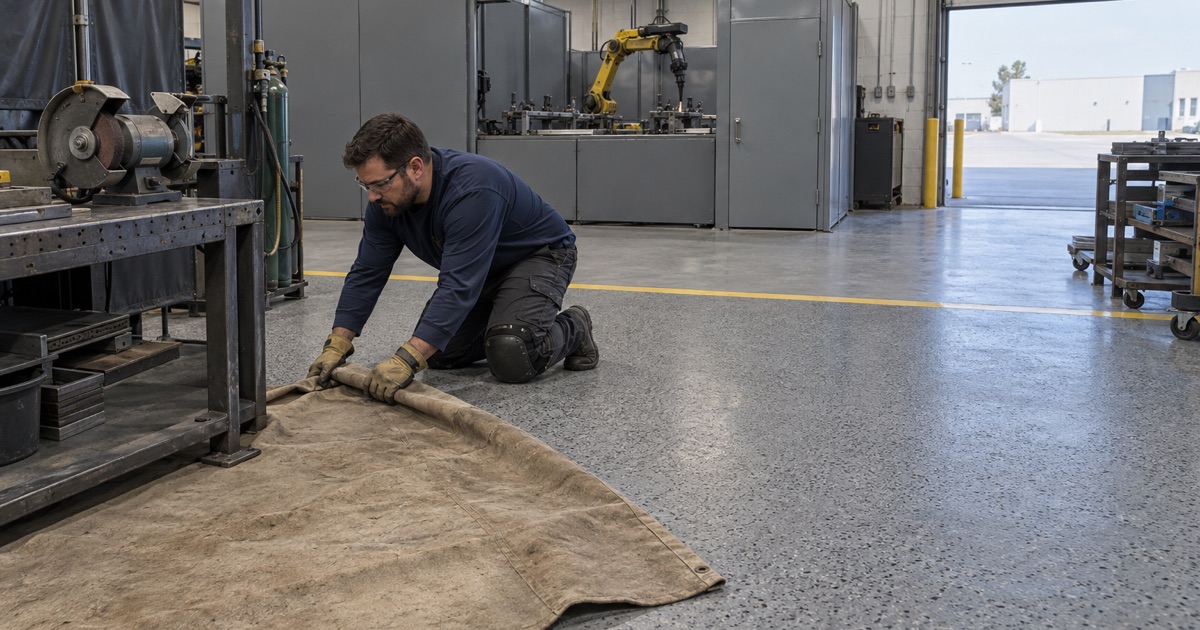
Plenty of people weld at home, and the same physics applies in a two-car garage as in a stamping plant. Shop practice is to lay sheet metal or backer board where cutting or grinding sparks are aimed at the floor, and one fire-prevention article suggests silica fabric directly under welding. That cover is the cheapest floor protection you will ever buy.
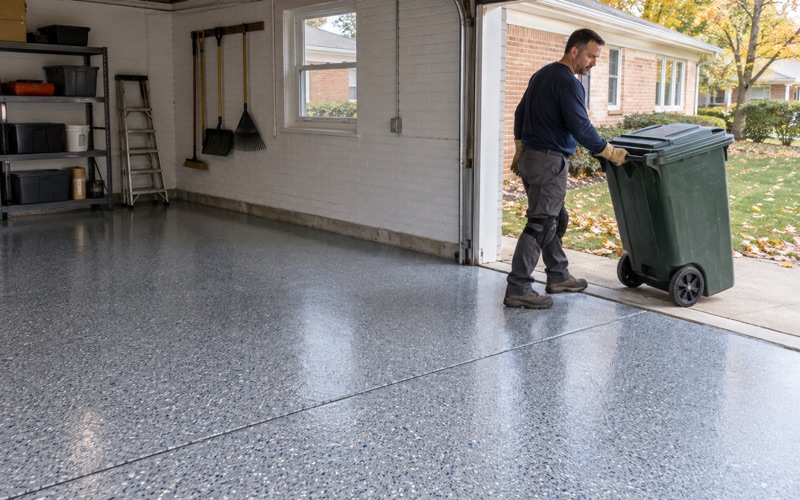
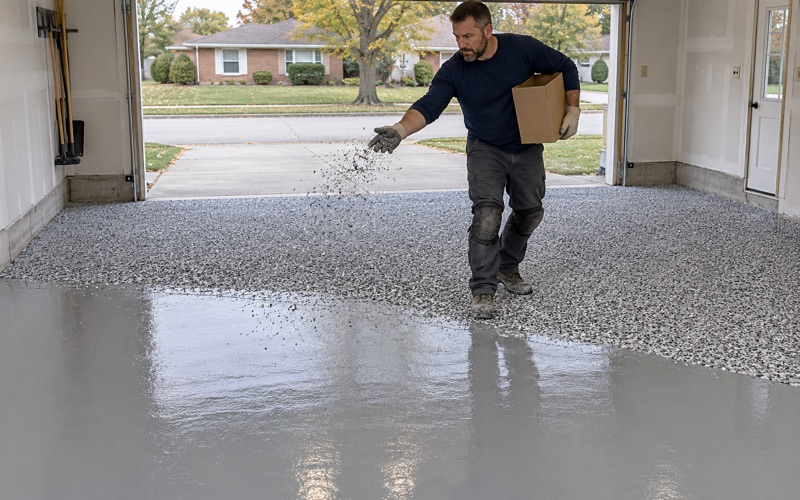
For a home shop floor we lean toward a flake broadcast in a busy blend and a topcoat that can be scuffed and recoated, the same logic as an industrial weld zone at a smaller scale. A burn-marked corner of a garage floor can be patched and recoated in place rather than redone. Keep a fire extinguisher and a metal bucket for hot scraps near the bench, whatever the floor.
A small shop or a single-bay business in the village gets the same conversation, scaled down. If a fabricator runs a welding table near the overhead door and keeps finished work along the far wall, those are two zones, and the proposal treats them that way rather than pricing one coating for the whole room.
Older Slabs, Winter Salt and Paperwork
Garage work in Schiller Park is almost all existing slab. The census count shows no units built in 2010 or later, and 1,425 built in the 1960s alongside 1,395 from the 1950s, so a garage floor here is usually decades old and may carry patches or an old coating. We grind those down, map the cracks and test for moisture before choosing a system.
Winter adds brine and rock salt riding in on tires, so garage systems are chosen to stand up to them, and an unheated detached garage in deep winter is told to wait for warmer slab temperatures. Home jobs over the state threshold get a written contract and the Illinois consumer-rights pamphlet before any grinding starts.
Illinois has no state flooring license, so the village’s own rules govern who can work here. Schiller Park requires contractors to register through its Community Core system with insurance, bond and workers’ compensation as applicable before construction begins, on a license year running May 1 to April 30, and we check those requirements before a job is booked.
- 20+ Years on Concrete
- Moisture Tested First
- Free Written Estimates