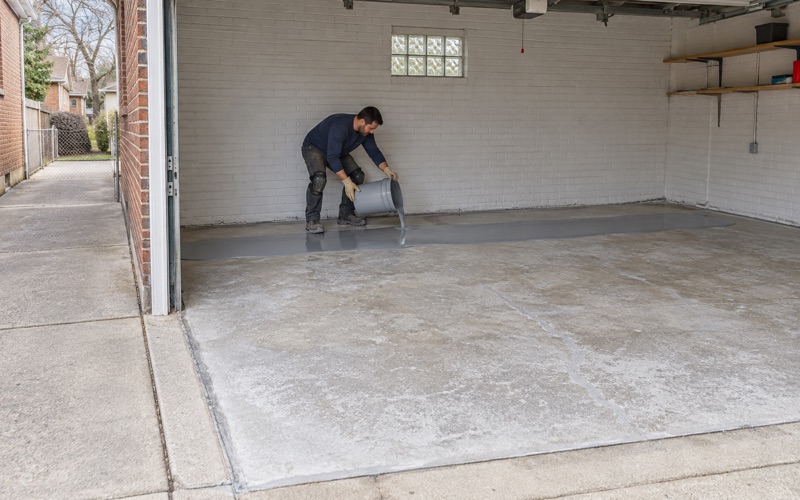
Skokie Epoxy Flooring brings more than 20 years of work to epoxy-flooring in River Grove, and this page is about the job where a floor’s chemistry matters more than its color: concrete that meets acid. Most garage and basement floors never see anything stronger than road brine. A few floors in this village, and some home workshops, see acid regularly.
Acid is the one exposure bare concrete has no answer to. A coating chosen for hot tires and salt can fail fast under an acid splash, and a lining chosen for acid service is a different product with a different installation. We explain which kind of floor a space actually needs before we price it, because the wrong system looks fine on the day it cures and fails on the day the chemistry arrives.
Every floor we take on gets a moisture test written into the scope before the price is final, and the written proposal names the product line, the coat count and the finished thickness. That paper trail matters most on chemical-service floors, where the resin, the bath it faces and the film build all have to line up.
A Metal Finisher on West Street That Pickles 20-Foot Steel
What Happens at 2120 N. West Street
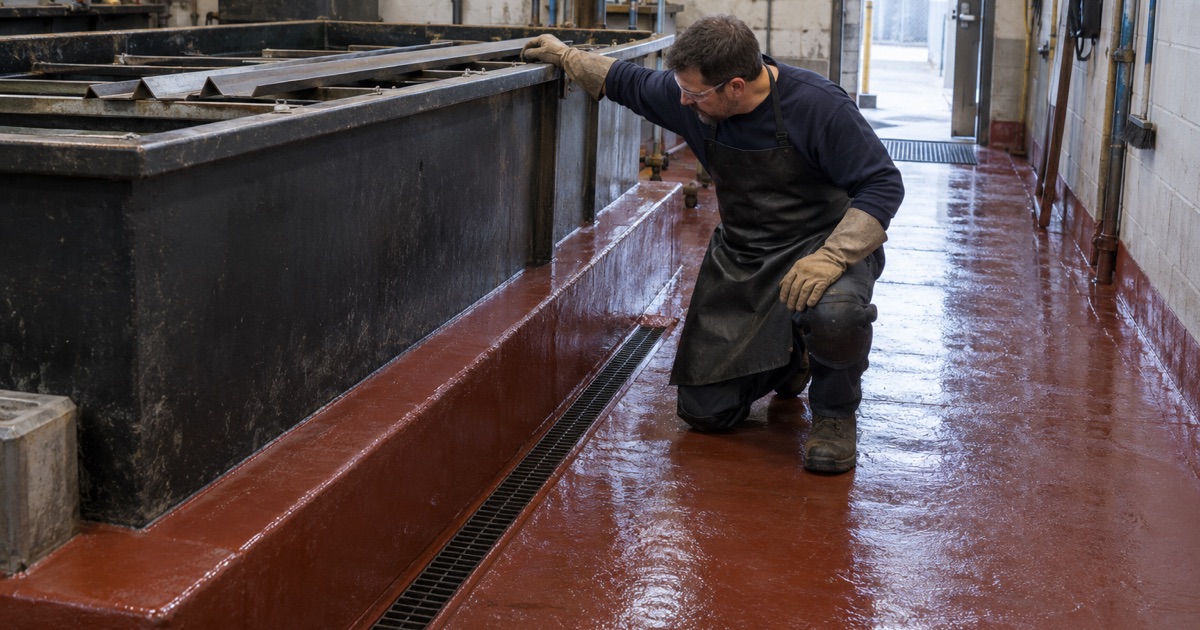
River Grove is a village in Leyden Township, Cook County, with a population of 10,612 at the 2020 census, and one of its industrial addresses is on West Street. Expert Metal Finishing, at 2120 N. West Street, pickles hot-rolled carbon steel in a hydrochloric acid bath to strip rust and carbon scale, then oils the steel against flash rust. That bath is the reason this page exists: the same acid that cleans steel is the acid concrete handles worst.
The shop’s own services page lists flat bars, angles, tubing and plate up to 20 feet long, and it uses hydrochloric acid dipping to strip rust and paint as well. The Metropolitan Water Reclamation District carries it as a significant industrial user under the metal finishing category, the only River Grove name on that list. We have never worked inside the building and do not know what its floor is made of; we describe it because it shows plainly what acid service asks of concrete.
Phosphate, Passivation and Anodizing Beside the Pickling Line
Pickling is not the only acid process on the site. The same services page describes manganese, zinc and iron phosphate coatings applied by immersion in phosphoric acid-based solutions, citric-acid passivation of stainless steel and titanium, zinc plating in rack and barrel, black oxide and anodizing of aluminum. Its About page lists more than 20 services in all, electropolishing and powder coating among them.
For anyone specifying a floor, that list is the point. A room with several tanks is a room with several chemistries, and each one can drip, splash or drag out on a part being lifted from the bath. A floor that holds up to one of them is not automatically rated for the others, which is why acid-service floors are chosen tank by tank rather than room by room.
Looking for epoxy-flooring closer to Franklin Park? See Franklin Park Epoxy-Flooring.
What Hydrochloric Acid Does to Bare Concrete
Soluble Calcium Salts Washing Out of the Slab
Hardened concrete holds together because of the hydrated portland cement paste around the sand and stone, and acids generally attack that paste through its calcium hydroxide. Hydrochloric acid reacts with the compounds of hydrated cement to form soluble calcium salts, chiefly calcium chloride, and those salts dissolve and leach out of the slab.
What is left behind is more porous, more permeable and weaker than the concrete that was poured. The surface sands off, aggregate stands proud, and the next spill soaks deeper than the last because the paste that would have slowed it is gone. On a working floor, that shows up as a low spot that holds every drip and speeds the next round of damage.
Why a Sealer or Densifier Does Not Stop It
A penetrating sealer or a lithium silicate densifier tightens the surface of a slab, and both are good choices for the right floor. Neither puts a barrier between the acid and the cement paste, so on a floor that sees hydrochloric acid they are not a defense.
The practical answer is a continuous film or lining the acid cannot get under. That puts the weight on two things: the resin itself, and the bond, since a lining that lifts at a crack or an edge lets acid pool against bare concrete where nobody can see it. Edges, trenches and column bases are where that kind of failure tends to start.
Checking a Slab That Has Already Taken Acid
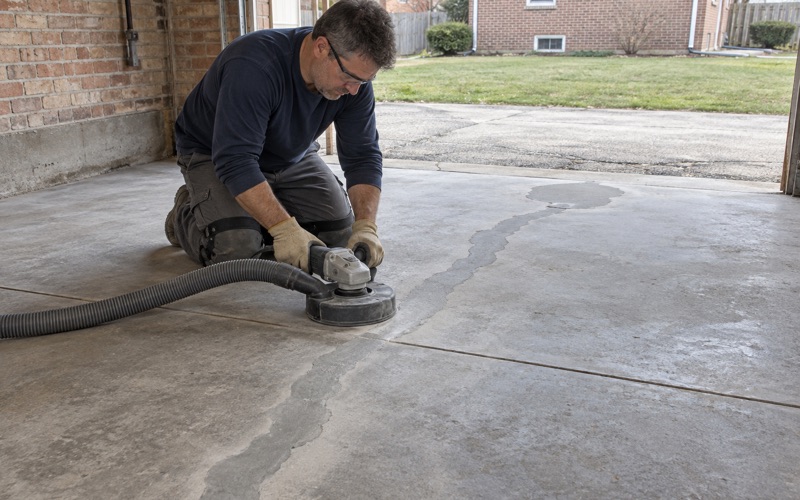
When we look at concrete that has seen acid, we map the soft, sanded and pitted areas before anything else. Grinding shows quickly how deep the damage runs, and sound concrete under a thin weak layer can usually be profiled and coated. On a home floor, that might be a single patch under a bench; on a shop floor, it can be a whole aisle along a tank line.
Where the paste is gone deep into the slab, we say so, and the honest scope is repair or replacement before any lining goes down. Residual chloride salts also have to be removed and the slab tested for moisture, because a lining laid over contaminated or damp concrete is set up to blister.
Why Garage-Grade Epoxy Is the Wrong Floor Beside a Pickling Tank
Where a Standard Epoxy Stops
A 100% solids epoxy with a polyaspartic topcoat is an excellent garage floor. It is built to resist hot tire pickup, rock salt and the calcium chloride brine that rides in all winter, and it cleans up with a mop. On the right slab, with the right prep, it is the system most River Grove garages actually need.
Strong mineral acid is a different test. Standard bisphenol epoxies tolerate occasional dilute splashes better than bare concrete does, but sustained contact with hydrochloric acid can soften, stain and eventually break down the film, and the damage often starts at a seam or pinhole before it shows on the surface. Next to a pickling tank, the drips are not occasional.
What a Novolac Vinyl Ester Lining Is Built For
Novolac vinyl ester resins are among the families coating makers point to for acid service on concrete. Chesterton, for one, describes its novolac vinyl ester system as a two-layer coating for concrete that protects against a wide range of concentrated acids, organic solvents and alkalis, and names pickling and plating lines and pickling rooms among its applications.
Other makers list novolac vinyl ester linings for dilute and some concentrated hydrochloric acid. Those are statements about specific products, not a blanket rating, and no lining holds up to every chemistry at every strength. The lining is also a system rather than a paint: profiled concrete, primer, reinforced or filled layers where the maker calls for them, and a finish coat, each at a stated thickness.
Matching the Lining to the Bath
Choosing an acid-service floor starts with the bath, not the brochure. We want the acid type, its concentration, its operating temperature, and whether the floor sees splash and drips or standing immersion in a containment pit, because a resin rated for one of those conditions may not be rated for another. Temperature matters more than most people expect, because a lining that holds up to a cool splash can behave very differently against a heated bath.
Those numbers are checked against the manufacturer’s chemical resistance chart for the exact product and thickness in the proposal. A coating is not secondary containment certification, and where a shop’s containment or wastewater rules govern the floor, that sign-off belongs to the shop and its regulators, not to us.
Acid Rust Removers and Etchers in a River Grove Garage
Muriatic Acid Etching, and Why We Grind Instead
Muriatic acid is hydrochloric acid sold by the jug at hardware stores, and etching with it has long been the do-it-yourself way to prepare a garage slab. The same chemistry described above is at work: the acid dissolves the top of the cement paste and leaves chloride salts behind.
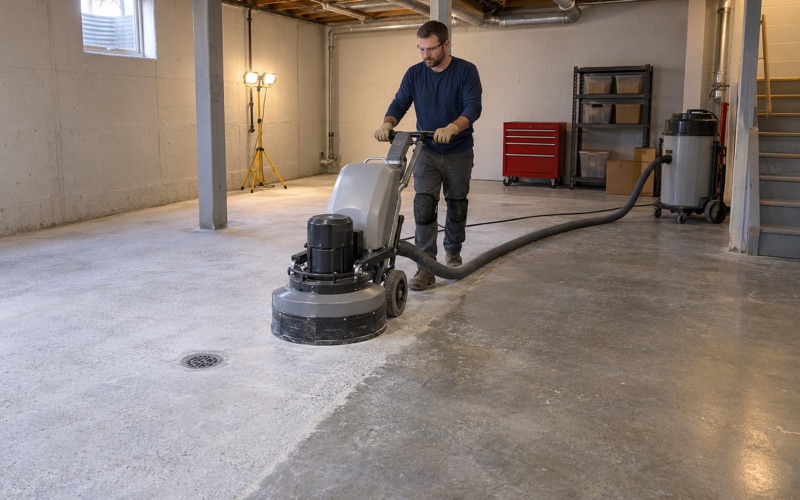
An etched slab gives a shallow, uneven profile, and if the residue is not neutralized and rinsed completely, the coating sits on salts instead of sound concrete. We open every slab with a diamond grinder or a shot blaster to a measured concrete surface profile on the ICRI CSP scale, and the dust is pulled into a vacuum at the machine. If a River Grove garage was etched for an earlier coating, we grind through that layer too.
Rust Removers, Drips and Home Workshops
Many rust removers and metal-prep products sold for home use are acid-based, often phosphoric or hydrochloric. A workbench where tools, trailer parts or patio furniture get stripped can leave a ring of etched, chalky concrete under the bench, sometimes stained orange where rust dripped off the part. The damage is usually local, and it is easy to miss under a stack of boxes until a new coating is about to go down.
A home garage does not need a pickling-room lining. It needs the damaged patch ground back to sound concrete and filled, a coating system that tolerates the odd spill if it is wiped up promptly, and a straight answer that no garage floor is meant to be a soaking tray for acid. If the bench sees regular acid work, a chemical-resistant tray under the part does more than any upgrade to the floor.
Permits and Paperwork in River Grove
The Village of River Grove Building Department, at 2621 N. Thatcher Avenue, requires a building permit for any remodeling valued over $100, concrete work included. Contractor licenses here run on the calendar year, January 1 to December 31, whatever the application date, with a $10,000 trade-specific license and permit bond and a certificate of liability insurance naming the village.
Illinois has no state flooring license, so we confirm the village’s own registration and insurance requirements before a job is booked. On home jobs above the state threshold, the written contract and the Illinois consumer-rights pamphlet come before any grinding starts, and on a shop floor we phase the work around the hours the business has to keep running. Fire-code questions on a commercial job go to the River Grove Fire Department, which runs one station on Thatcher Avenue.
- 20+ Years on Concrete
- Moisture Tested First
- Free Written Estimates