Skokie Epoxy Flooring brings more than 20 years to epoxy flooring in River Forest and across the area we serve, and the floors that ask the hardest questions are the ones that meet chemicals. A bench drips, a cleaner is left to sit, a solvent bottle tips during cleanup. Whether the coating under that spill survives depends on what was spilled and how long it stayed there.
So we begin a chemical-exposure job with an inventory, not a product name. What gets used on the floor, at what strength, how often, and how fast someone cleans it up are the inputs; the coating is the answer. A slab is still opened with a diamond grinder or shot blaster, never an acid etch, and the moisture test still goes into the written scope before the price is final.
This page works through one way of reading that question: a coating’s chemical-resistance chart held up against a real reagent list. The proposal that follows names the product line, the coat count and the finished thickness, so whoever signs it can check the floor against the quote.
Parmer Hall and Why a Chemical List Comes First
Four Departments of Lab Floors Around One Atrium
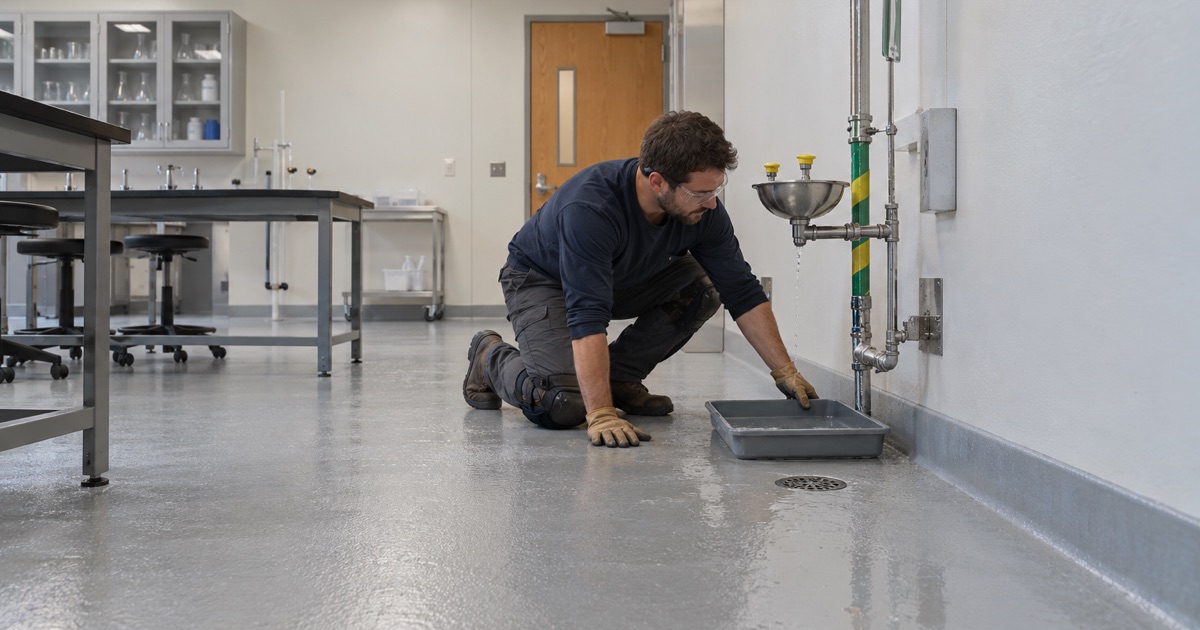
Dominican University’s Parmer Hall, at the campus address of 7900 W. Division Street, is a good local example of what a lab floor is up against. The four-story, two-winged building was dedicated in 2007 after 17 months of construction and houses the biology, chemistry, physics, nutrition and dietetics, and psychology departments alongside humanities classrooms.
Its lab suites sit above the first floor in a horseshoe around a central atrium, with research labs placed near their teaching counterparts. The campus itself sits inside the village, in River Forest Township, Cook County. We have not worked in the building and have not seen its floor finishes. We use it because it shows, in one address, how many different reagent lists a single science building can hold.
One Building, Several Reagent Lists
A chemistry teaching lab, a biology prep room and a nutrition kitchen lab do not spill the same things. Chemistry benches see acids, bases and solvents; biology rooms lean on disinfectants such as bleach and peroxide; a food lab sees fats, organic acids and hot water. Calling all of them lab floors hides the differences that decide the coating.
Physics rooms often have the gentlest list of the four and the heaviest rolling equipment. Nutrition labs add another twist, because hot water and steam from cleaning test a coating differently from a cold splash. That is the point: the same building can need two or three floor specifications, and one blanket choice either overspends on the quiet rooms or underserves the rooms that see real chemistry.
Why the Label Is Not a Specification
“Chemical-resistant epoxy” is a marketing phrase, not a rating. A serious manufacturer publishes a chart that lists specific chemicals at specific concentrations and says what happens to its own product, and those charts disagree with each other because the products differ. No coating resists every chemical, and no chart speaks for any product but the one it was written for.
So the useful question to a lab manager is not which epoxy is strongest. It is which chemicals reach the floor, at what concentration, and what happens next. With that list in hand we read candidate charts line by line, and where a chemical on the list is rated as not resisted, that product is out for that room.
Looking for epoxy-flooring closer to Deerfield? See Epoxy-Flooring Services in Deerfield.
Reading a Resistance Chart: Same-Day Rinse Versus Standing Exposure
What Short-Term Means on One Chart
One manufacturer’s chart for its epoxy floor coating splits every rating into two columns, and the split is the most useful thing on the page. Short-term exposure is defined as temporary splashes on a floor, provided they are rinsed off the same day. Long-term exposure means repeated splashes to one spot, or contact lasting up to three months.
Those two columns turn a cleanup habit into part of the specification. A chemical that the coating resists only short-term is acceptable in a room where spills are wiped and rinsed before the end of the day, and a poor match for a room where a puddle under a bench can sit through a weekend. We ask who cleans the floor, when, and with what, because the answer decides which column a spill actually lands in.
The Conditions Printed Under the Chart
The same chart states that its ratings depend on temperature, mechanical strain, chemicals acting in combination, and the concentration a chemical reaches as it evaporates. A dilute acid left to dry on a warm floor does not stay dilute. A spill under a cart wheel is not the same exposure as one on an open aisle.
Solvents carry their own footnote. On that chart, acetone, 93 percent ethanol, ethyl acetate and xylene are resisted, but not for objects subjected to immersion strain. A floor that takes a splash of acetone is fine; a floor under a leaking solvent drum is a different question, and we treat it as one.
Turning the Rinse Window Into a Room Rule
When a room’s list includes short-term-only chemicals, we say so in writing and name the rinse habit the rating assumes. The floor and the cleanup routine are specified together, because the routine is what keeps the exposure in the column the coating can handle. In practice that can be as simple as a squeegee, a rinse bucket and a rule that nothing is left on the floor at lockup.
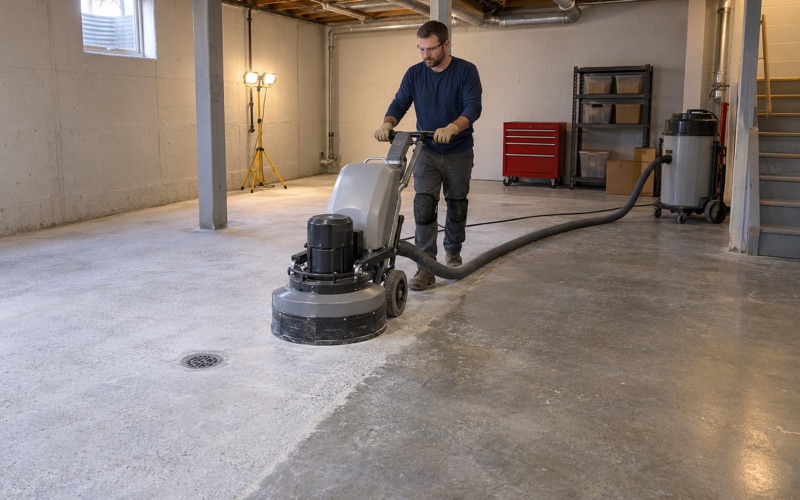
Labs and other working rooms rarely close for long, so we phase the work around the hours the building must stay open, coating a suite at a time. Grinding dust is pulled into a vacuum at the machine instead of being washed toward a floor drain, which matters doubly in a room whose drains are already part of a chemical plan.
The Acids It Will Not Hold and the Cleaners That Only Dull It
Nitric and Concentrated Sulfuric Acid
On that same chart, nitric acid is not resisted at 10 percent or concentrated, short-term or long-term. Concentrated sulfuric acid is not resisted either. There is no rinse habit that rescues those lines: if either one is on a room’s list and can reach the floor, that coating is the wrong coating for that room.
Ten percent nitric acid is not an exotic reagent in a teaching chemistry room, which is why we ask about it by name rather than waiting for it to show up as a stain. Where it is in use, the answer is a different chemistry rated for it, containment at the bench, or a floor system chosen around that one line rather than around the rest of the list.
Acids That Survive Only a Short Visit
Concentrated acetic acid, concentrated lactic acid and 10 percent phosphoric acid are rated as resisted short-term only on that chart, and even then with a change in color and gloss. These are the chemicals the same-day rinse was written for. Spilled and cleaned up promptly, the floor keeps working; left to stand, it does not.
Bases and alcohols are kinder to this product. Sodium hydroxide from 5 to 20 percent, 10 percent ammonia and isopropanol are all listed as resisted, which is why a caustic-heavy list can be easier to coat for than an acid-heavy one. That puts ordinary ammonia-based floor cleaners on the safe side of this product’s chart.
Bleach, Peroxide and the Look of the Floor
The cleaning closet deserves its own line on the list. On that chart, 15 percent sodium hypochlorite and 30 percent hydrogen peroxide leave the coating’s mechanical properties unchanged but change its color and gloss. The floor keeps protecting the slab; it just stops looking new.
For a biology room that disinfects daily, that is worth knowing before the color is chosen. A darker or mottled finish hides the change better than a bright solid one, and it is worth asking whether a different topcoat, such as a polyaspartic over 100% solids epoxy, has a better line for bleach on its own chart. We put that tradeoff in the proposal rather than leaving it for the first semester to reveal.
Home Workshops and Hobby Benches in River Forest
Read Your Own Product Labels
The same method scales down to a house. A River Forest basement darkroom, a pottery corner or a garage bench where someone etches metal or cleans parts uses real chemicals too, and the labels and safety data sheets on those bottles are the reagent list. Bring them, or photos of them, to the estimate.
Pool chemicals, drain openers, rust removers and concentrated cleaners are the usual suspects. We read them against the chart of the product we intend to use, and if one of them is a line that product does not resist, we tell you before you buy the floor, not after. Where a hobby uses something rated short-term only, a spill tray or mat at the bench does more for the floor than a thicker coat.
Moisture and Cure Before Any Chemical Rating Applies
A resistance chart describes a fully cured coating bonded to a sound slab. If moisture pushes up from below, or the coating cures cold, the chart stops describing your floor. That is why the moisture test in our scope uses a calcium chloride test under ASTM F1869 or in-situ relative humidity probes under ASTM F2170, depending on the slab.
Cure follows slab temperature and dew point rather than the calendar, and chemical resistance builds as the coating cures. A garage or basement bench area should not see its first spill of anything on the list until the product’s full cure time has passed, which we write into the handoff along with the rinse habit the room needs.
What the Proposal and Warranty Say
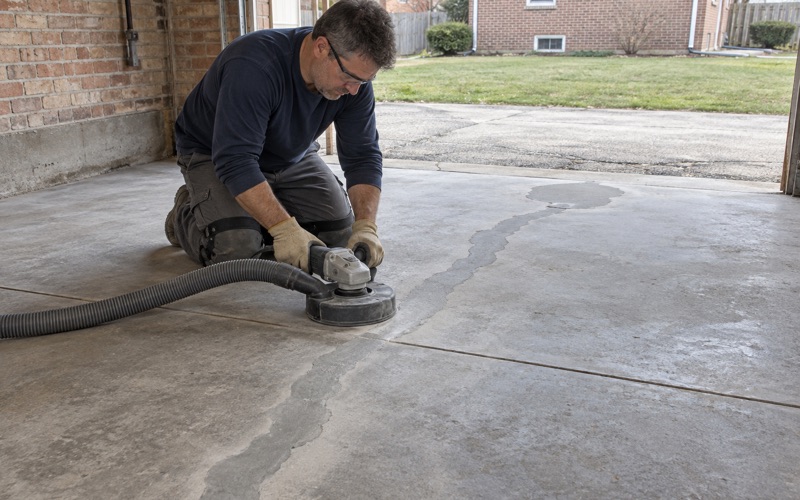
On a chemical-exposure floor our written proposal also lists the chemicals we checked and the column each one fell in. Cracks, spalls and old coatings are mapped first, and when a slab needs repair before it should be coated, we say that plainly.
Before anything is sold we walk through what the warranty leaves out, starting with moisture and then the chemicals that fell outside the chart. A home job above the state threshold gets a written contract and the Illinois consumer-rights pamphlet before any grinding starts, and Illinois has no state flooring license, so we confirm River Forest’s own contractor requirements before booking.
- 20+ Years on Concrete
- Moisture Tested First
- Free Written Estimates