
Skokie Epoxy Flooring applies polyaspartic floor coating in Skokie, IL and works across surrounding cities including Lincolnwood, Winnetka, Norridge, Schiller Park and River Grove. With 20+ years of resin floor work behind us, we use polyaspartic where its strengths count most: fast return to service, color that holds up in sunlight and a tough wearing surface over a properly prepared slab.
Polyaspartic is an aliphatic polyurea chemistry that cures in hours rather than days. It can be a complete floor system on its own or the clear topcoat over an epoxy base, and choosing between those depends on the slab, the use of the room and how quickly it has to be back in service.
What it cannot do is make up for poor preparation. A fast-curing coating has less time to wet into the concrete, so mechanical grinding to a measured surface profile matters even more with polyaspartic than with slower epoxies, and moisture is tested before anything is mixed.
Where Polyaspartic Earns Its Place
Garage Floors That Face Sun and Salt
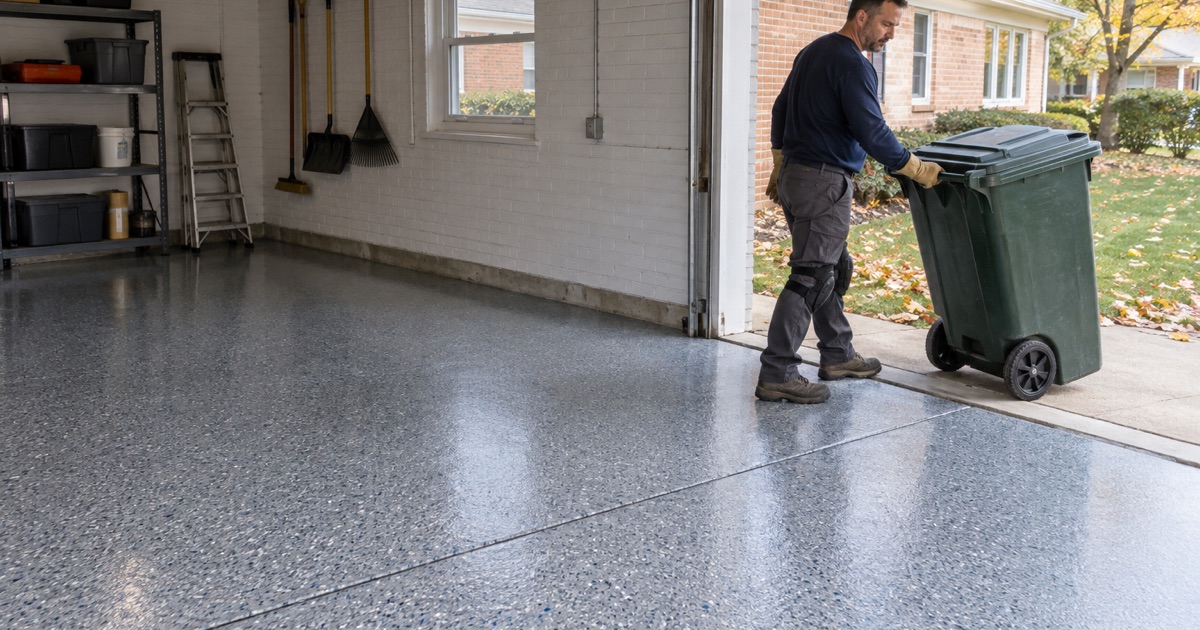
A garage door left open on a summer afternoon throws ultraviolet light across the floor, and standard epoxy ambers under that exposure. A polyaspartic topcoat keeps colors and flake blends true, so a gray floor stays gray instead of drifting toward yellow by the edge of the door.
The same topcoat stands up to the brine, rock salt and calcium chloride that come in on tires all winter. It is hard enough to resist hot tire pickup and wipes clean of oil and antifreeze, which is why most of our garage systems finish with it.
Basements and Rooms That Have to Reopen Quickly
A family that relies on a basement laundry room or a finished lower level cannot always wait days for a floor to cure. Polyaspartic systems let us grind, coat and return many basement floors to light use within a day.
That speed is only useful if the slab is ready. Basement slabs in older Skokie homes often carry paint, mastic and patches, and they sit over soil that can push moisture upward, so testing and prep set the schedule before speed comes into it.
Commercial Floors With Tight Downtime
Storefronts, offices, clinics and service bays often have a single night or weekend to replace a floor. Polyaspartic’s short recoat window lets us apply multiple coats in one shift and reopen the space the next morning in many cases.
We phase larger floors section by section and confirm each section’s cure before it goes back into service. The schedule follows the product’s cure chart at the actual slab temperature, not a promise made at the sales stage.
Polyaspartic Systems We Install
Epoxy Base With Polyaspartic Topcoat
Our most common build pairs a 100% solids epoxy primer and base coat with a polyaspartic clear coat. The epoxy wets deeply into the ground slab and builds thickness economically, while the polyaspartic provides abrasion, chemical and UV resistance on top.
This hybrid suits garages, workshops and many commercial floors. It takes a little longer than a pure polyaspartic floor because the epoxy base needs time to cure before the topcoat goes on.
Full Polyaspartic Flake Floors
For a true one-day floor, we use polyaspartic for the base coat, the flake broadcast and the topcoat. This gives the fastest return to service and works well in cooler conditions when epoxy would cure too slowly.
Because polyaspartic cures quickly, crews work in small sections and must keep a wet edge, so this is a system that rewards experience. Flake blends range from subtle grays to high-contrast mixes, and samples are laid on your floor before you choose.
Clear Polyaspartic Over Polished or Stained Concrete
A clear polyaspartic coat can protect polished or stained concrete where a penetrating guard alone is not enough, such as in a kitchen or a garage. It adds stain resistance and a uniform sheen while letting the concrete’s character show through.
The trade-off is that a clear coat turns a penetrating finish into a film, which can scratch and will eventually need recoating. We recommend it where staining is the bigger risk, and leave polished floors uncoated where abrasion and easy re-honing matter more.
Polyaspartic Compared With Epoxy
Cure Speed and Working Time
Epoxy gives an installer a comfortable working window and cures over a day or more, while polyaspartic can gel in well under an hour and be recoated the same day. That speed is the whole point for a business that must reopen, but it also means mixing in small batches and moving quickly with a consistent crew.
On a large, open floor with no deadline, the slower working time of epoxy can produce a smoother result with less risk of lap marks. On a garage the family needs back tomorrow, polyaspartic’s pace usually wins.
Color Stability and Abrasion
Aromatic epoxies amber when exposed to ultraviolet light, which shows first along the garage door line and under windows. Aliphatic polyaspartic coatings hold their color in the same conditions, keeping whites, grays and flake blends true.
Polyaspartic topcoats are also generally harder and more abrasion resistant than epoxy topcoats, which helps in areas that see grit tracked in on shoes and tires. That is why we prefer them as the wearing layer even when the base is epoxy.
Cost and When Epoxy Alone Makes Sense
Polyaspartic resins cost more per gallon than standard epoxies, so a full polyaspartic system usually carries a higher price. The hybrid build, with epoxy below and polyaspartic on top, often gives the best value for a garage or workshop.
In a windowless utility room or a back-of-house space with no sunlight and no rush to reopen, an all-epoxy system can be a sensible, economical choice. Our proposal explains why a given system was chosen and names each layer, so you can see where the money goes.
Preparation and Testing for Polyaspartic
Grinding to the Right Surface Profile
We open the slab with a diamond grinder or shot blaster to an ICRI concrete surface profile matched to the system, never with acid etching. A fast-curing resin needs that clean, porous surface to anchor before it sets.
Grinding dust is captured at the machine by vacuum, so it does not end up in the house, on stored items or rinsed toward a floor drain. The slab is then vacuumed again and checked for any remaining contamination before the first coat is mixed.
Moisture, Temperature and Dew Point
Every polyaspartic quote includes a moisture test, using an in-situ relative humidity probe under ASTM F2170 or a calcium chloride test under ASTM F1869. A slab that reads high gets a moisture-mitigation primer or a frank recommendation not to coat.
We also check slab temperature and the dew point spread at the surface. Polyaspartic tolerates cold better than epoxy, but condensation on the slab still ruins adhesion, so the readings decide the install day.
Repairs Before the First Coat
Cracks, pits and spalls are filled with fast-setting repair materials compatible with the coating. Where a slab is too broken or unstable to hold a floor, we say so before quoting rather than coat over the problem.
On garage floors, the door apron is usually the worst area, scaled by years of salt and slush. We cut back loose concrete, rebuild the edge with a repair mortar and grind it flush, so the coating does not end at a crumbling lip where it can be pried up by a snow shovel.
Products Within Illinois VOC Limits
Illinois limits volatile organic compounds in floor and industrial maintenance coatings under 35 Ill. Adm. Code Part 223, and those limits bind the person applying the product, not just the manufacturer. We select polyaspartic products that comply in the Chicago ozone nonattainment area and list them by name on the proposal.
What to Expect After Installation
Return to Use
Most polyaspartic floors take foot traffic within hours and vehicles after the product’s stated cure, often a day or so. Your proposal lists the cure times for the products we use, so you know exactly when the floor is ready.
Care and Longevity
A soft broom, a mop and a pH-neutral cleaner are all a polyaspartic floor needs. Avoid dragging steel equipment or using harsh solvents for cleaning, and the topcoat will keep its gloss and protection for many years.
- 20+ Years on Concrete
- Moisture Tested First
- Free Written Estimates