
Skokie Epoxy Flooring grinds and finishes polished concrete floors in Skokie, IL, serving surrounding cities including Lincolnwood, Winnetka, Norridge, Schiller Park and River Grove. Over 20+ years we have learned that every slab polishes differently, so each job starts with a test grind that shows what the concrete will actually look like.
Polished concrete is not a coating. We cut into the slab with metal-bond diamonds, harden it with a lithium silicate densifier and work up through finer resin-bond diamonds until it reaches the sheen you picked. The finished floor is the concrete itself, with nothing on top to peel, chip or delaminate.
That makes it a strong choice for spaces that see heavy foot traffic, rolling carts or moisture moving through the slab. It also means the slab’s history shows through: patches, cracks and the aggregate placed decades ago all become part of the finish.
Residential Polished Concrete
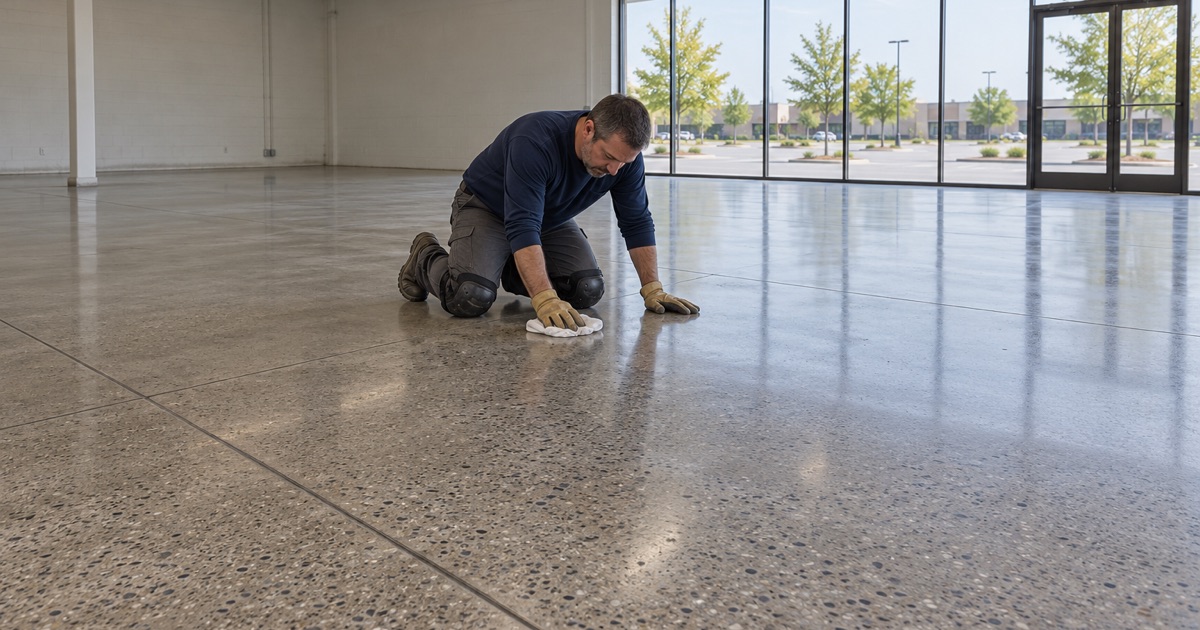
Basement Floors in Older Homes
Much of Skokie’s housing went up in the 1950s and 1960s, and nearly every house has a basement. A polished basement slab is breathable, so it tolerates moisture vapor better than a film-forming coating, and it removes the carpet and pad that hold dampness and odor.
We still test the slab and check for efflorescence, cracks and old adhesive before quoting. Paint, tile mastic and patching compound are ground off first, and any suspect black mastic is flagged for testing before we cut into it.
Living Areas, Lofts and Additions
New construction and additions with a slab on grade can be polished as the finished floor, which is easiest when the concrete is placed with polishing in mind. On existing floors, we grind a test patch first so you see the aggregate exposure before deciding.
A satin or semi-gloss sheen suits most living spaces, reflecting light without the mirror effect of a high polish. Area rugs and furniture pads protect the finish in the rooms that get the most use.
Home Workshops and Utility Rooms
Polished concrete makes a hard-wearing workshop floor that resists rolling toolboxes and dropped parts. A penetrating stain guard helps it resist oil and solvent, though spills should still be cleaned up quickly.
For a garage or shop that sees heavy fluid drips, we will tell you plainly that a coating may serve better. Polished concrete is hard and handsome, but it remains porous enough that a puddle of motor oil left overnight can leave a mark.
Commercial Polished Concrete
Retail Floors and Showrooms
Retail spaces want a floor that looks clean, reflects light and survives carts, pallet jacks and constant foot traffic. Polished concrete delivers all of that and needs no stripping or waxing, which removes a recurring maintenance cost for the store.
We phase retail work so sections can stay open, and our grinders run with vacuum dust extraction so merchandise and shelving are not coated in concrete dust. Fixtures are moved in stages, and the busiest aisles are scheduled for after closing.
Offices, Lobbies and Healthcare Spaces
Polished floors suit lobbies, corridors and office suites where a low-maintenance, durable surface matters. In clinics and healthcare offices the seamless surface cleans easily, and we confirm the floor will tolerate the disinfectants used on it before recommending the finish.
Offices that move from carpet to polished concrete usually find the space brighter, because the floor reflects overhead and window light. Acoustics change too, so we suggest rugs or ceiling treatments in open-plan areas where hard floors can make the room sound louder.
Warehouses and Light Industrial Floors
In warehouses, densified and polished concrete resists dusting and abrasion under forklift and pallet jack traffic. Joints are filled with a semi-rigid joint filler so wheels roll across them instead of chipping the edges.
A densified floor also stops the fine concrete dust that an untreated slab sheds under traffic, which settles on stock and gets into equipment. Because there is no coating, there is nothing to wear through in the forklift lanes, and the floor can be re-honed later instead of stripped and recoated.
Phasing Around a Business That Stays Open
Most commercial clients cannot close for a week. We split the floor into sections, grind and polish one area while the rest of the space stays in use, and schedule the dustiest passes for nights or weekends where needed.
Because polishing involves no long cure time, a finished section can usually go back into service as soon as the guard is burnished in. That is a real advantage over film-forming coatings that need a day or more before traffic.
Polished Concrete Compared With Coatings
Where Polishing Wins
Polished concrete costs nothing to strip and wax, has no film to peel and tolerates moisture vapor moving through the slab. For large retail, warehouse and office floors, the lifetime cost is often lower than a coating that needs periodic recoating.
Where a Coating Is the Better Call
A badly damaged or heavily patched slab will look patchy when polished, and a floor that sees acids, hot water or regular chemical spills needs the protection of a resinous system. In those cases we recommend an epoxy, polyaspartic or urethane cement floor instead and explain why.
The choice also depends on looks. Clients who want a uniform color or a decorative flake or metallic effect get that from a coating, while those who like the natural variation of the concrete itself are usually happiest with a polished floor.
Finish Choices: Sheen and Aggregate Exposure
Cream, Salt-and-Pepper or Full Aggregate
A cream finish leaves the top paste intact with little or no stone showing. A salt-and-pepper finish grinds just deep enough to reveal fine aggregate, and a full aggregate finish cuts deeper to expose the larger stone in the mix.
On an existing slab, the stone pattern depends entirely on how the concrete was poured and finished, so we always grind a sample area. Deeper exposure takes more grinding passes and costs more.
Gloss Levels
Polished concrete can be left at a matte hone, brought to a satin sheen or polished to high gloss. Higher gloss shows more reflection and tends to need more frequent dust mopping to look its best.
The sheen is set by the final diamond grit, not by a topical product, so it does not wear off in traffic lanes the way a wax finish does. Over many years a busy aisle can dull slightly, and a light re-polish with fine diamonds brings it back without starting over.
Dyes and Stains
Color can be added with penetrating dyes during the polishing process. Dyed floors look best with a consistent slab, since patches and old repairs take color differently from original concrete.
Dyes range from soft earth tones to strong blacks and grays, and they can be used to mark walkways, departments or borders. Sunlight can fade some dyes over time, so floors near storefront glass get a UV-stable dye or a more muted color choice.
Our Step-by-Step Polished Concrete Floors Process
Step 1: Slab Assessment and Test Grind
We check the slab’s hardness, flatness, cracks, coatings and moisture, then grind a small test area. That test shows the likely aggregate exposure and lets you approve the look before the full job. The written proposal then names the finish level, the densifier, the guard and the number of grinding passes, so the result can be checked against it.
Step 2: Coating Removal and Coarse Grinding
Existing coatings, adhesives and the weak surface layer are removed with metal-bond diamonds. Cracks and joints are filled at this stage, before finer passes begin.
Step 3: Densifying
A lithium silicate densifier is applied after the coarse passes, reacting with the concrete to harden the surface. It makes the slab more resistant to dusting and helps it take a lasting polish.
Step 4: Honing and Polishing
Resin-bond diamonds take the floor through progressively finer grits until it reaches the agreed sheen. Each pass removes the scratches left by the previous one, which is why polishing cannot be rushed.
Step 5: Stain Guard and Handover
A penetrating guard is burnished in to help resist staining. You get written care instructions and the right cleaner recommendations so daily maintenance does not dull the finish.
- 20+ Years on Concrete
- Moisture Tested First
- Free Written Estimates