Skokie Epoxy Flooring has spent more than 20 years on epoxy flooring in Northlake and across the north and west suburbs, and the floors that teach us the most are the ones that fail in one small patch while the rest still looks new. That pattern almost never comes from bad product. It comes from traffic that concentrates its wear in a few square feet the original scope treated like every other square foot.
On an industrial floor, those few square feet are usually where a lift truck turns. On a home garage floor, they are where a car’s front tires sit and get turned while parked. Either way, we zone the coating by how the floor is actually used, putting the heaviest build where the wear will land rather than spreading one thickness wall to wall.
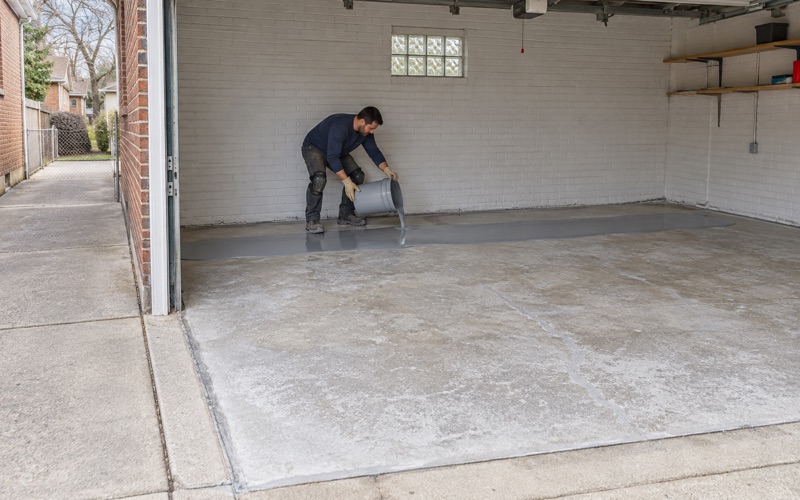
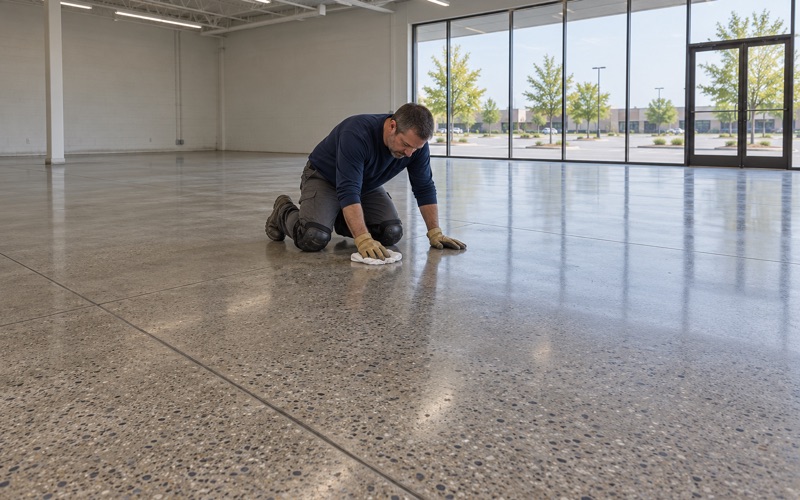
Every slab we take on is opened by diamond grinding or shot blasting, never acid etching, and our written proposal names the product line, the coat count and the finished thickness for each zone. That way an owner can hold the finished floor up against the quote, section by section.
Rail Cars, Paper Rolls and Turning Clamp Trucks
What Arrives by Rail on Northwest Avenue
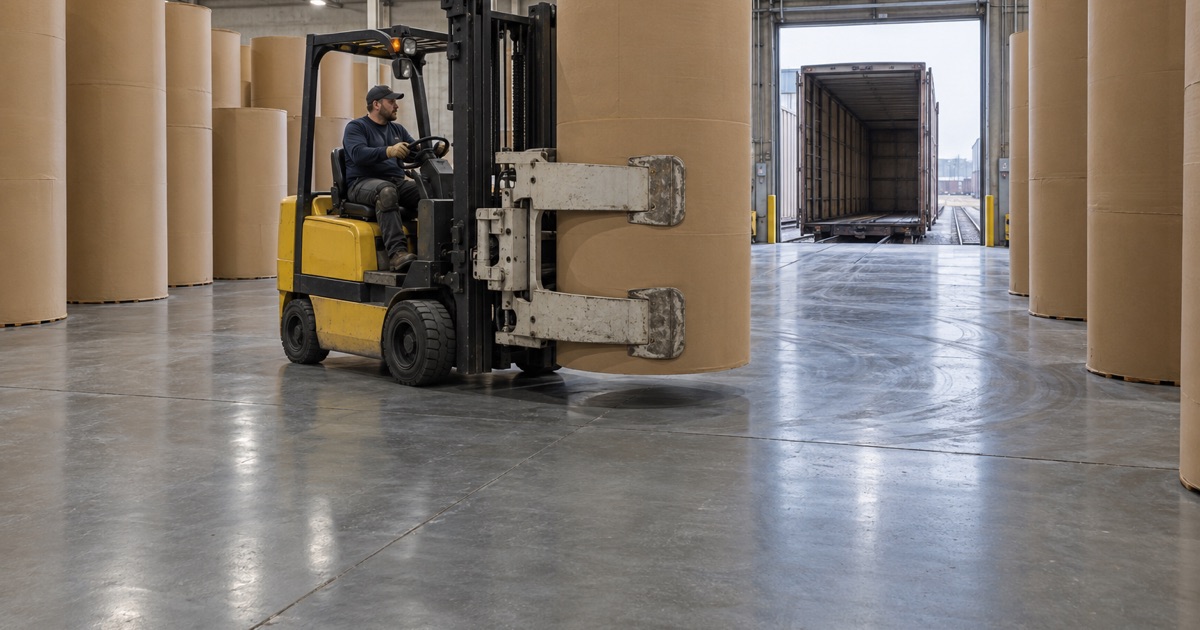
Northlake sits in Leyden Township and Proviso Township on the western edge of Cook County, and it shares a major part of the Proviso Railroad Yards. At 401 Northwest Avenue, International Paper lists its Northlake Container Plant, a corrugated packaging operation. The company’s own clamp-truck job postings for that facility describe the core of the work: loading and unloading rollstock from rail cars or the shipping department and getting rolls ready for the corrugator.
We have not seen that plant’s floor, and we make no claim about it. What the postings do show is a familiar sequence for any paper converter: a roll comes off a rail car, gets staged in a row, and later travels to the machine that turns it into board. Clamp suppliers note that a single roll may be handled as many as 15 times between the winder and converting, so each roll crosses the same floor again and again.
Why the Wear Shows Up at the Turns
A clamp truck carrying a heavy roll steers on its rear axle, and under that load the steer tires twist against the slab whenever the truck pivots. Straight runs down an aisle roll the tire across the coating. A pivot grinds it in place, and the same pivots repeat at the rail-car door, at the end of each roll row and at the corrugator infeed many times a shift.
That torsional scrub is what wears a coating through first. On a worn floor of this kind, the aisles often look fine while dull, polished arcs appear at every turning point, then gray concrete shows through at their centers. No coating stops that wear entirely, but a floor built for it can go longer between recoats.
Gentle Handling Starts With a Flat Floor
Paper rolls are most sensitive when clamped at or near their edges, and clamp makers warn that overclamping can push a roll out of round while underclamping lets it slide or drop. An operator working across a floor with ridges, lipped joints or a worn hollow at the turn has a harder time setting the roll down squarely. A flat, even surface in the turning zones is part of handling rolls well, not just part of floor upkeep.
That is also why we avoid heavy textures in the pivot zones. A coarse broadcast that helps foot traffic on a ramp can chew steer tires and hold paper dust, so slip resistance there is tuned with fine aggregate in the topcoat rather than a rough finish.
Looking for epoxy-flooring closer to Forest Park? See Forest Park Epoxy-Flooring.
Mapping the Pivot Spots Before Choosing the System
Walking the Traffic Before Writing the Scope
We start a warehouse or plant floor by watching the trucks, not by measuring the room. Turning arcs, staging rows, door approaches and machine infeeds get marked on a floor plan, along with cracks, spalls and any old coating that is lifting. That map decides where the build goes, and it shows plainly when part of a slab needs repair before anything is coated.
Worn patches already on the floor are the best evidence we have. A polished arc in an old sealer or a bare crescent in an old coating marks a pivot spot more accurately than any drawing, and the new system is laid out to match it.
Zoning the Build by Traffic, Not by Room
In the turning zones we typically specify a higher-build system, such as a 100% solids epoxy body coat with a quartz aggregate broadcast, finished with an abrasion-resistant topcoat. Straight aisles and low-traffic storage can carry a thinner build without giving anything up. Where a zone also sees heat, washdown or thermal shock, urethane cement is the stronger base.
Zoning keeps the budget where the wear is. Each zone appears in the proposal with its own coat count and finished thickness, so a plant manager can see exactly why the turn at a dock door costs more per square foot than the aisle beside it.
Moisture and Profile Come Before Product
No system holds up in a pivot zone if the slab underneath is pushing moisture or the surface was never opened properly. Before the price is final we run moisture testing, usually ASTM F2170 in-situ relative humidity probes, and moisture is the first exclusion we name when we explain what a coating warranty leaves out.
Turning zones also need a deeper surface profile than a light-duty floor. Grinding or shot blasting to the ICRI CSP range the system calls for gives the high-build coat something to grip, and our grinders run with vacuum capture at the machine so dust never gets rinsed toward a floor drain.
Joints, Transitions and the Rail-Car Door
Joints Filled Flush Where Trucks Pivot
A saw-cut joint in a straight aisle mostly sees tires rolling across it. The same joint inside a turning zone sees a loaded tire twisting on its edge, which chips the shoulder and opens a gap that keeps growing. In pivot zones we fill joints flush with a semi-rigid filler before the coating goes down, so the tire meets one continuous plane.
Timing matters with fillers. A joint filled while the slab is still shrinking can pull away from one side, so on newer concrete we discuss when to fill and how the filler will be maintained.
The Rail-Car Door and Dock Plates
The doorway where rolls come off a rail car is usually the hardest-working square of floor in a converting plant. Trucks turn there while loaded, dock plates and thresholds meet the slab, and winter brings in grit and moisture from outside. We end the coating in a cut keyway at the threshold instead of feathering it to nothing, because a feathered edge is the first place a turning tire lifts the coating.
Cure timing at that door follows slab temperature and the dew point spread at the surface, not the calendar. A cold slab next to an open rail door in winter can sweat or blush, so we schedule that zone for conditions the product can actually cure in.
Transitions Between Zones
Where a high-build turning zone meets a thinner aisle system, the change happens at a joint or a ground step rather than as a ridge in open floor. A ridge is exactly the kind of bump that unsettles a clamped roll, and phasing the work around production hours lets each zone cure fully before trucks return to it.
Color helps here too. A contrasting band or a different topcoat color in the turning zones shows operators where the heavy-duty floor is and lets a maintenance crew spot early wear before it reaches bare concrete.
Turning Scrub in Northlake Garages and Small Warehouses
Power-Steering Scrub From Parked Cars
The same physics shows up at home. Turning the steering wheel while a car sits still twists the front tires against the floor, and in a garage that happens in the same two spots every time the car is backed out. Add hot tire pickup on a summer afternoon and a thin coating can lift in two neat patches where the front wheels rest.
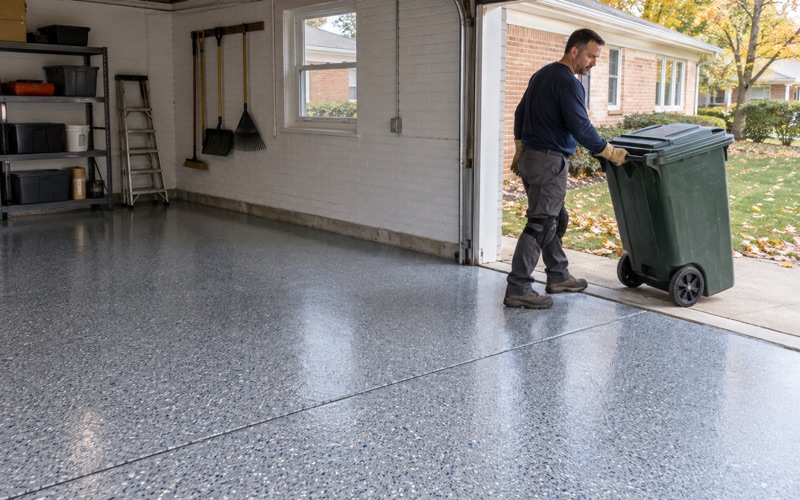
Detached houses make up most of Northlake’s owner-occupied stock: of 3,020 owner-occupied homes, 2,627 are single-family detached, and the 1950s alone account for 1,799 of the city’s housing units. For a garage like that we use a 100% solids epoxy base with a vinyl flake broadcast and a polyaspartic topcoat, built heavier in the tire paths, and chosen to stand up to the brine and rock salt that ride in all winter.
Older Garage Slabs and Winter Cures
A garage slab poured decades ago may have no vapor retarder under it, so the moisture test is written into the scope before the price is final, just as it is on a plant floor. If the slab is cracked or spalled past what repair can fix, we say so before anyone pays for a coating.
We tell owners of unheated detached garages to wait out deep winter, since the slab is too cold to cure a coating properly. Any home job above the state threshold comes with a written contract and the Home Repair: Know Your Consumer Rights pamphlet before the grinder starts.
Small Shops and City Registration
Northlake’s smaller warehouses and shops see the same problem at a smaller scale: a pallet jack or a compact forklift that always turns at the same rack end or the same overhead door. We map those spots the way we map a plant floor and put the extra build there. Work is phased around the hours a business has to stay open.
Illinois has no state flooring license, so local rules govern. The City of Northlake Building Department requires every contractor and subcontractor to register and provide a certificate of insurance naming the city, along with a bond, and we check those current requirements before a job is booked.
- 20+ Years on Concrete
- Moisture Tested First
- Free Written Estimates