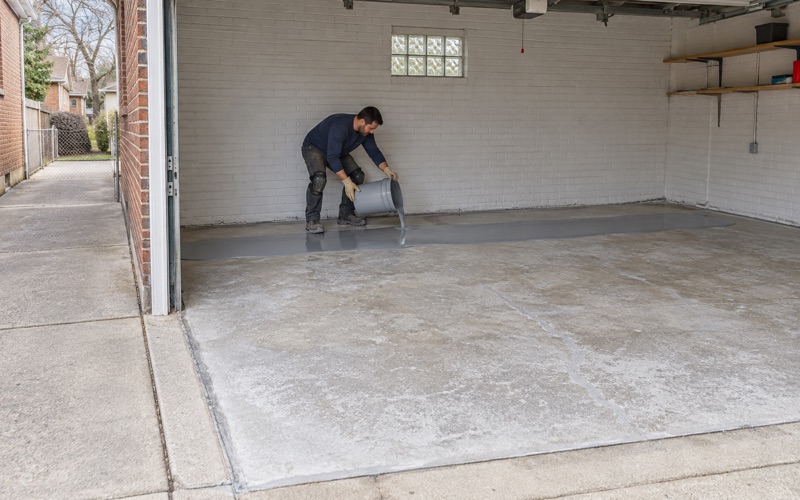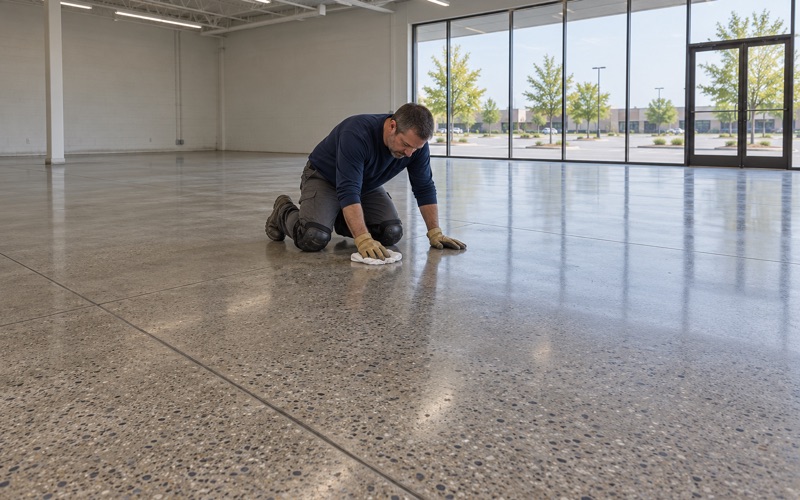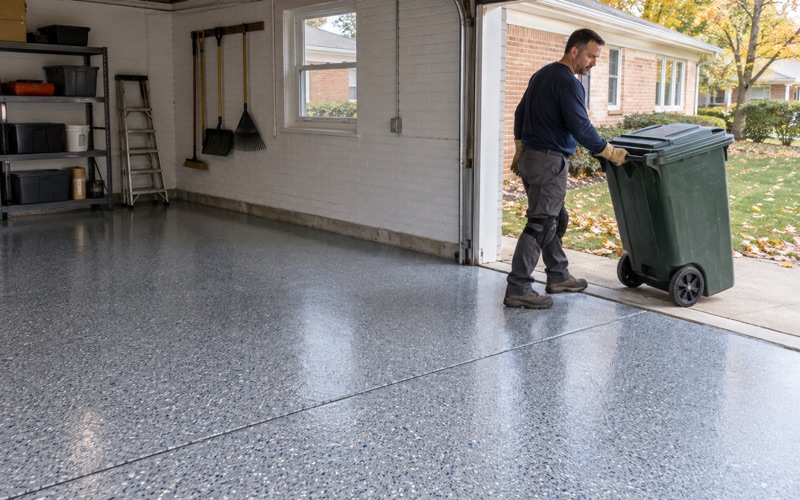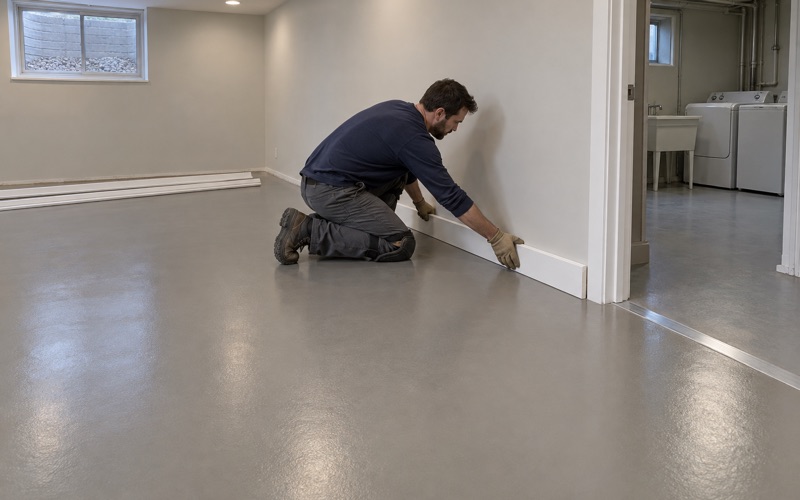
Skokie Epoxy Flooring has spent more than 20 years putting down epoxy flooring in Lyons and across Cook County, and the floors we are asked about most here are the ones people cross in street shoes and still expect to stay clean. Our work starts with the slab, not the color chart: every floor is opened with a diamond grinder or a shot blaster rather than an acid etch, so the coating bonds to a real profile.
Before a price is final, a moisture test goes into the written scope, and the proposal names the product line, the number of coats and the finished thickness. That gives you something to check the finished floor against, whether it is a two-car garage, a basement rec room or a commercial floor that has to stay open while we work.
This page looks at one question that a 32-lane bowling center in Lyons makes easy to see: what a floor leaves on the soles of the people crossing it. A waxed floor sheds wax, a poorly chosen cleaner leaves a film, and both travel. A seamless resinous floor that never needs wax is one of the cleanest answers we know.
Thirty-Two Lanes and the Floor Before the Foul Line
Lucky Strike Lyons on 47th Street
Lucky Strike Lyons sits at 7700 W. 47th Street, inside the Village of Lyons in Lyons Township. The center, formerly Bowlero Lyons, runs 32 lanes alongside an arcade, billiards, a sports bar, a lounge and private party rooms, with food and drinks on the menu. It is open from 11:00 a.m. to midnight Saturday through Monday and from 4:00 p.m. to midnight Tuesday through Friday.
We have no connection to the center and have not seen its floors, and we are not describing how it is kept. We use it as an example because a 32-lane house makes a problem visible that every bowling floor, and a good many home game rooms, share.
The Approach Is Only as Clean as the Shoes
Kegel, a lane-equipment maker, puts it plainly in its guidance on synthetic approach maintenance: wax from tiles and residues from carpets and carpet treatments can stick to shoes and can easily be tracked onto the approach. The same guidance says it is just as important to keep the non-bowling areas clean as the bowling areas, and that the carpets and flooring around the bowler’s circles must be kept clean as well.
In other words, the concourse is part of the approach’s maintenance whether anyone plans it that way or not. A bowler who walks from the bar to the settee carries whatever the concourse floor gave up, and a slide step that grabs or skids is often a sole problem before it is a lane problem.
Where Our Work Stops
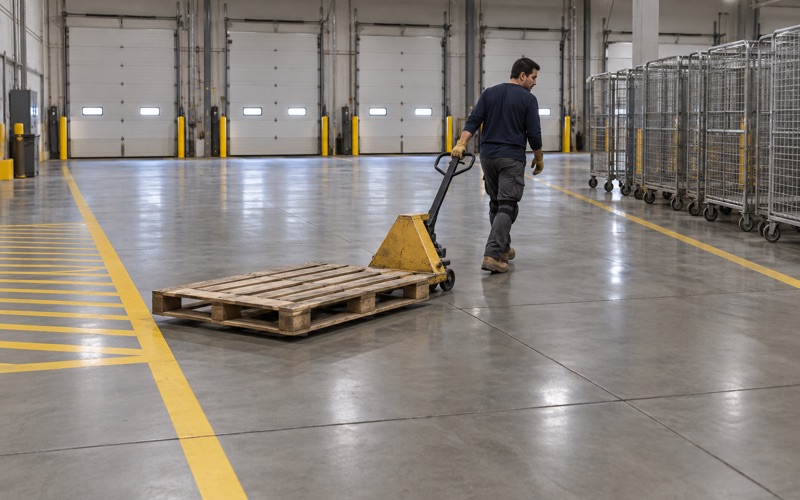
The approach itself is a lane-equipment specialty. We do not work on lanes or approaches, and nothing on this page should be read that way. Our part is the floor around them: concourses, corridors, party rooms, restrooms and back-of-house areas, and the same no-wax thinking carried into basement game rooms at home.
If you run a venue with lanes, the useful split is this: the lane specialist owns the approach, and the floor contractor owns everything a shoe crosses before it gets there. Brunswick’s synthetic lane manual makes a related point, advising mats and carpets that keep abrasive particles from being tracked onto the approach or lane. Planning the two together keeps each from undoing the other.
Looking for epoxy-flooring closer to La Grange? See Epoxy-Flooring Services in La Grange.
Wax, Carpet Treatments and Cleaner Residue on Shoe Soles
Why a Waxed Tile Floor Sheds
Vinyl composition tile is usually finished with layers of floor wax that are buffed, worn through and reapplied. That wax is a sacrificial film by design. It wears off under traffic, and the part that wears off goes somewhere, often onto the soles that crossed it. Rental shoes and personal bowling shoes pick it up the same way.
Carpet near the lanes adds its own load. Stain-resistant treatments and the solutions used to clean carpet can leave a residue that transfers the same way, and Kegel names both tile wax and carpet residues among what ends up on the approach.
When the Cleaner Is the Culprit
Even a floor without wax can leave something behind if the cleaner does. Kegel notes that many cleaning products leave behind residues that can easily be tracked onto the approach. A concentrated degreaser mixed by eye, or a cleaner with a polish additive, can lay down a film on a sound floor every night it is mopped.
For spills on the approach itself, the same guidance describes a dry cloth, then a weak dilution of cleaner, then isopropyl alcohol, which leaves no residue behind of its own. That is a lane maker’s routine for its own surface, not a recipe for every floor, but the principle carries over: the last thing to touch the floor should leave nothing of itself behind.
Older Lyons Floors, Older Finishes
Lyons housing skews old: of the village’s 4,390 housing units, 1,131 were built in 1939 or earlier and another 798 date from the 1950s. A basement that age has often been through more than one floor covering, and tile from those decades was typically kept up with wax.
When we coat a floor like that, the old wax and any mastic under it come off completely, because a coating laid over wax has nothing to hold. Old black mastic can contain asbestos, so it is tested before anyone grinds it. The result is a game room or laundry floor that never needs another coat of wax.
A Concourse Floor That Never Needs Wax
What a Resinous System Changes
A seamless coating built from 100% solids epoxy and finished with a polyaspartic or urethane topcoat has no wax layer to wear off. The wearing surface is the coating itself, so there is nothing sacrificial to scrub loose and carry away. When the topcoat dulls in a traffic lane, it is recoated rather than buffed under a fresh film.
Texture is set during the build, not added afterward. A quartz aggregate broadcast locked under the topcoat gives grip in wet areas near a bar, while a finer texture or a vinyl flake broadcast suits drier walkways. On a concourse leading toward the lanes, we keep the walk path’s texture modest and save heavier grit for the wet zones.
Preparation Decides Whether It Lasts
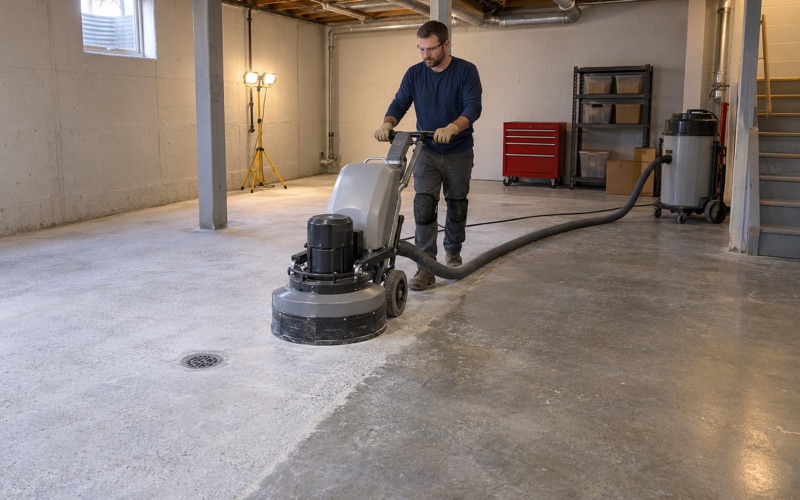
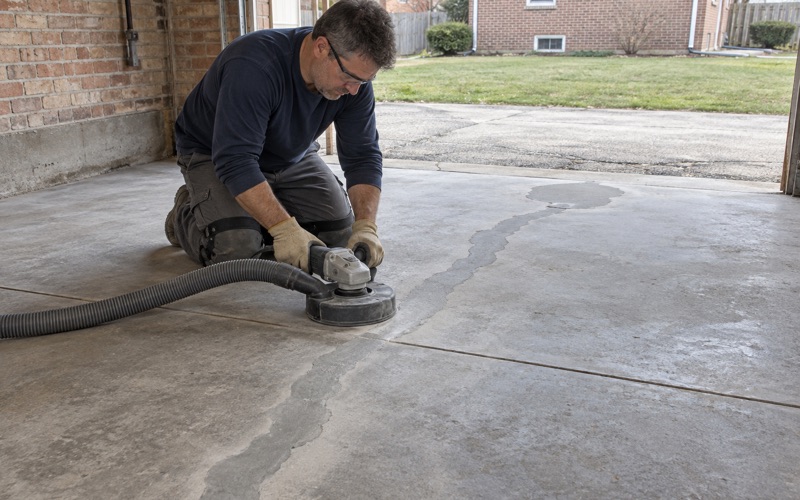
A no-wax floor only stays no-wax if it stays bonded. Old tile, mastic and any previous coating come up first, and the slab is ground or shot blasted to the ICRI concrete surface profile the product calls for. Cracks, spalls and old patches are mapped before the price is set, and if a slab needs repair before it should be coated, we say so.
Grinding dust is captured at the machine with a vacuum rather than washed toward a floor drain. In a building that serves food, that matters as much as the finish, and it keeps the job from leaving a residue of its own in corners and on equipment.
Moisture, Cure and Opening Hours
The moisture test in our scope is an ASTM F2170 in-situ relative humidity probe or an ASTM F1869 calcium chloride test, chosen to suit the slab. Where readings run high, a moisture-mitigation primer goes down first, and we explain before the job is sold that moisture is the first exclusion in a coating warranty.
Commercial work is phased around the hours a building has to stay open, and a venue that opens in the afternoon on weekdays leaves morning windows. Cure schedules follow slab temperature and the dew point spread at the surface, not the calendar. Products are chosen inside the Illinois VOC limits for floor and industrial coatings, which bind the person applying them.
Soda, Beer and Food Between the Bar and the Lanes
Spills in a Mixed Venue
An entertainment center puts a restaurant floor, a bar floor and a game floor under one roof. Kegel lists lane conditioner, soda and beer among the things spilled on approaches, and the drinks cross the concourse first. Soda dries tacky, beer leaves a sticky film, and lane conditioner is an oil.
A seamless coating gives each of those nowhere to hide. There are no grout lines or tile seams to wick liquid in, and a coved base keeps spills out of the joint where floor meets wall. Food-service areas in suburban Cook County answer to the Cook County Department of Public Health, so a kitchen or bar floor is planned with that review in mind.
A Cleaning Routine That Leaves Nothing Behind
The routine we hand over with a coated floor is short: pick up dry debris, mop with a neutral, residue-free cleaner at the label dilution, and rinse where the label calls for it. No wax, no polish additive, no mop-on restorer. On an oily spill, a dry wipe first keeps the oil from spreading before any cleaner touches it.
If a coated floor turns dull and streaky, the cause is usually built-up cleaner rather than a worn topcoat. A few passes with plain water often bring the sheen back, and they lift the same film a shoe would otherwise carry toward the lanes.
The Same Idea in a Lyons Basement
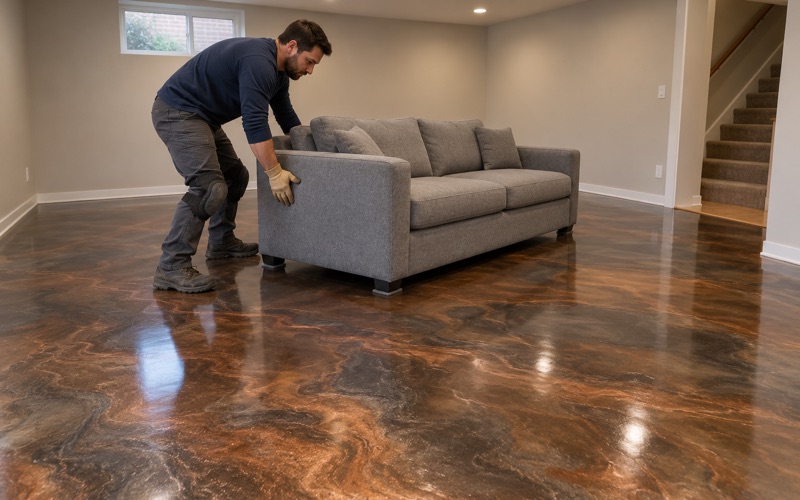
Many basement rec rooms have a pool table, a bar or a dartboard, and the logic holds at home. A no-wax coated floor wipes up spilled soda without a dull ring, and the slippers crossing it pick up no film. We coat around the sump pit, the floor drain and the overhead sewer line rather than over them, and a floor coating is never sold here as waterproofing or flood protection.
Home jobs above the state threshold get a written contract and the Home Repair: Know Your Consumer Rights pamphlet before any grinding starts, as the Illinois Home Repair and Remodeling Act requires. Illinois has no state flooring license, so we confirm current village requirements with the Lyons Building Department at 4200 Lawndale Avenue before booking.
- 20+ Years on Concrete
- Moisture Tested First
- Free Written Estimates