Skokie Epoxy Flooring has spent more than 20 years on epoxy flooring in Lincolnwood and the rest of our corner of Cook County, and the floors we think hardest about are the ones animals walk on. A resin floor can be built to shed water and wipe clean in seconds. It can also be built so slick that a dog’s nails find nothing to hold, and that second version is far more common than it should be.
This page is about the choice between those two floors. We cover exam rooms and waiting areas in small animal practices, and we cover the basements and garages where pet owners watch a dog skid every time it comes in from the yard. The questions are the same in both places: how much grip, how much texture, and how that texture holds up to a mop.
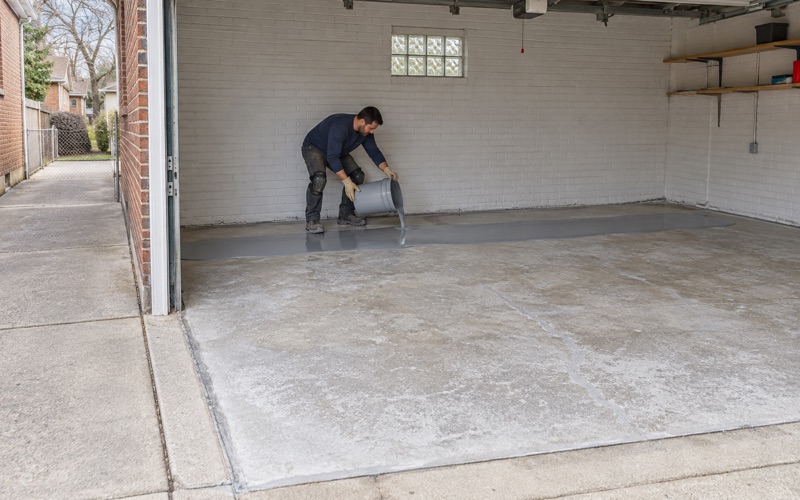
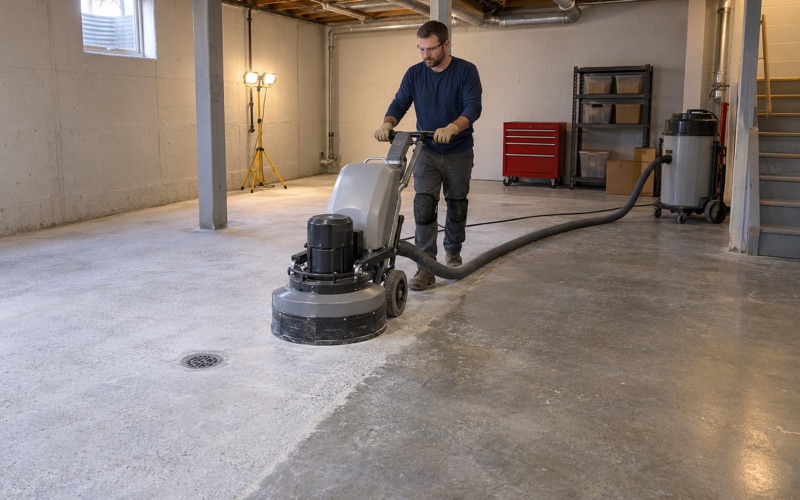
Our starting point never changes. Every slab is ground open with a diamond grinder or a shot blaster before anything goes down, and the written proposal names the product line, the coat count and the finished thickness. That way a texture choice we talk through on site is the texture you can check against the quote once the floor is down.
A Fear Free Clinic on Lincoln Avenue
My Neighborhood Vet at 6927 Lincoln Avenue, inside the village in Niles Township, Cook County, describes itself as Fear Free certified. The clinic says every team member is trained to spot fear and stress early, and it lists low-stress handling and a cat-friendly approach alongside laser surgery and dentistry. We have never worked on that building, and we have no idea what its floor is made of. It is simply the clearest local example of a practice run on the idea that the room itself is part of how an animal is handled.
What the certification asks of a practice
Fear Free certifies veterinary practices, not floor products and not installers. Its facility category lists non-slip flooring among the items a practice can put in place, and its examples treat harder surfaces such as tile and epoxy as acceptable only when they are carefully controlled with the manufacturer to give a true non-slip surface. That wording matters to us. It means a resin floor is not ruled in or out by its chemistry; it is judged by what the finished surface actually does under a paw.
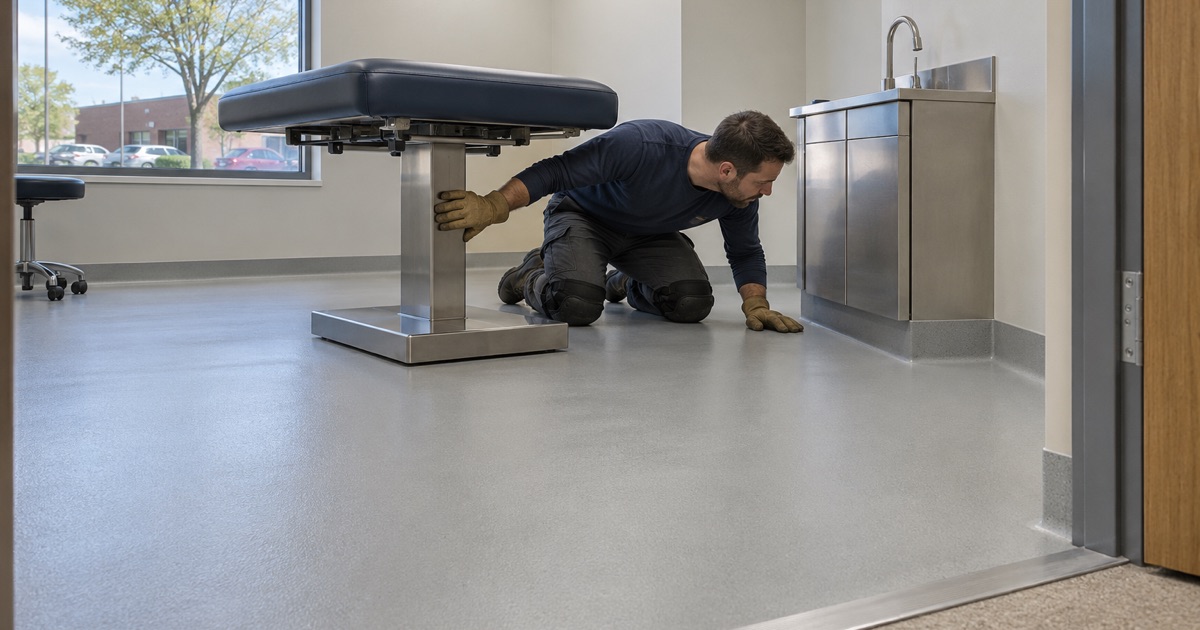
So when a practice owner asks whether epoxy fits a low-stress clinic, our honest answer is that it depends on the build. A smooth, glossy coat fails the test the certification describes. A broadcast or textured system, chosen with the manufacturer’s data in hand, is the version worth discussing.
Why a slip is a fear problem, not just a safety problem
A veterinary architect writing in dvm360 in November 2024 put it plainly: when an animal slips on the floor, it provokes an instinctive fear response, and it is difficult for an animal to recover from that kind of fear. A dog that loses its footing on the way to the exam table arrives tense, and every step after that gets harder for the patient and the team. The floor has undone the handling plan before anyone touches the animal.
The same article notes that slipping also raises the risk of workplace injuries for staff, who spend the day crouched, lifting and turning on that surface. A floor that grips for a dog usually grips for a technician carrying one. That shared benefit is why we treat traction as the first line of a clinic floor scope rather than an add-on.
Looking for epoxy-flooring closer to Winnetka? See Epoxy-Flooring Services in Winnetka.
Grip You Can Measure: What 0.42 DCOF Means for a Coating
Traction is not a feeling you judge by rubbing a shoe across a sample board. The dvm360 article cites a dynamic coefficient of friction of 0.42 or greater, wet and dry, for products used indoors. DCOF is a measured value, and the wet reading is the one that tells the truth in a room that gets mopped between patients.
What the number is and what it is not
That 0.42 figure is what an architect cites for tile-type products. It is not a code requirement for a resin floor, and the article itself does not discuss epoxy at all. We use it as a reference point when we compare manufacturer data sheets, not as a promise about any finished floor. No coating removes every chance of a slip, and we will not tell a clinic owner otherwise.
What we can do is pick systems whose published data addresses wet traction, build them the way the manufacturer specifies, and put that system name in writing. If a practice wants a slip test on the finished floor, that is a reading taken after installation, and the result belongs to the floor, not to our sales pitch.
Broadcast and textured finishes
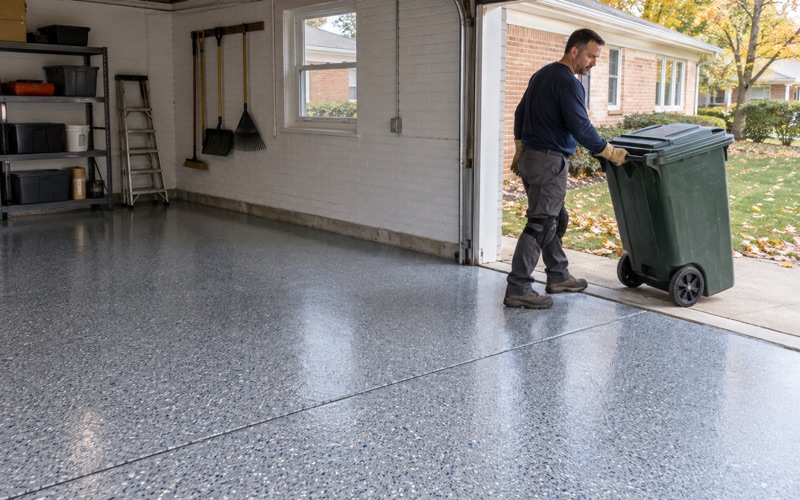
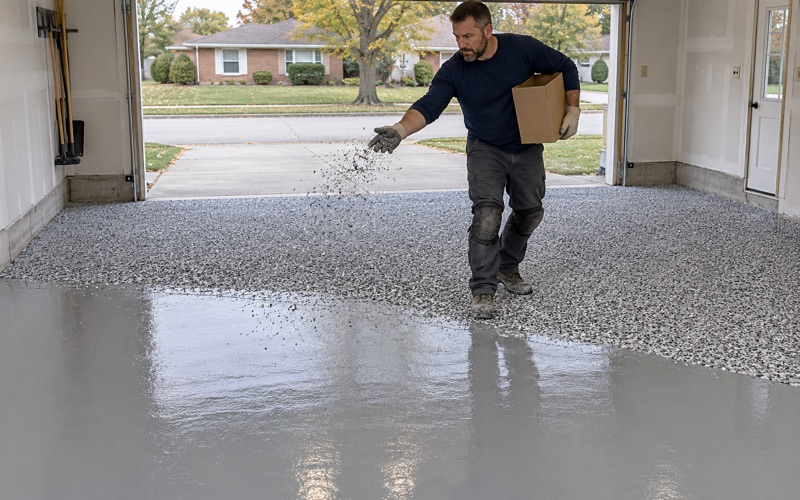
The grip in a resin floor comes from what sits in or on the top coat. A broadcast aggregate finish seeds quartz or fine grit into a wet coat, then locks it under a sealing coat so the profile stays put. A vinyl flake broadcast gives a softer texture and a speckled look that hides hair and scuffs. Some systems add a fine grit directly to the topcoat instead, which produces a lighter tooth that is easier to mop.
Polyaspartic and polyurea topcoats are often used over these systems because they cure quickly and resist the scratching that claws do to a softer coat. We match the aggregate size and the topcoat to the room rather than using one recipe for every space in the building.
Why high gloss is the wrong answer
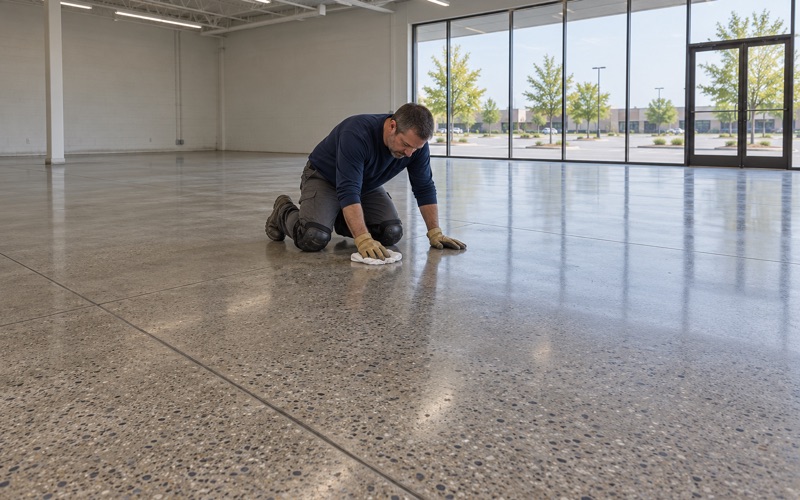
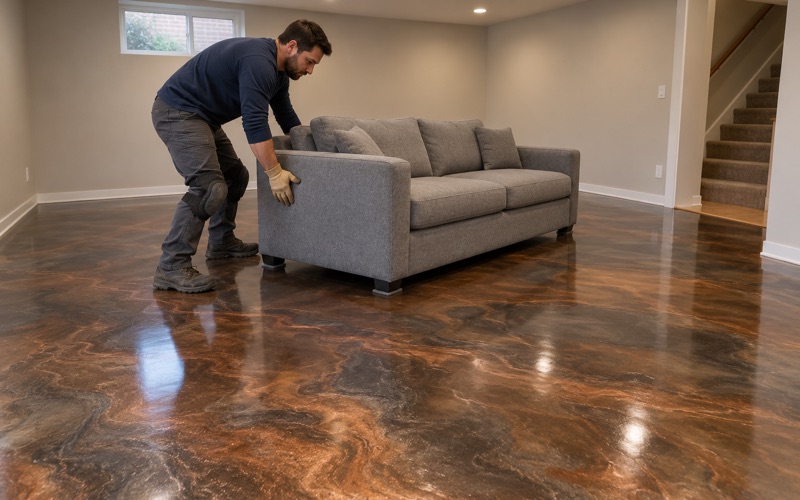
A high-gloss coat looks clean and reads well in a photo. It is also the version most likely to send a nervous dog sliding on its first step through the door. In a waiting room with water tracked in on paws and a mop running all day, a glossy surface is the floor working against the clinic.
We would rather show a practice owner two textured samples, wet, and let them run a hand across both than sell a finish that only performs on a dry, empty day.
Texture Versus Cleanability in Rooms That Are Mopped All Day
Every gram of grip has a cost at the mop. Coarse aggregate holds a paw well, but it also holds hair, dander and the residue of whatever was spilled in the last appointment. A clinic floor has to land on a texture fine enough to clean in one pass and rough enough to stay useful when it is wet.
Sizing the texture to the room
Exam rooms usually do best with a fine, even texture, because they are mopped after almost every visit and an animal spends a few tense minutes standing still on them. Waiting areas and the path from the door take more water and more movement, so a slightly heavier broadcast can make sense there. Dog play areas, where a patient is meant to run, need the most grip of all; the dvm360 article asks for floors grippy enough for dogs to run without slipping.
We map those zones on the floor plan with the practice and write each one into the proposal. One building can carry two or three textures that read as a single floor, and the cleaning crew knows which room is which.
Phasing work around clinic hours
My Neighborhood Vet lists hours of 7:00 a.m. to 6:00 p.m. on weekdays and 7:30 a.m. to 1:00 p.m. on Saturday. Village construction hours run 7:00 a.m. to 6:00 p.m. Monday through Friday and 7:00 a.m. to noon on Saturday, with Sunday work prohibited. For any practice keeping a schedule like that, there is no quiet weekend to do the whole floor at once.
That is why we phase clinic floors room by room, keeping an exam room and the entry usable while another space is ground, coated and cured. Grinding dust is pulled into a vacuum at the machine, so the rooms still seeing patients are not breathing it.
Getting the slab ready for a textured system
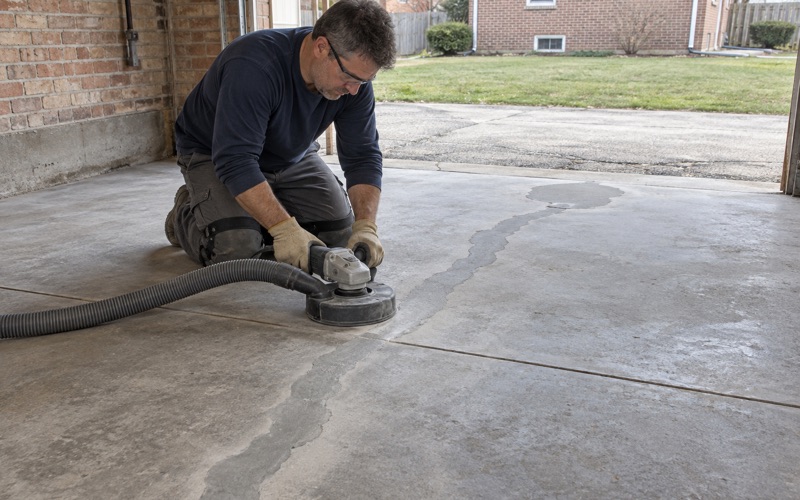
Texture only works if the coating stays bonded, and that starts underneath. We map cracks, spalls and any old coating first, and if a slab needs repair before it should be coated, we say so. A moisture test is part of the written scope before the price is final, using ASTM F2170 in-situ relative humidity probes or ASTM F1869 calcium chloride testing depending on the slab.
The grinder leaves an ICRI concrete surface profile matched to the system’s thickness. Cure times follow the slab temperature and the dew point spread at the surface, not a calendar date, so a room comes back into service when the coating is actually ready.
The Same Trade-Off at Home: Dogs, Stairs and a Slick Basement Floor
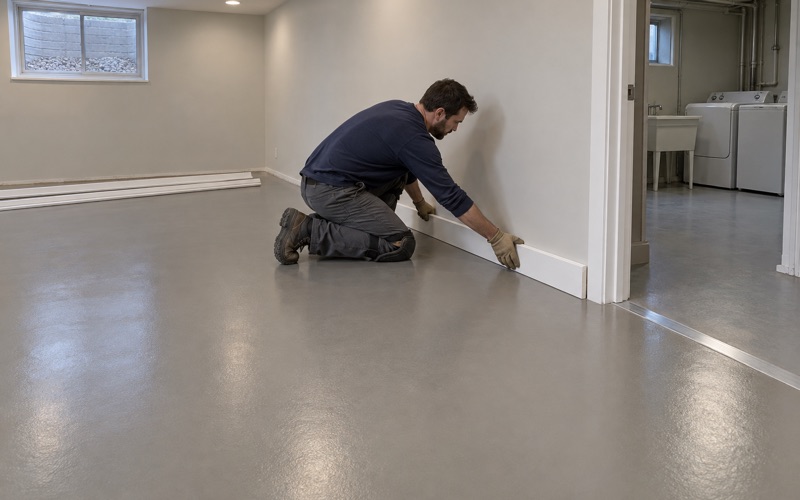
Lincolnwood is mostly owner-occupied detached houses, and plenty of them have a dog that lives as much in the basement or garage as anywhere else. The clinic logic carries straight over. A smooth painted basement floor is a skating rink for an older dog, and a glossy garage coat does the same thing the moment snowmelt drips off the car.
The yoga mats and runners stopgap
Most owners we meet have already tried the usual fixes: yoga mats at the bottom of the stairs, rubber runners down the middle of the room, rugs that creep and bunch. They help for a while. They also trap moisture against the slab, slide out of place, and give a dog a narrow path rather than a floor it trusts.
A textured coating does the job those mats are standing in for across the whole room. It also gets rid of the trip hazard the mats create for the people walking the same stairs.
Basement floors around the sump and the drain
A basement coating for a pet household gets the same moisture test a clinic gets, because water pushing up through the slab will lift a coating no matter how good the texture is. What the warranty leaves out is explained before the job is sold, and moisture is the first exclusion we name. We coat around the sump pit and the floor drain, not over them.
We also say clearly what a coating is not. It is not waterproofing, it is not flood protection, and it does nothing for radon. A basement with a water problem needs that problem handled first, and we would rather tell you that before grinding than after.
Garage floors that work for paws and tires
In a garage, the system has to grip a dog’s feet and stand up to the brine and rock salt that ride in on tires all winter. A flake or quartz broadcast under a polyaspartic topcoat handles both, and it resists the hot tire pickup that lifts cheaper coatings. Home jobs over the state threshold get a written contract and the Illinois consumer-rights pamphlet before any grinding starts.
If you have a pet floor in Lincolnwood that needs more grip, tell us who walks on it and how it gets cleaned. We will start the scope from there.
- 20+ Years on Concrete
- Moisture Tested First
- Free Written Estimates