Skokie Epoxy Flooring brings more than 20 years of work to epoxy flooring in La Grange Park, and the jobs that teach us the most are the ones where the owner asks for the paperwork before the color chart. A low-emitting floor is decided on test reports and VOC figures long before anyone looks at a flake blend. We read those documents with the owner, then build the scope around what they actually say.
Every proposal we write names the product line, the coat count and the finished thickness, so the installed floor can be measured against the quote. Cracks, spalls and old coatings are mapped before the price is final, and when a slab needs repair before it should be coated, we say so on paper.
This page walks through one standard in particular: the low-emitting materials rules a building follows when it is designed to LEED criteria. Those rules separate two numbers people tend to blur, what a coating releases into the room and how much solvent is in the can, and both shape which system we would put down. We also cover how we keep that kind of work moving in rooms that cannot close.
The Sisters of St. Joseph Campus on Ogden Avenue
A Campus Rebuilt Between 2017 and 2019
The Congregation of the Sisters of St. Joseph first settled in La Grange Park in 1899, and its campus at 1515 W. Ogden Avenue sits beside Nazareth Academy, the high school the Sisters founded in 1900. According to the village Sustainability Commission’s article on the project, the congregation planned a new two-story assisted care facility there and renovated its Spirituality Center and administrative offices. The work started in 2017, with completion estimated for 2019.
The oversized six-story building on the site was deconstructed rather than simply knocked down. The commission reported about 2,300 tons of brick, 225 tons of wood and 673 tons of other material recovered for Habitat for Humanity and similar agencies, and contractors used environmentally friendly materials where they could, including carpet made from recycled materials. Reuse on that scale shows how closely the project weighed what went into and came out of the buildings. The campus also added solar panels, EV charging, LED lighting and water-efficient fixtures.
Built to LEED Gold Criteria, Not to a Certificate
Sister Pat Bergen told the commission the Sisters were not seeking a LEED certification. Instead, the criteria for LEED Gold buildings were the guide for both the new construction and the renovation. That leaves the owner, not an outside reviewer, deciding whether each material meets the standard. For a floor built to LEED Gold criteria, the paperwork has to stand on its own, because no certification reviewer will check it later.
We have no connection to that project and did no work on the campus. Recycled-content carpet is the only floor product the village article names, and we do not guess at what else went down. What the project does show is how a building held to those criteria judges a floor coating: before anyone discusses color or gloss, the question is whether the product’s emissions test and VOC content fit LEED’s low-emitting materials rules.
Looking for epoxy-flooring closer to Lyons? See Epoxy-Flooring in Lyons.
Emissions Testing and VOC Content: Two Different Numbers
The CDPH Standard Method Emissions Test
LEED’s low-emitting materials rules, as summarized for LEED v4, ask flooring products to meet the California Department of Public Health Standard Method v1.2. That is an emissions test: a sample of the product goes into a sealed chamber, and the lab measures which chemicals it gives off into the air over a set period, then estimates the concentrations a typical room would see.
A passing report describes the cured floor that people will live and work around for years. It says nothing directly about how much solvent was in the can on install day, which is why the rules carry a second, separate number. A product can carry a modest VOC figure and still fail an emissions test, or the reverse, because the two tests look at different things at different times.
VOC Content and SCAQMD Rule 1113
For interior paints and coatings applied on site, the same summaries point to VOC content limits from the CARB 2007 Suggested Control Measure or South Coast Air Quality Management District Rule 1113, applied to every such product. A share of those coatings by volume must also pass the CDPH emissions test. One summary of v4 gives 90 percent and a v4.1 summary gives 75 percent, so we check the exact credit language for the version a project follows.
VOC content is measured in grams per liter of the product itself. A laboratory report applies a threshold below 50 grams per liter to floor coatings under Rule 1113, so a building following LEED criteria is looking for a floor coating at or under roughly that figure. That is a content limit, read off the label and data sheet before the lid comes off, not a measurement taken in the room.
Illinois Allows 250 Grams per Liter
Illinois sets its own limit for floor coatings at 250 grams per liter under 35 Ill. Adm. Code 223.310. That limit binds whoever applies the coating, and the products we use fall inside it. A product sitting right at the state ceiling, though, carries about five times the VOC content a LEED-guided project is aiming for.
Legal in Illinois and fit for LEED criteria are two different answers. When an owner tells us a building follows LEED, we narrow the choice to products whose own data sheets state VOC content in that low range, and we never call a product compliant with Rule 1113 or the CDPH method unless its own test report says so. If a data sheet gives no VOC figure at all, that product is off the list for a LEED-guided floor.
Reading Data Sheets and Test Reports First
What the Data Sheet Tells Us
A product data sheet lists VOC content in grams per liter, along with solids content, recoat windows and minimum cure temperatures. A 100% solids epoxy usually reports a low figure because there is little or no solvent to evaporate, while some primers, sealers and thinned topcoats run much higher. We read every layer of the system, not just the headline coat, because the primer and topcoat are coatings too.
Emissions are a separate document. If a manufacturer has a CDPH Standard Method report, it names the product, the test date and the exposure scenario it was evaluated for; if there is none, we tell the owner so rather than inferring a pass from a low VOC number. Some owners also ask for the safety data sheet, which lists hazardous ingredients and is worth reading beside the emissions report.
Moisture Before Chemistry
Moisture is the first exclusion we name on any coating warranty, and a low-emitting system is no exception. Our written scope includes an ASTM F2170 in-situ relative humidity test or an ASTM F1869 calcium chloride test before the price is final. If the readings call for a moisture-mitigation primer, that primer goes through the same VOC and emissions check as the coats above it.
Cure timing follows slab temperature and the dew point spread at the surface, not a calendar date. A coat applied too close to the dew point can develop amine blush, and correcting it means more sanding and another product, the opposite of what a low-emission job wants. In an unheated space in deep winter, the right answer is often to wait.
Grinding Dust Stays in the Vacuum
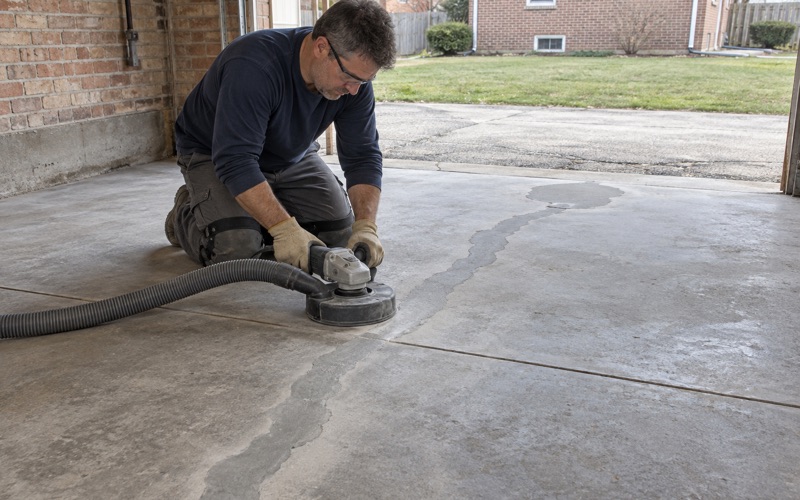
Every slab we coat is opened with a diamond grinder or a shot blaster to a measured ICRI concrete surface profile, never an acid etch. That gives the coating a real profile to grip without bringing an acid wash and rinse water into a building that is working to keep its indoor air clean.
The dust is captured at the machine by a vacuum rather than swept or rinsed toward a drain. In an occupied building, that captured dust belongs to the air-quality plan just as much as the coating’s VOC number does. The same rule holds on a residential garage, where the dust would otherwise drift into the house.
Low-Odor Floors for Rooms That Stay in Use
Phasing Around the Hours a Building Keeps
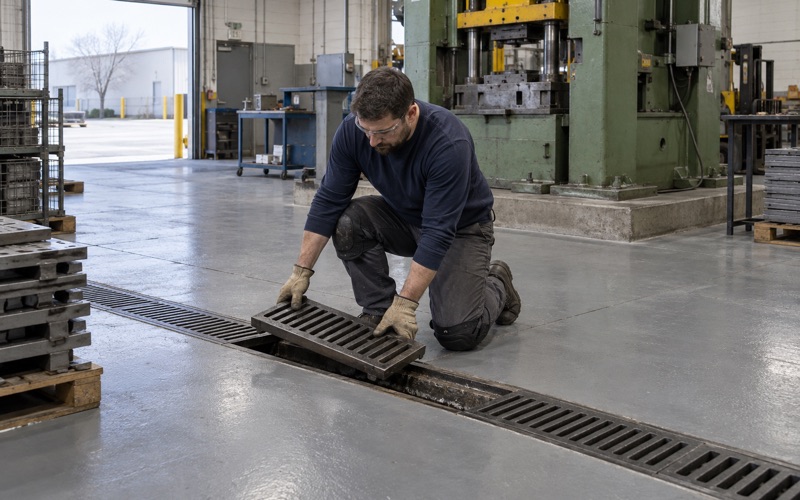
A care building, an office wing or a chapel does not empty for a week so a floor can cure. We phase lab, clinic, kitchen and shop floors around the hours a building has to stay open, sealing off one area at a time and setting the sequence with the owner before the job starts. On a care campus that might mean one corridor or one wing at a time, with the schedule set around meals and care routines.
Low-VOC chemistry helps, but it does not replace ventilation and separation. We plan where the air goes during application and early cure, and we tell the owner which rooms can be reoccupied when, based on each product’s own cure data. Odor is the complaint people notice first, but the CDPH test is about what the floor releases after it cures.
Matching the System to the Room
For rooms that take carts, walkers and wheelchairs and get cleaned constantly, a 100% solids epoxy base with a low-VOC topcoat is a common starting point. Polyaspartic topcoats cure fast enough to return a space quickly, but their VOC content varies widely by product, so they get the same data sheet review. Kitchens on a care campus answer to Cook County Department of Public Health inspection, and that floor is scoped around the kitchen’s own cleaning and slip requirements.
Whichever system fits, the proposal lists the VOC figure from each product’s data sheet beside the product line and coat count. An owner following LEED criteria can then file it with the rest of the project’s material records instead of chasing the numbers after the floor is down.
Permits, Contracts and Who Reviews the Work
La Grange Park is a non-home-rule village, and its Department of Building and Inspectional Services contracts building code services to an outside consultant. Because plan review runs through that consultant rather than an in-house examiner, we ask the Building Department what a coating scope requires before we quote a schedule. Illinois has no state flooring license, so the village’s own contractor registration and insurance rules get checked before the job is booked.
On a home job over the state threshold, the owner gets a written contract and the Illinois Home Repair: Know Your Consumer Rights pamphlet before any grinding starts. A floor coating is never sold as waterproofing, flood protection or radon reduction, and every proposal says so in writing.
- 20+ Years on Concrete
- Moisture Tested First
- Free Written Estimates