Skokie Epoxy Flooring has spent 20+ years on epoxy flooring in Hickory Hills and across the region, and the floors we think hardest about are the ones that meet something softer. A coated slab next to synthetic turf, a rubber mat or a cage net behaves differently from a slab with nothing on it. Loose material arrives on it all day, and the finish has to deal with that rather than show it off.
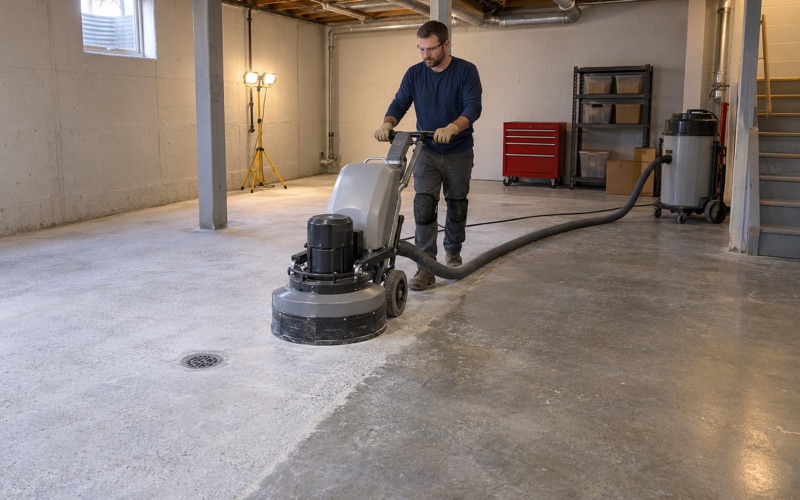
Our work starts with the slab, not the color chart. Every floor is opened with a diamond grinder or shot blaster to a measured profile, and a moisture test sits in the written scope before we fix a price. The proposal names the product line, the coat count and the finished thickness, so an owner can hold the finished floor up against the quote.
This page is about a specific problem: the hard floor where turf ends. Training rooms, lobbies and garages with hitting mats all share it, and the right answer there is usually a fine broadcast texture and a planned cleaning zone, not a mirror finish. Everything else about the job, from the moisture test to the cure schedule, follows the same rules as any slab we coat.
A Batting Facility in a 78th Avenue Warehouse
D-BAT Hickory at 9905 S. 78th Avenue
D-BAT Hickory opened to the public on April 19, 2021, at 9905 S. 78th Avenue, according to the mayor’s update that spring. The city described 21,456 square feet given over to training and instruction, with advanced pitching machines, HitTrax training and analytics, a party and conference room, and batting cages open for public use and rental.
The address sits inside Hickory Hills city limits in Palos Township, within an 83,096-square-foot concrete industrial building with 20-foot clear height and 40-by-35-foot column bays. D-BAT’s own listing calls the space indoor and climate-controlled, with cages that throw real baseballs and softballs, plus a pro shop. The mayor’s update does not describe the turf or the floor finishes, and we make no claim about either.
A Concrete Building Filling With Sports Tenants
D-BAT is not the only sports tenant on this stretch of 78th Avenue. City council minutes record a 2012 business license for a cheer and gymnastics facility at 9911, and in June 2026 a license for Me First, a martial arts school, at 9831. Read together, a concrete industrial block is being re-tenanted by indoor sports.
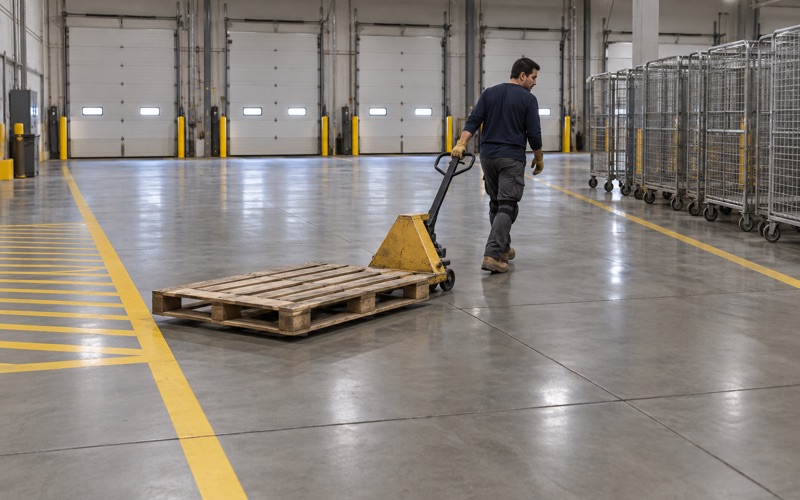
That matters for floors because warehouse slabs were generally poured for racking and forklifts, not for people in socks, cleats and sneakers. When a bay converts, the slab under the lobby and the party room usually stays, and whatever goes on top of it has to suit a very different crowd. We have no connection to any of these tenants and have not seen their floors; the pattern is what we are describing.
Looking for epoxy-flooring closer to Chicago Ridge? See Epoxy-Flooring in Chicago Ridge.
Turf Sheds Onto the Floor Beside It
Where Infill and Fibers End Up
Synthetic turf is not a closed surface. A Pitchcare summary of the European CEN/ESTC technical report says infill will naturally tend to disperse outward toward the pitch perimeters, and the Synthetic Turf Council’s maintenance guidelines tell operators to redistribute migrated infill where necessary. Whatever reaches the perimeter is one step from the hard floor. In a converted warehouse, that perimeter often butts straight against bare or coated concrete.
Not every indoor turf is infilled, and we do not know what any particular Hickory Hills facility uses. Even unfilled turf drops fibers and carries grit from shoes, though, and infilled turf adds rubber crumb or sand granules that ride out on cleats and in the treads of sneakers. A turf-critical brochure notes that crumb rubber gets tracked off fields and into cars, schools and homes.
Granules Underfoot Act Like Rollers
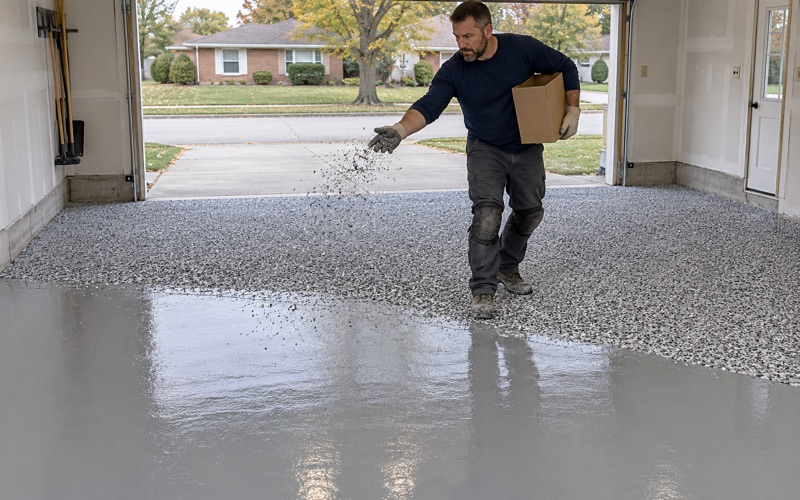
A few loose granules on a smooth, glossy coating behave like tiny ball bearings. A foot lands, the granule rolls, and the shoe slides on a film that would have been perfectly sound if it were clean. The gloss is not the hazard by itself; the gloss plus a scatter of rounded particles is.
Texture changes that. A surface with fine peaks gives a granule somewhere to lodge, and gives a sole contact points that sit above the loose material. It reduces the risk rather than removing it, which is why the floor plan also needs a place where the debris is expected to land and get swept up.
Boot-Cleaning Stations After Play
The same CEN/ESTC summary recommends decontamination mats or boot-cleaning stations so players clean their footwear after play. On a coated floor, that station works best as a defined zone: a stretch of textured resin just past the turf, a walk-off mat on top, and a clear line where the sweeping happens. Players and parents tend to stop where the floor tells them to, so the zone does much of the cleaning before a broom comes out.
We can mark that zone into the coating itself with a contrasting color band, so staff know where to aim the broom and a parent walking in knows where the turf world ends. It is simple to build in at install time and awkward to add later.
Cleaning matters as much as the coating. A textured floor holds more grit in its valleys than a smooth one, so it wants an auto-scrubber or a stiff deck brush with a neutral cleaner rather than a damp mop that just moves crumb around. We walk the owner through that routine at handover, because a texture that is never scrubbed loses most of what it was put there to do.
Texture, Not Gloss, at the Turf Edge
A Fine Broadcast Instead of a Glossy Film
For the strip of floor beside turf, we usually build a 100% solids epoxy base with a fine quartz aggregate broadcast into it, then lock the grains under a polyaspartic topcoat. The grit size is chosen to grip a sole without turning into a cheese grater for a kid who drops to one knee. Because quartz is hard and angular, the texture it leaves holds up under turning feet where a smoother finish would only get slicker.
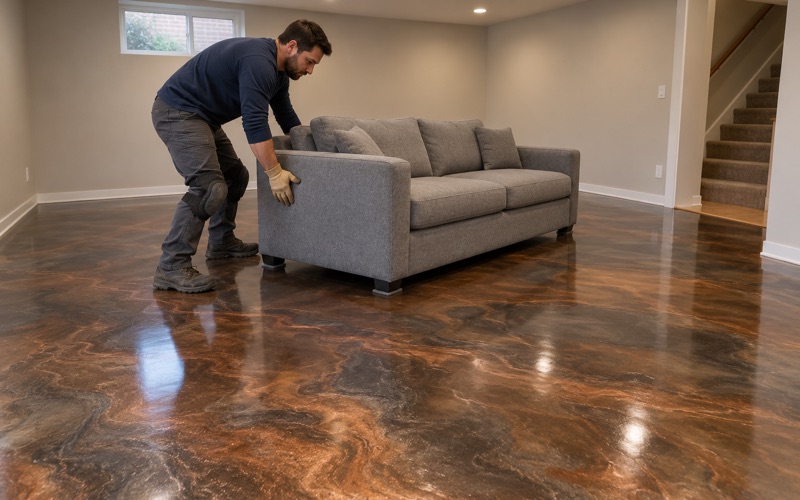
A satin or matte topcoat also hides the light scuffing that cleats leave, where a high gloss shows every mark. Owners who want shine can have it farther from the turf, in the lobby or along a hallway, with the texture concentrated where the granules arrive. Glossy and textured areas can share one color, so the change reads as intentional rather than a repair.
The Turf-to-Resin Edge Detail
The joint where turf meets resin is where most trouble starts. A raised lip catches toes and carts, and a gap collects infill that then feeds back out onto the coated floor. We aim for the coating to finish flush against a metal or resin edge strip, with the turf installer setting their edge to it.
We do not install or maintain synthetic turf, so that edge is a coordination job between two trades. On a new build-out, the coating usually goes down first and the turf follows; on an existing room, we grind and coat up to the existing turf line and protect the turf while we work.
Where turf is laid loose over the slab rather than glued, the coated floor should run under its edge by a few inches. That way a turf panel that creeps or gets lifted for cleaning does not expose a raw concrete band that soaks up spills and sheds dust.
Lobby, Pro Shop and Party Room Floors
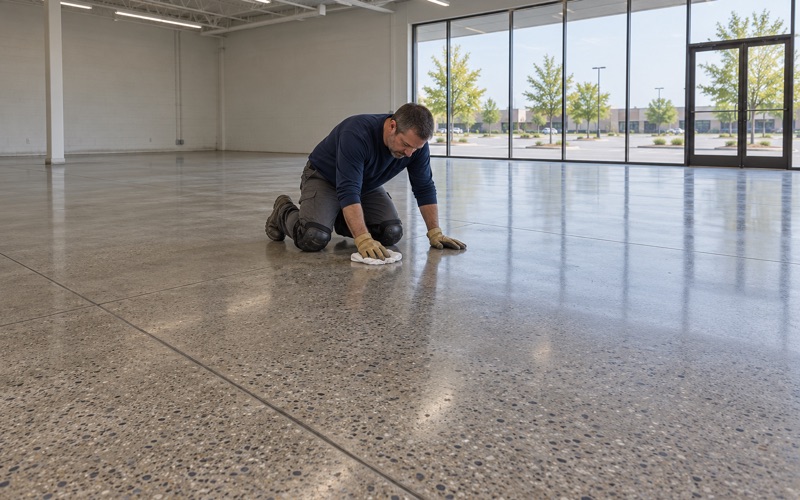
The rooms next to the cages carry a different load. A pro shop sees display fixtures dragged and restocked, a lobby sees parents, strollers and wet boots in winter, and a party room sees spilled drinks and cake. Each of those is a slab that once served a warehouse, so we map cracks, spalls and old coatings first and say plainly when a section needs repair before it is coated.
A converted warehouse also has to stay open. We phase the work around the hours a business runs, coating one room while another stays in use, and we capture grinding dust at the machine with a vacuum so it does not drift into the cages or the shop stock.
Turf Mats, Cleats and a Hickory Hills Garage
A Hitting Setup on a Garage Slab
Plenty of players take the habit home. A turf hitting mat, a net and a tee in the garage turn a two-car bay into a practice space for the winter, and the same shedding happens on a smaller scale: rubber, fibers and grit work out from the mat edges and get ground into the floor by sneakers and car tires. Grit trapped under a tire or a shoe scratches a soft topcoat, so the finish has to be hard as well as textured.
Before we quote a garage, we test it. A moisture test is part of the written scope before the price is final, using ASTM F1869 calcium chloride kits or ASTM F2170 relative humidity probes, because a coating over a damp slab can fail however good the texture is.
Building a Garage Floor for Cleats and Salt
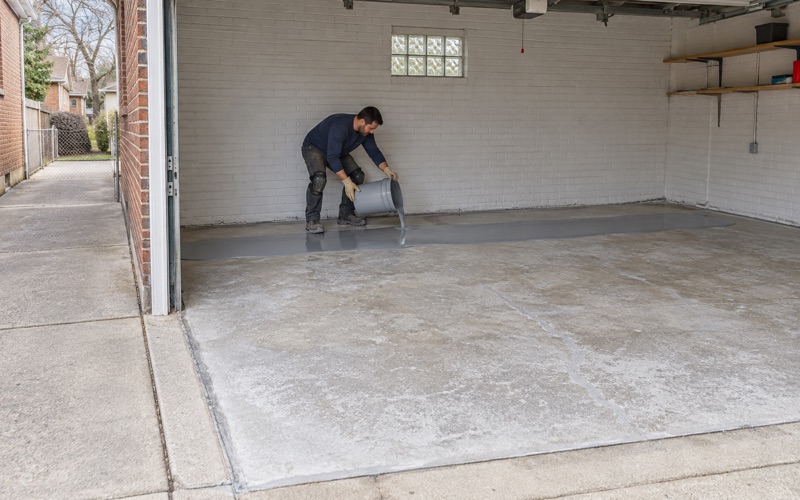
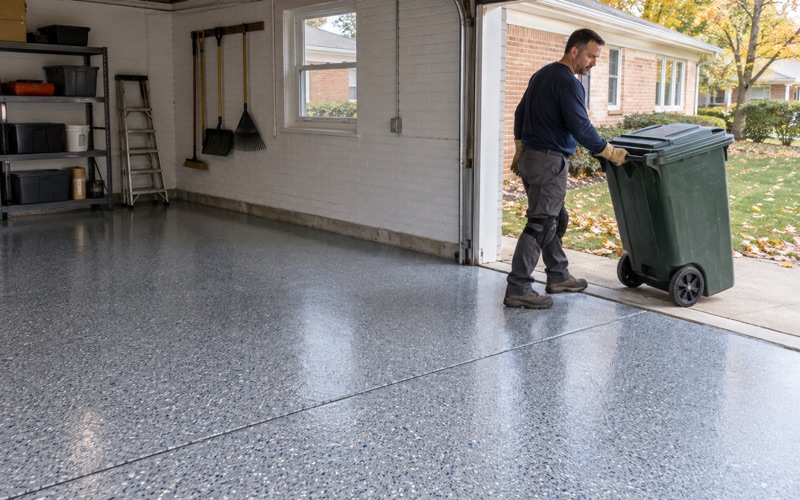
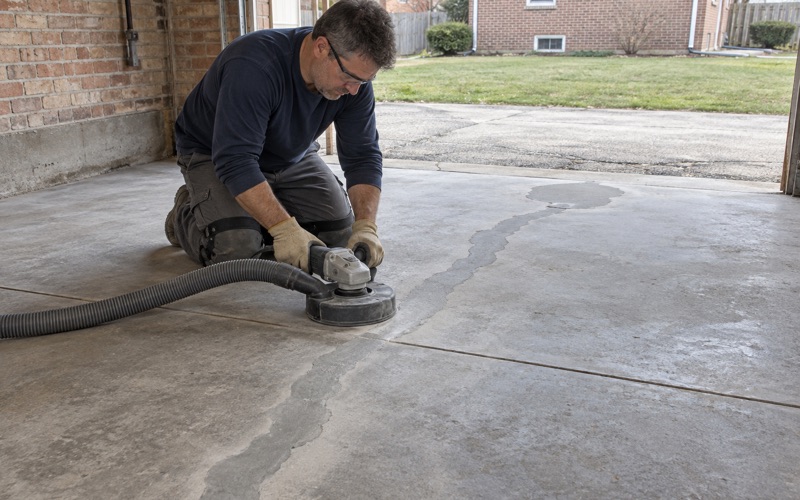
We open the slab with a diamond grinder rather than an acid etch, so the base coat has a real profile to grip. Under the mat and the batting area, a fine quartz broadcast gives sneakers and molded cleats something to bite through the loose crumb; a vinyl flake broadcast can carry the rest of the bay if the owner wants the look.
The same floor still has to park a car. Brine and rock salt ride in on tires all winter, so the topcoat is chosen to hold up to deicers. Cure schedules follow slab temperature and dew point, not the calendar, and an unheated detached garage in deep winter is told to wait.
Who Signs Off on the Job
Illinois licenses no flooring or coatings contractor, so the binding license here is the city’s own. A contractor working in Hickory Hills must hold a City of Hickory Hills contractor license at $100 per calendar year, and the application carries a certificate of insurance naming the city as certificate holder. No bond is required, which is the reverse of several neighboring municipalities.
We check those requirements before a job is booked, and a copy of the certificate goes to the homeowner or business owner before any work begins. Home jobs over the state threshold also get a written contract and the Home Repair: Know Your Consumer Rights pamphlet before grinding starts, and we haul our own debris, since the city’s hauler does not take contractor waste.
- 20+ Years on Concrete
- Moisture Tested First
- Free Written Estimates