Skokie Epoxy Flooring has spent more than 20 years on epoxy-flooring in Franklin Park and the surrounding industrial suburbs, and the floors that teach the most are the ones under machines that leak something other than oil. A coating can look perfect on the day it cures and still fail later if the fluid dripping onto it attacks the binder. That is a chemistry question, and we treat it as one.
Before we price a production floor, we ask what runs in the machines, what gets sprayed or quenched nearby, and how the floor is cleaned. The answers decide the primer, the resin, the topcoat and the texture. A floor next to a hydraulic press is not specified the way a showroom or a warehouse aisle is, and a proposal that ignores the fluid is guessing.
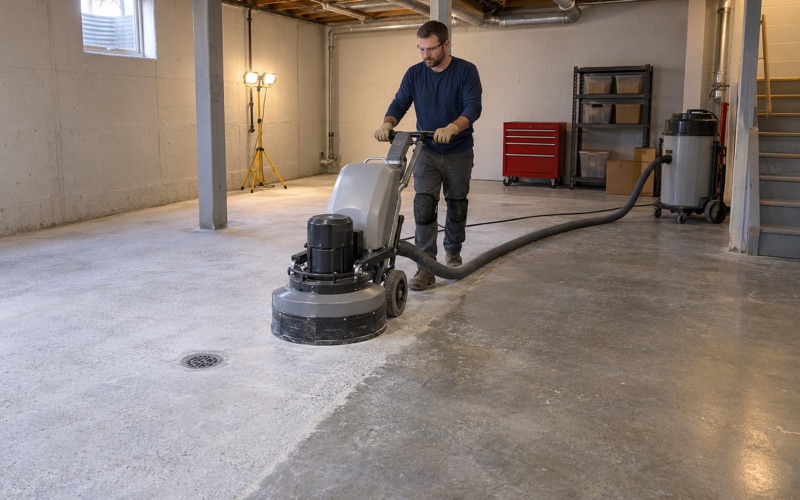
Every quote we write names the product line, the coat count and the finished thickness, so the plant can hold the installed floor against the paper. Slabs are opened mechanically with a diamond grinder or a shot blaster rather than an acid etch, and the dust goes into a vacuum at the machine instead of down a drain.
Aluminum Die Casting on Cullerton Street
A Foundry Floor in Leyden Township
Aallied Die Casting, a trade name of RCM Industries, runs a nonferrous aluminum die-casting foundry at 3021 Cullerton Street, an address that geocodes inside the village of Franklin Park in Leyden Township. Directory listings put roughly 250 employees on site. The Metropolitan Water Reclamation District carries the plant on its September 2026 Significant Industrial Users list under CFR 464, the federal category for metal molding and casting.
RCM has described setting up a newer cell there built around a 1200-ton Lester press, with ABB robots handling the work: a model 4600 ladling the metal, and a model 6600 doing extraction, spraying, quenching and trim loading. A cell like that concentrates machinery, release spray, quench water and hydraulics into a small patch of concrete, and that patch takes the abuse.
Why Die Casters Run Water-Glycol Hydraulic Fluid
A die-casting machine closes and injects with hydraulic force a few feet from molten aluminum. A ruptured line spraying mineral oil onto hot metal is a fire risk, so die-casting machines commonly run a fire-resistant water-glycol fluid instead, a blend in which water does the fire-suppressing work. One fluid maker’s sheet lists diecasting machines and presses among its typical applications.
That sheet, for Mobil Nyvac FR 200D, says the water content must be maintained at 38 percent and that the fluid is not recommended above 65 degrees Celsius bulk temperature. We do not know which fluid any particular Franklin Park plant runs, including the Cullerton Street foundry, and we never assume it. The point is the class of fluid, and what the class does to paint.
Where the Fluid Ends Up
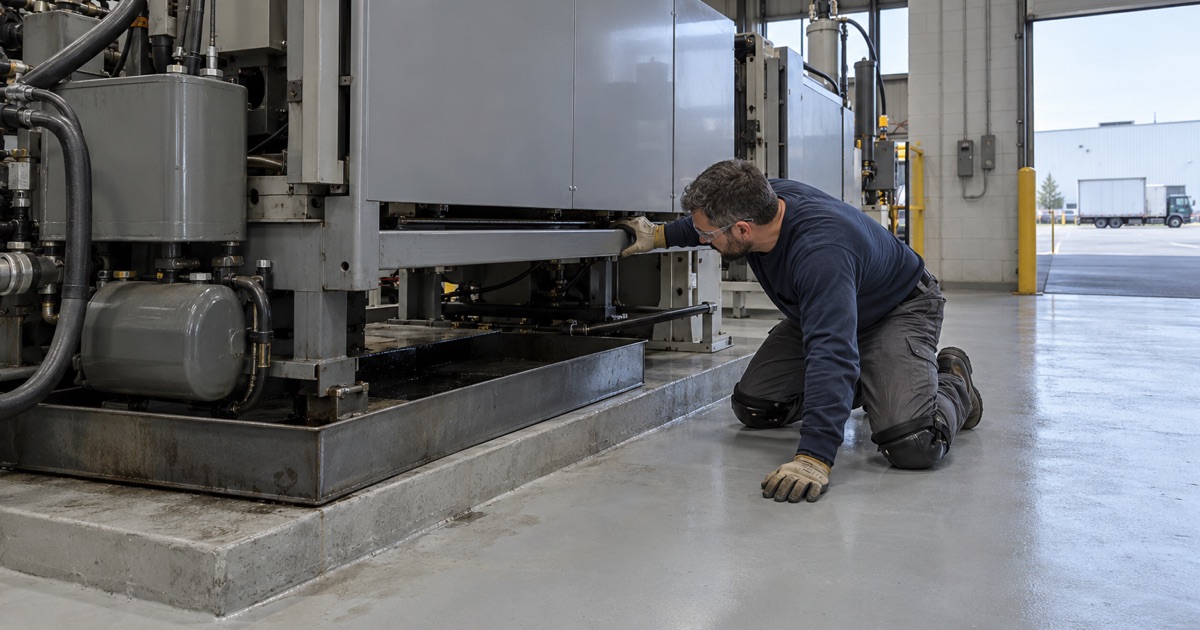
Hydraulic systems weep. Fittings seep, hoses sweat at their crimps, and a burst line can mist a wide arc before the pump stops. On a water-glycol machine the residue that reaches the floor is a wet, slippery film, and as the water flashes off, the glycol and additives stay concentrated on the surface.
Around a die-casting cell that film mixes with die release, quench overspray and trim scrap, and it is cleaned up again and again. The floor sees chemical contact, foot traffic, carts and scrubbing every shift, which is why we specify the area around the machines as its own zone rather than as part of the general plant floor.
Looking for epoxy-flooring closer to River Forest? See Epoxy-Flooring in River Forest.
Not Compatible With Typical Paints: What That Does to a Floor
The Line on the Data Sheet
The Nyvac sheet is blunt about it: in common with all other water-glycol type fluids, the product is not compatible with typical type paints. The warning does not single out floors, but a floor coating is a paint in the sense that matters, a resin film bonded to a substrate, and the same chemistry reaches it.
Summaries of the same sheet point to epoxy or phenolic resin based paints as suitable, which is useful as a direction and dangerous as a shortcut. Epoxy is a family, not a single product. Whether a given floor epoxy holds up under a given glycol fluid is checked product by product, never assumed.
How Softening and Lifting Show Up
Ordinary floor paint and one-part garage coatings are the usual casualties. Where glycol fluid sits on them, the film softens, turns tacky under a thumbnail, and starts to whiten or wrinkle. Wheels and boots then peel it back in sheets, and the bare concrete underneath takes the next leak directly.
A failure like that rarely starts in the middle of an aisle. It starts at a machine base, a hose run or a drip tray edge, where contact is constant, and spreads outward from there. When we inspect a peeling floor near hydraulic equipment, the pattern of the failure usually tells us whether chemistry or preparation was the cause.
Preparation Still Matters
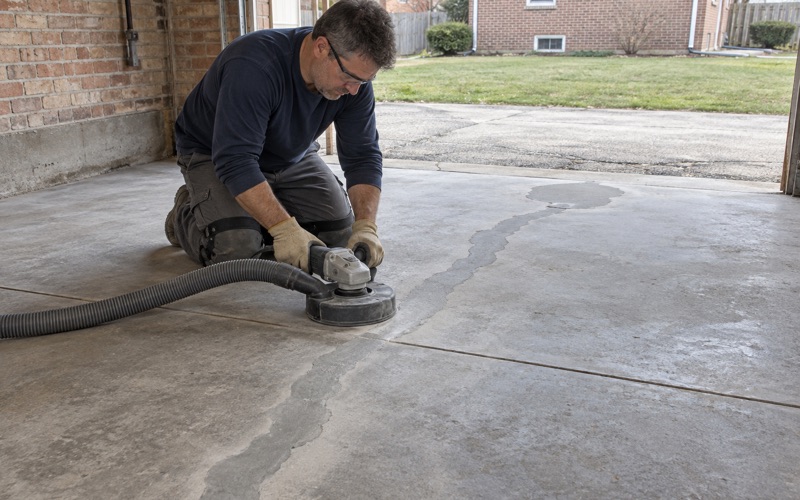
Chemical resistance on a product sheet assumes a coating that is bonded to sound concrete. A slab around an old machine footprint needs to be ground back past old paint and contamination until the surface is clean and open, and we test adhesion before we commit to a system. Sometimes the honest answer is a section that has to be cut out and replaced.
We map cracks, spalls and failed coatings before quoting, and the profile we grind to is stated as an ICRI CSP number so it can be checked. A moisture test is part of the written scope as well, using ASTM F2170 relative humidity probes or ASTM F1869 calcium chloride kits, because a resin that resists glycol from above can still be pushed off from below.
Matching the Floor System to the Plant’s Fluid Data Sheet
Start With the Fluid, Not the Catalog
On a die-casting or press floor, our first request is the safety data sheet and the product data sheet for every fluid that can reach the concrete: the hydraulic fluid, the die lubricant, any coolant and the cleaner the crew uses. The hydraulic sheet’s paint-compatibility line is the starting point, and the resin maker’s chemical resistance chart is the second half of the match.
Where the chart is silent on a specific fluid, we ask the manufacturer or run a spot test, placing the plant’s own fluid on a cured sample for a set period and checking hardness and adhesion afterward. That takes days, not weeks, and it is cheaper than finding out on the production floor.
Building the System Around the Cell
A typical specification near the machines starts with a primer chosen for the slab’s moisture reading, then a body coat of 100% solids epoxy or a novolac-type epoxy where the chart calls for more chemical resistance, then a topcoat matched to the fluid. A broadcast of quartz aggregate gives traction on a floor that is often wet with a slippery film.
Edges get as much attention as the field. We terminate the coating in a cut keyway at machine bases and trench drains so a leak cannot track under the film, and we cove up curbs where fluid collects. Each zone gets its own line in the proposal, so the cell floor and the aisle beside it are never priced as one.
Working Around Production Hours
A foundry cannot stop for a week while a floor cures. We phase cell floors around shutdowns and weekends, coat one zone while the next keeps running, and pick resins whose cure fits the window. Cure timing follows slab temperature and the dew point spread at the surface, not the calendar, because amine blush on a cold, damp slab weakens the next coat.
Before any cell is coated, the machines’ hydraulic leaks should be fixed. A new floor under a weeping fitting should outlast paint, but no coating is a substitute for maintenance, and a drip tray under a known leak protects the floor and the warranty alike. We explain what the warranty excludes before the job is sold.
Hydraulic and Glycol Drips in Franklin Park Shops and Garages
Smaller Shops With Presses and Power Units
Not every water-glycol machine sits in a large foundry. Franklin Park is a production-floor village, and one water account in five here is commercial or industrial, 1,237 of them against 4,664 residential in 2024. Smaller job shops run presses and hydraulic power units too, and some of them may use fire-resistant fluids for the same reason the casters do.
For a shop owner the method is the same at a smaller scale: find the fluid’s data sheet, read the paint line, and ask for a floor system that has been checked against it. If a shop’s existing floor paint is soft and lifting around one machine and sound everywhere else, the fluid in that machine is the first suspect.
Glycol in a Home Garage
The residential side of the village is mostly owner-occupied detached houses, and 62.0 percent of the housing stock predates 1960. In those garages, glycol arrives as engine coolant from a leaking radiator, a hose or a drained system, and it sits on the slab next to the brine and rock salt that come in on tires every winter.
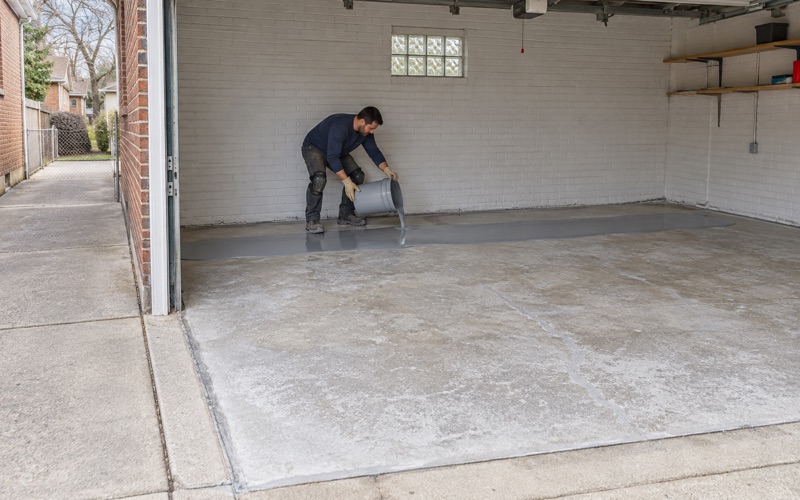
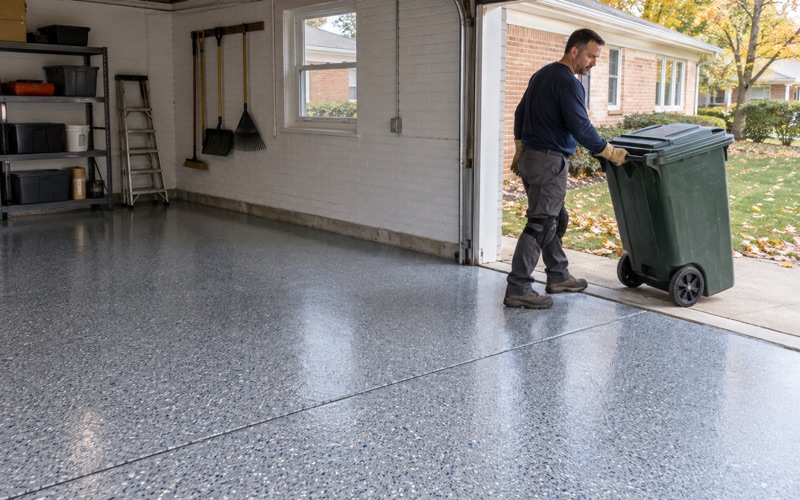
Big-box one-part kits handle that combination poorly; they often soften, suffer hot tire pickup and peel. We build garage floors as ground, moisture-tested multi-coat systems with a vinyl flake broadcast and a polyaspartic topcoat, and we still tell owners to wipe up coolant promptly, because it is toxic to pets and children and no floor makes it harmless.
Before the Work Starts in the Village
A slab poured in the 1950s often carries a previous coating, patched cracks or a dusty surface, and a garage floor that old gets the same survey a plant floor does. Where a slab needs repair or replacement first, we say so. In an unheated detached garage in deep winter, the right advice is usually to wait until slab temperatures allow a proper cure.
Franklin Park requires every contractor working in the village to hold a village license, post a $10,000 trade-specific license and permit bond and carry at least $1,000,000 in liability insurance. Illinois has no state flooring license, so we check those village rules before a job is booked, and home jobs over the state threshold get a written contract and the consumer-rights pamphlet first.
- 20+ Years on Concrete
- Moisture Tested First
- Free Written Estimates