Skokie Epoxy Flooring installs epoxy flooring in Evergreen Park with more than 20 years in the trade behind every floor, and some of the most demanding rooms we see are the ones where a spill has to come up the same day it lands. A surgical prep area in a small animal hospital is one of them, because the worst mark on that floor may be the amber-brown of an iodine skin prep rather than water or blood.
That stain behaves differently from ordinary dirt. It sinks into a waxed finish, travels below it, and stays put through the mop bucket. Our work in rooms like this starts with the question of what the floor needs to keep out, and only then with which resin and color will do it. Getting that right before the first coat goes down is cheaper than living with the wrong floor for a decade.
The same thinking covers a quieter case: the home first-aid kit, a bottle of antiseptic knocked off a basement shelf or a garage workbench. Whether the room is clinical or domestic, we test the slab for moisture before the price is final and put the product line, coat count and finished thickness in writing.
Routine Surgery on Kedzie Avenue and the Stain It Can Leave
A Neighborhood Animal Hospital at 10042 S. Kedzie
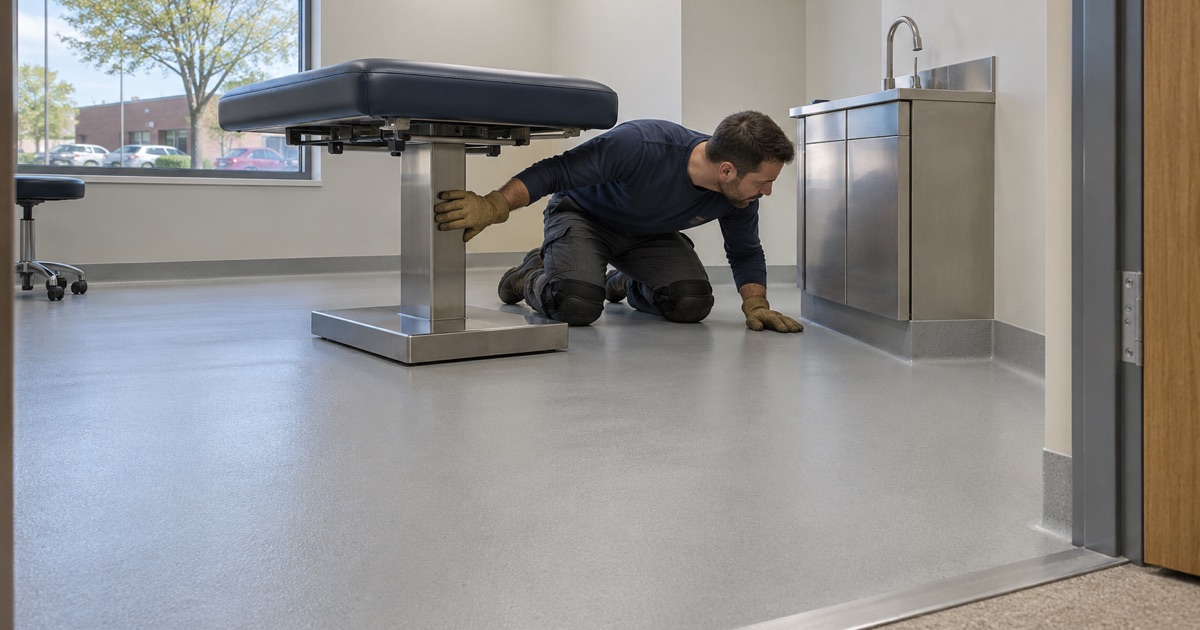
Hilltop Animal Hospital at 10042 S. Kedzie Avenue lists preventative care, dental care, diagnostics, boarding and routine spay and neuter surgery among its services. The address geocodes inside the Village of Evergreen Park, in Worth Township, Cook County, on the same avenue that carries the village hall and the fire department. Its listed hours run weekdays and Saturday mornings, with Sundays closed.
We have never worked on Hilltop’s floors and have not read what its surgical suite is finished with. We use it here because it is a real, local example of a practice doing routine surgery, and routine surgery means a prep area where skin is scrubbed before every incision.
What Spay and Neuter Prep Puts on the Floor
Before a spay or neuter, the surgical site is clipped and scrubbed with an antiseptic. Povidone-iodine scrub and chlorhexidine are both common choices in veterinary surgical prep, and which one a given clinic uses is its own choice. Iodine preps leave a characteristic brown color on skin, and that color is the whole point: staff can see where they have scrubbed.
Where an iodine-based prep is in use, drips happen. A bottle tips at the prep table, a soaked gauze sponge falls, a scrub brush is set down on the wrong surface, and the floor collects a brown spot that looks like it should mop right up. It rarely does.
The Same Problem at Home
Iodine antiseptic also sits in plenty of household first-aid kits, sometimes on a basement shelf or in a garage cabinet over bare or painted concrete. A tipped bottle on a sealed garage floor is a small version of the clinic problem, and it follows the same rules. The difference is that a homeowner often finds the spot days later.
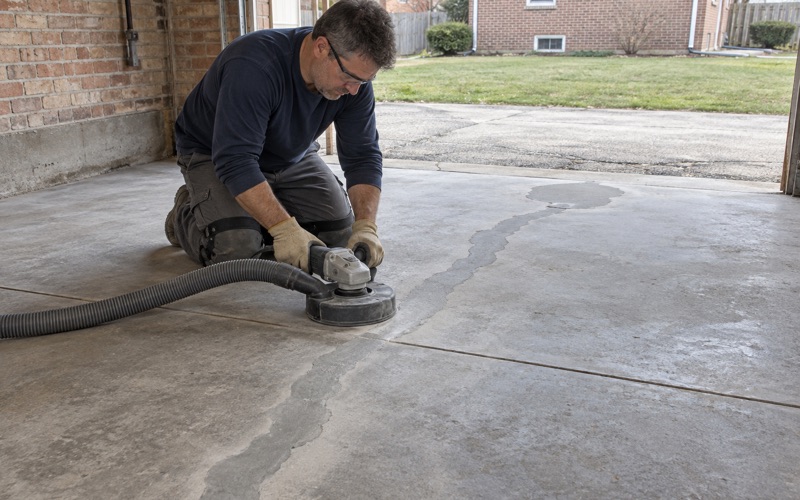
Home slabs often carry years of paint, patches or old sealer under the top layer. We map that history, along with cracks and spalls, before quoting, because an iodine spill on a failing old coating soaks into whatever is underneath it. A spill on bare concrete wicks into the pores and can stay there for good.
Looking for epoxy-flooring closer to Burr Ridge? See Epoxy-Flooring Services in Burr Ridge.
Why Iodine Gets Through Wax, and Where a Seamless Floor Stands
Through the Floor Finish to the Tile Below
A 2001 patent from the cleaning-chemical maker Ecolab, US Patent 6,309,471, describes the problem in plain terms. It notes that health care facilities routinely use povidone-iodine formulations, that spills soil floors, countertops and walls, and that the iodine will go right through the floor finish to the tile below.
The same patent calls those stains very difficult to remove by the usual cleaning techniques, which is why the tile often ends up replaced. It was written about hospitals and nursing homes, but the chemistry does not change because the patient on the table has four legs. For a floor buyer, the lesson is in the problem the patent set out to solve.
Why a Waxed Tile Floor Loses
Vinyl composition tile under a sacrificial wax finish is a common floor in older clinics and offices. The finish is thin, it is reapplied on a schedule, and the seams between tiles give a spill more edges to work into, so a stain that passes the finish ends up in the tile itself. Every scuff in that wax is another opening.
Stripping and rewaxing can lift a surface mark, but not one that has already reached the tile. At that point the choices are living with the spot or cutting out tiles, and a busy surgery day does not leave much room for either. Replacement tiles from a different lot rarely match, so the repair often shows as a patchwork.
What a Sealed Seamless Floor Changes
A resin floor bonded to ground concrete has no tile seams and no wax layer to soak through. A 100% solids epoxy body coat under a dense topcoat gives a spill one continuous surface to sit on, which buys time to wipe it up before it sets. Cove the floor up the base of the wall and the corner where drips collect stops being a seam too.
We say plainly that every floor can stain. The patent describes tile and floor finish, not resin, and a topcoat resists staining by degree, so the honest promise is a better chance and a faster cleanup, not a guarantee. That difference still matters in a room cleaned after every procedure.
Topcoat, Color and the Slab Underneath
Choosing a Stain-Resistant Topcoat
For a prep room we usually specify a stain-resistant topcoat over the epoxy, most often a polyaspartic or polyurea chosen for chemical resistance and a tight, nonporous surface. Before choosing one, we check its data sheet against the cleaning products the room already uses, because a topcoat that dulls under the daily mop solution has traded one problem for another.
Texture is part of the same decision. A fine aggregate in the topcoat helps footing on a floor that gets wet during cleaning, but too coarse a texture holds residue, so we set the grit for the way the room is actually mopped. Footing matters most where staff are carrying an animal to the table.
A Forgiving Color
Color matters more than most owners expect. A bright white or pale gray floor shows every faint amber shadow an iodine drip leaves, while a warm tan, mid-gray or a flake blend with brown tones lets a light residual mark disappear into the pattern. We bring physical samples so the choice is made under the room’s own lights.
That is not hiding dirt; it is choosing a floor whose appearance survives the occasional mark that cleaning cannot fully lift. A vinyl flake broadcast under a clear topcoat is a common way to get that forgiving look while keeping the surface smooth enough to wipe. Quartz aggregate broadcast offers a similar mottled finish with more grip.
Preparing the Slab First
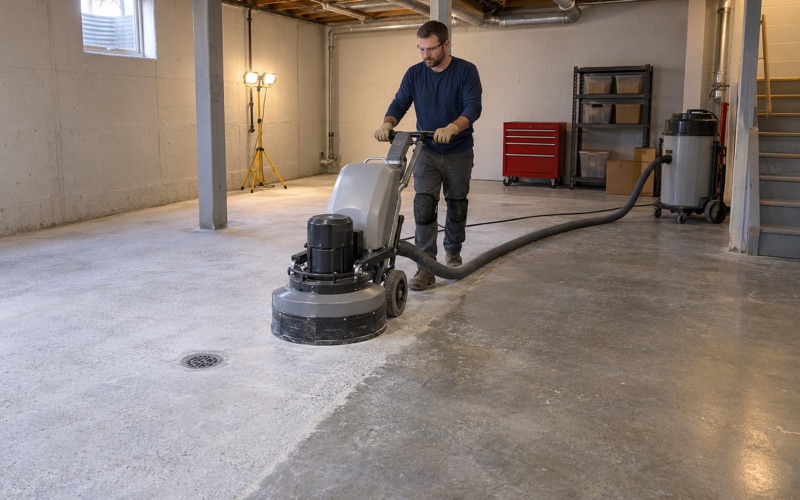
None of that works on a weak bond. We open every slab with a diamond grinder or shot blaster rather than an acid etch, and capture the grinding dust with a vacuum at the machine, which matters in a building that holds animals and surgical supplies. The goal is a profile in the ICRI CSP range the primer calls for.
Moisture comes next. A calcium chloride test under ASTM F1869 or in-situ relative humidity probes under ASTM F2170 are written into the scope, and if vapor is high we add a moisture-mitigation primer or tell the owner the slab is not ready. Moisture is also the first exclusion we name in any warranty.
Same-Day Cleanup, and the Thiosulfate Fix When a Stain Sets
Wiping a Spill the Same Day
The single most useful habit on any coated floor is same-day cleanup. An iodine drip wiped while it is still wet is far easier to lift from a good topcoat; the same drip left under a cart over a long weekend has days to work into any scratch or worn spot. We suggest keeping a roll of paper towels and a spray bottle of the approved cleaner within reach of the prep table.
We hand over plain care notes with every floor: what to wipe with, what to keep off it, and when a scuffed topcoat is due for a recoat. A worn traffic lane by the prep table is where a stain finds its way in, so recoating on time protects the color as much as the gloss.
When a Stain Sets: Sodium Thiosulfate
The Ecolab patent records the existing remedy for set iodine stains: a sodium thiosulfate paste left on the stain for 24 hours, a method it describes as tedious. Thiosulfate is a standard way to bleach iodine back to a colorless form, and it is worth knowing about before anyone reaches for an abrasive pad. On a sealed resin floor it is a last resort, not a routine.
We test any such paste on a hidden corner first and check the topcoat maker’s chemical-resistance chart. If a mark still will not lift, a scuffed or stained topcoat can be abraded and recoated without tearing out the floor, which is the practical advantage over replacing tiles.
Scheduling the Work Around Surgery Days
Clinic floors are phased around the hours a building has to stay open. A practice that sees patients on weekdays and Saturday mornings can often have a prep room ground and coated in a closed stretch, with cure time set by slab temperature and dew point rather than by the calendar. We will not ask anyone to walk on a floor that has not reached its stated cure.
Illinois licenses no flooring contractor, so the binding credential here is the village’s own. The Evergreen Park Building Department at 9418 S. Kedzie Avenue requires a licensed, numbered contractor before any permit issues, and a permit for any alteration, repair or remodel, which we arrange before work is booked. We also carry and show the certificate of insurance the village asks for.
- 20+ Years on Concrete
- Moisture Tested First
- Free Written Estimates