
Skokie Epoxy Flooring handles concrete grinding in Skokie, IL, serving surrounding cities including Lincolnwood, Winnetka, Norridge, Schiller Park and River Grove. After 20+ years preparing slabs, we treat grinding as the step that decides whether a floor coating lasts, not as a quick scuff before the paint goes on.
Nearly every coating failure we are called to inspect started with poor preparation. A coating rolled over an etched, washed or sealed slab grips only the surface it was given, and when that surface is weak, dirty or slick, the coating lets go in sheets. Grinding and shot blasting remove that weak layer and give the resin clean, open concrete to lock into.
We grind with diamond tooling or shot blast every slab we coat, and we capture the dust at the machine. The goal is a measured surface profile matched to the product going down, not simply a floor that looks roughed up.
Diamond Grinding and Shot Blasting
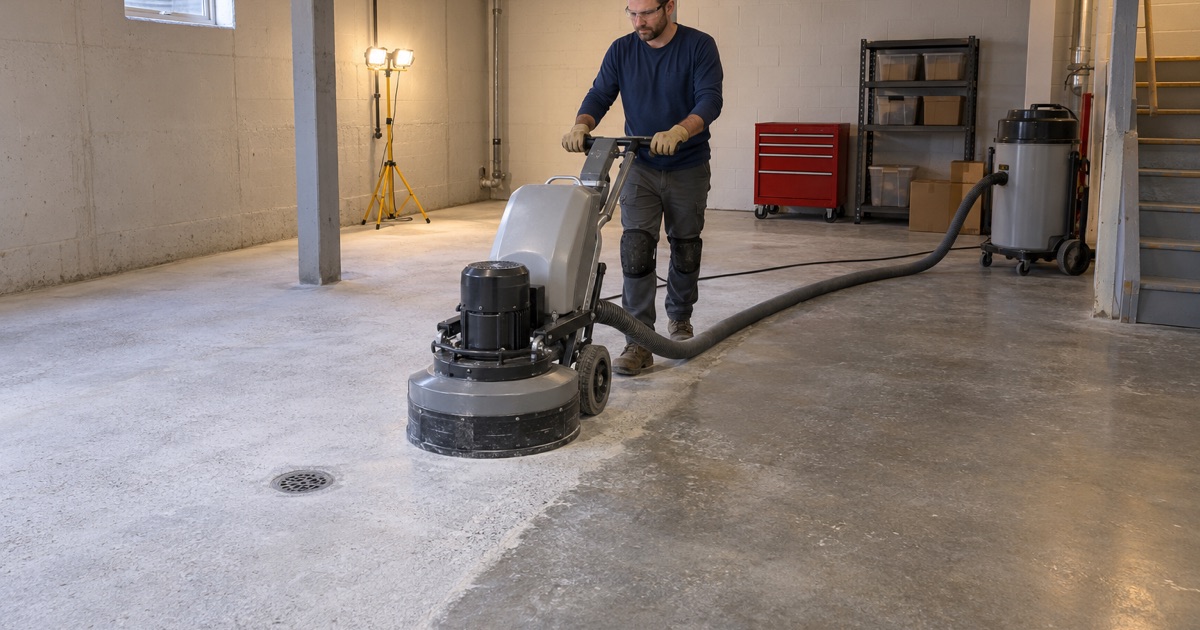
Planetary Diamond Grinding
Planetary grinders spin several heads fitted with metal-bond or resin-bond diamonds, cutting the surface evenly as the machine moves. They are our main tool for garages, basements and most interior floors, because they handle edges well, remove coatings efficiently and leave a controllable profile.
The diamond grit and bond are chosen for the hardness of the concrete and the job at hand. Coarse metal-bond diamonds strip coatings and open hard slabs, while finer grits are used when the floor is being prepared for polishing or a thin system.
Shot Blasting Larger Floors
A shot blaster throws steel shot at the surface, fracturing the top layer and recycling the shot through the machine. It is fast on large, open commercial and warehouse floors and produces a rougher profile suited to thicker coatings and urethane cement. Shot blasting leaves a pattern of overlapping passes and does not reach tight edges, so we pair it with hand grinders along walls, columns and around equipment.
Edges, Corners and Tight Spaces
Walk-behind machines cannot reach the last few inches at walls, door frames and around fixed equipment. Hand grinders with vacuum shrouds finish those areas so the profile is consistent from wall to wall, which keeps coatings from peeling at the edges first.
Edges are where a rushed job shows. A coating that is well bonded in the middle of the floor but rolled over unground concrete along the walls tends to lift there first, and once an edge lets go, water and salt work their way underneath. Taking the time to grind every edge is one of the least visible and most important parts of the job.
The Right Surface Profile for the Coating
ICRI CSP Ratings
The International Concrete Repair Institute rates concrete surface profiles from CSP 1, nearly smooth, to CSP 10, very rough. Thin coatings and sealers need a light profile, while high-build epoxies, broadcast systems and urethane cement need deeper profiles to anchor properly.
We check the coating manufacturer’s required profile and grind to it, comparing against ICRI reference chips. Too smooth and the coating will not bond; too rough and a thin coating will not cover the peaks.
Opening Dense or Troweled Slabs
Hard-troweled garage and commercial slabs can be very dense and glassy at the surface. Grinding cuts through that skin so primers can penetrate, which acid etching often fails to do on hard concrete.
A simple water drop test shows the difference. On a sealed or glassy slab, water beads on the surface; after proper grinding, it darkens the concrete and soaks in within moments. We use that check alongside the profile chips before any primer is mixed.
Moisture Testing After Grinding
Grinding exposes fresh concrete, which is the right time to test moisture. We use ASTM F2170 relative humidity probes or ASTM F1869 calcium chloride kits, and the result is written into the scope before the price is final. A slab that reads high gets a moisture-mitigation primer or a recommendation to address the source of the moisture first.
Removing Old Coatings and Contaminants
Paint, Sealers and Failing Epoxy
Old floor paint, acrylic sealers and peeling epoxy all have to come off before a new system goes down. A new coating over an old one is only as strong as the old layer’s bond, so we grind until the original concrete is exposed.
Thick or rubbery coatings may need scraping or special tooling before grinding, and we account for that in the scope. The proposal notes what is being removed and how.
Tile Adhesive and Mastic
Basements and older commercial floors often carry thinset, carpet glue or black tile mastic. We identify what is on the floor first, and suspect older mastics are flagged for testing before any grinding, since some can contain asbestos and require specialized removal.
Oil, Grease and Salt
Garage and shop floors absorb oil, and garage slabs absorb deicing salts each winter. Grinding removes surface contamination, and deeply soaked areas are cleaned or treated so they do not keep the coating from bonding.
Oil that has soaked deep into a slab can keep wicking back to the surface after grinding. We degrease and test those spots, and where contamination is severe, we may cut out and patch the area rather than risk a coating that blisters over an oil stain months later.
Dust Control and Clean Work
Capturing Dust at the Machine
Every grinder and shot blaster we run is connected to an industrial vacuum, so most dust is captured at the tool rather than floating through a house or business. We bag and remove it, rather than sweeping it into corners or rinsing it toward a floor drain.
In attached garages and basements, we also seal the doorways into living areas. In occupied commercial buildings, grinding is scheduled for times when the space is empty where possible.
Noise and Scheduling
Grinding is loud, so we schedule around the household or business and follow village construction hours. Commercial projects that must stay open are phased by area, with the noisiest work moved to nights or weekends when needed.
We let neighbors in attached homes and multi-tenant buildings know when the loudest work is planned. Most residential garages are ground in a few hours, so the disruption is short, but a heads-up goes a long way.
Grinding Within Air and Coating Rules
Capturing silica dust protects the crew, the client and the building. It also keeps dust out of the coating, since particles settling on a fresh primer weaken the bond. The coatings that follow are chosen within the Illinois VOC limits for floor and industrial maintenance coatings, which apply to the person applying them in the Chicago ozone nonattainment area.
- 20+ Years on Concrete
- Moisture Tested First
- Free Written Estimates