Skokie Epoxy Flooring brings more than 20 years of epoxy flooring in Burr Ridge homes and businesses to a question most buyers never ask: when something breaks on the floor, where do the pieces go? A coated slab is judged on gloss and color at the walkthrough, but it lives or dies on how it behaves the hundredth time someone sweeps it.
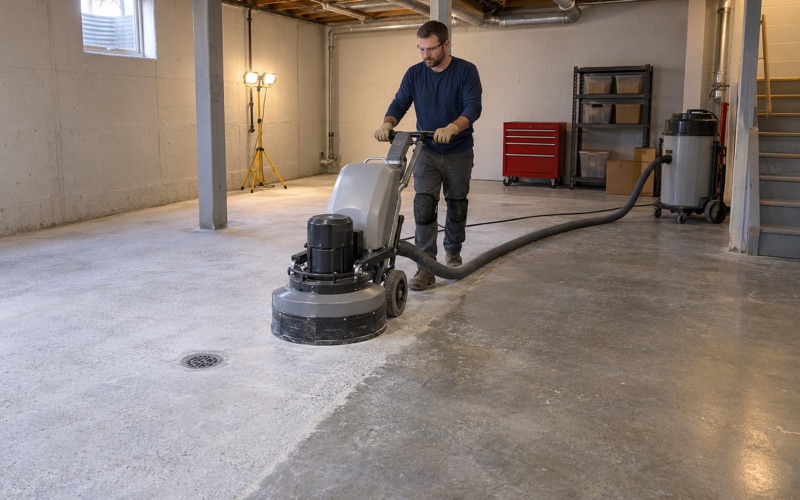
Our answer starts under the coating. Every slab we take on is opened with a diamond grinder or a shot blaster rather than acid, and every crack, spall and failing old coating is mapped before we price anything. That map decides where joints get filled, where a repair has to come first, and whether the slab should be coated at all.
The finish matters as much as the base. We write the product line, the coat count and the finished thickness into the proposal, along with the texture we plan to broadcast, so you can hold the floor up against the quote. On a floor that has to give up every sliver of glass, that texture line is the one worth reading twice.
A Rage Room at the Burr Ridge Village Center
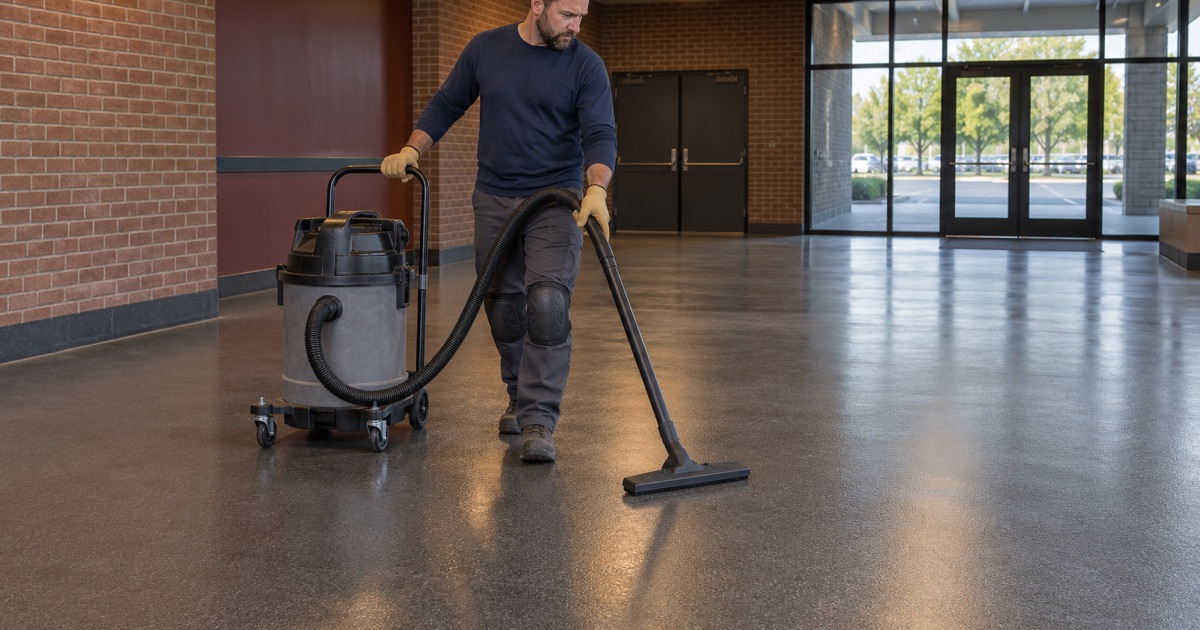
Breaking Things on Purpose
The Burr Ridge Village Center, at Burr Ridge Parkway and County Line Road, holds more than 200,000 square feet of retail and restaurant space, and its owner invested $2 million in an open-air entertainment district there. Among the tenants named is Bullseye Axe Lounge, listed at 770 Village Center Drive: an axe-throwing lounge that also runs a rage room.
The company’s own page says the rage room is available at Burr Ridge and Glenview only, so this is one of two. Guests wear flat, closed-toe shoes, staff supply the gear and check the straps, and then the point of the session is to break as much as possible before the timer runs out.
Glass, Plates and Electronics on the Floor
What gets broken is listed plainly: glassware, plates, monitors and printers, smashed with a bat, a hammer and a crowbar. Each of those leaves a different kind of debris. Glassware throws thin curved shards and fine glitter, plates break into heavy ceramic wedges with sharp edges, and electronics shed plastic housing, small screws and splinters of screen glass.
Almost all of it ends up on the floor, and most of it slides once it lands. We have no connection to Bullseye and have never seen the floor in that room, so we cannot say what it is. What we can describe is what any surface under that kind of debris has to do, because the same physics applies to every hard floor where glass breaks.
Looking for epoxy-flooring closer to Hickory Hills? See Hickory Hills Epoxy-Flooring.
Five-Minute Turnovers and the Shard Left Behind
Cleanup Is Part of the Ticket
Bullseye’s page says cleanup is included: when the timer ends, staff handle the sweeping, not the guests. Rage rooms elsewhere report that the job takes about five minutes, with a manager at one Toronto venue describing staff dumping the electronics and glass into a large garbage pail.
Five minutes is enough to clear the big pieces from almost any floor. The question is the small ones: the sliver that lies flat against the surface, the glitter that settles into texture, the chip that slides into a joint. Those are what the next guest in closed-toe shoes walks across, and what the staff member kneeling to pick up a plate wedge puts a hand down on.
What OSHA Asks of a Walking Surface
The people sweeping are employees, and that brings in 29 CFR 1910.22(a). It requires walking-working surfaces to be kept clean, orderly and sanitary, and its third paragraph says they must be maintained free of hazards such as sharp or protruding objects. In a room built for breakage, that rule describes the whole cleanup job in one line.
A floor cannot meet that rule on its own; people with brooms and pans do. What the floor decides is how hard their job is. A surface that releases every shard to a broom makes the rule easy to keep in five minutes, and a surface that grabs and hides slivers makes it close to impossible, however careful the crew.
A Floor Color That Shows the Glass
Clear glass on a busy multicolor flake blend is nearly invisible, which is exactly why flake hides dirt in a garage. On a floor where finding debris is the job, the logic runs the other way. A solid color, or a fine broadcast in one tone, lets a sweeper see the glint of a sliver from standing height instead of finding it by touch.
Lighting matters too. Raking light from a flashlight held low to the floor is a common way to find stray glass, and it works best on a smooth, even surface where nothing else casts a shadow. We raise color and sheen at the proposal stage for any space where breakage is routine, because changing them later means another full topcoat.
Seams, Cracks and Coarse Texture: Where Slivers Hide
Joints and Cracks Are Pockets
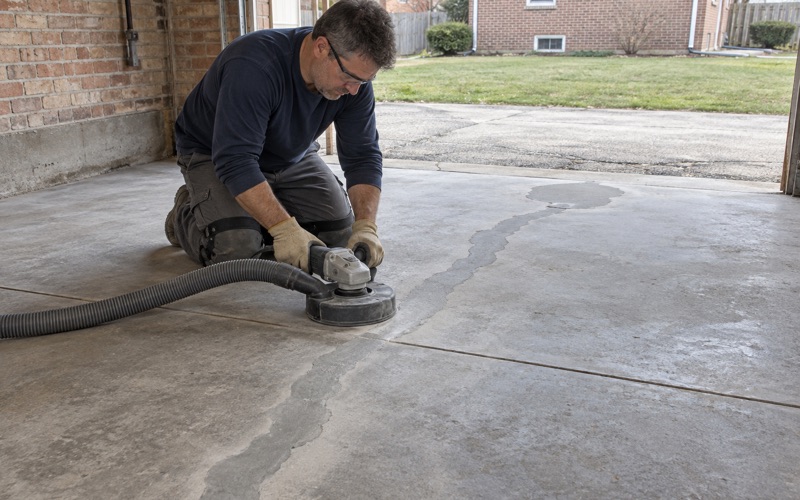
A sawcut control joint left open under a coating is a narrow straight trench, and a shard of glass that drops into it is beyond the reach of a broom. Cracks are worse, because they wander and widen at the surface. Once debris packs into either, every sweep drags across the top of it and leaves the sharp edge pointing up.
That is why our crack and joint map comes before the price. Static cracks are routed and filled flush with a rigid epoxy or polyurea filler, nonmoving joints are filled and ground level, and the coating then runs across them as one continuous surface. Where a joint genuinely moves, we say so and plan for it rather than pretend a seamless finish will hold over it.
When the Slab Needs Repair First
Some slabs are not ready for that treatment. Wide spalls, crumbling edges along old joints and slabs that have heaved out of plane all leave lips and pockets a coating will simply follow. If the map shows that, we tell the owner the slab needs repair or replacement before it should be coated, even when that means the coating job waits or goes away.
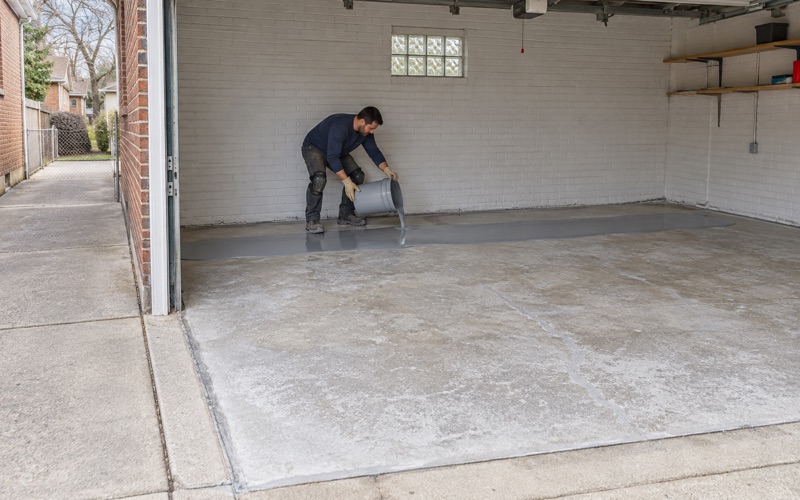
Grinding also matters here. A diamond grinder or shot blaster opens the surface to an ICRI concrete surface profile the primer can lock into, and it takes down the small ridges and trowel marks that would otherwise stand proud of the finished floor. Acid etching does neither, and we do not use it. Grinding dust goes into a vacuum at the machine rather than down a drain.
Fine Texture Versus Coarse Broadcast
Slip resistance usually comes from aggregate broadcast into the wet coat, and the size of that aggregate is a tradeoff. A coarse quartz aggregate broadcast grips well under wet boots, but every peak is a tooth that holds a shard and every valley is a pocket for glass dust. A broom rides over the top and leaves the fines behind.
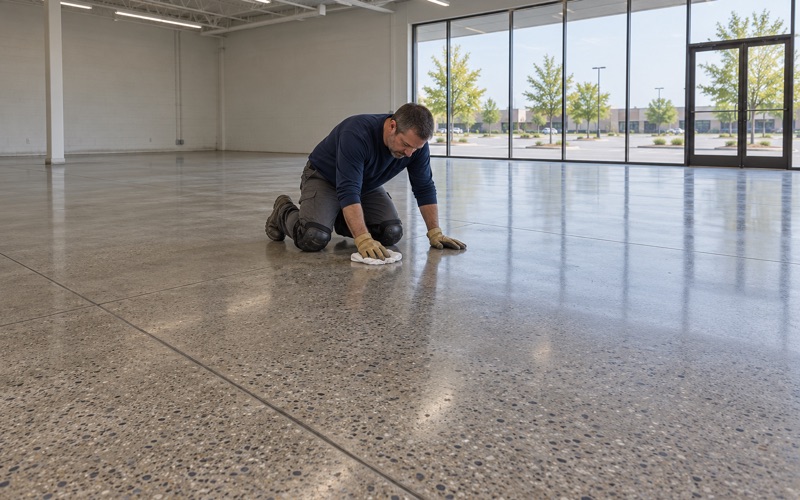
For a dry room where sweepability comes first, we lean toward a fine texture: a light grit or fine aggregate locked down under a polyaspartic or polyurea topcoat that rounds over the particles. It still gives shoes some purchase but lets a push broom carry glass across it. Your proposal names the aggregate and the topcoat, so the texture you approve is the texture you get.
Broken Glass in a Burr Ridge Garage or Basement
A Dropped Jar on the Garage Floor
The same sweep-up rule applies at home, at a smaller scale. Most Burr Ridge homes are detached and owner-occupied, and most were built between 1980 and 2009, so many of the garage and basement slabs here have already seen decades of use. A jar or bottle that slips from a grocery bag on that garage floor scatters much the way a plate does.
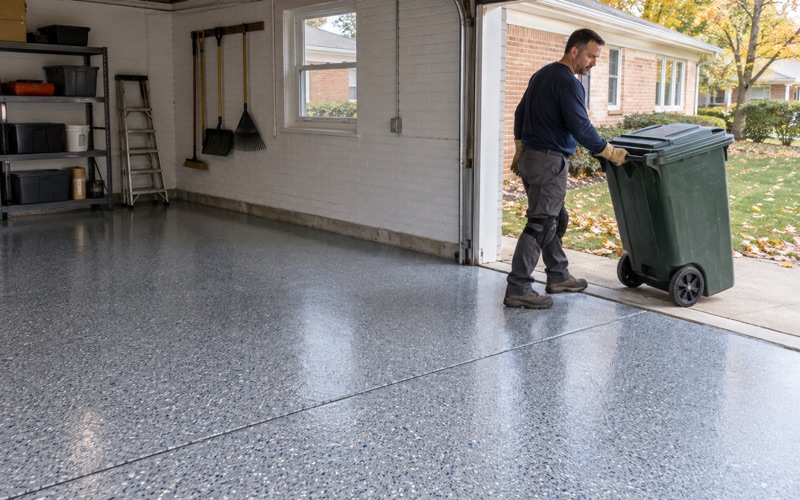
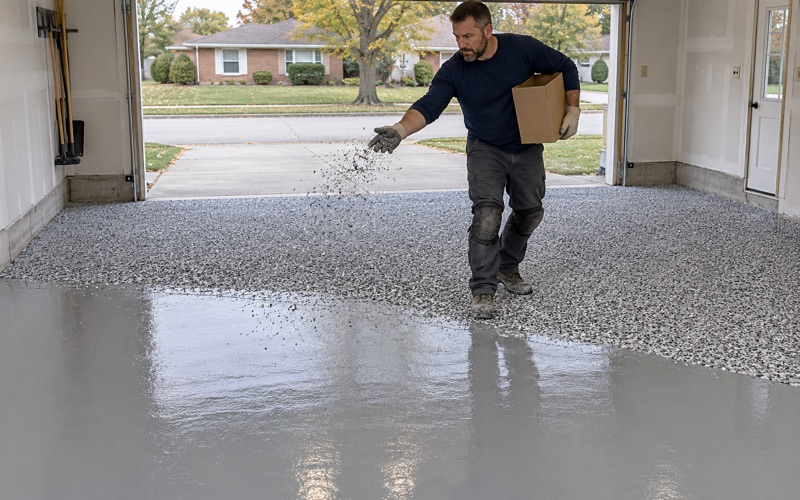
Flake is still the right garage system for most of those homes, because it hides tire marks and stands up to the brine and rock salt that ride in on tires all winter. We pick the blend with cleanup in mind and seal it under a topcoat thick enough that the chips sit beneath a smooth surface instead of standing up as edges.
Basements, Drains and Sump Pits
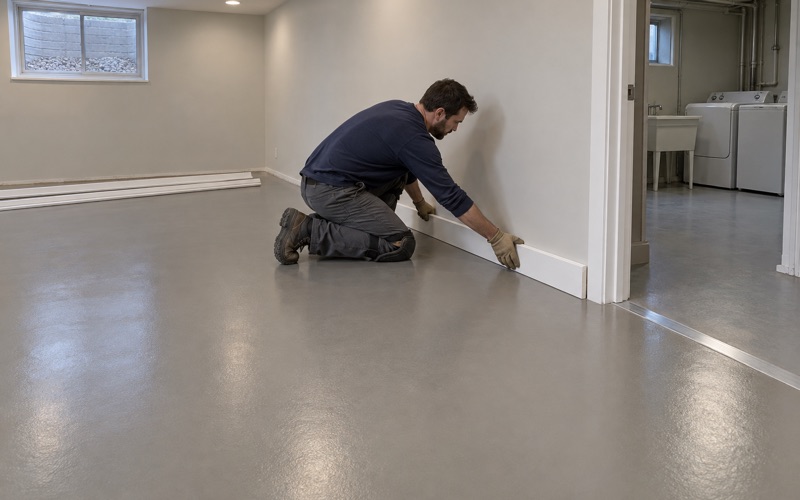
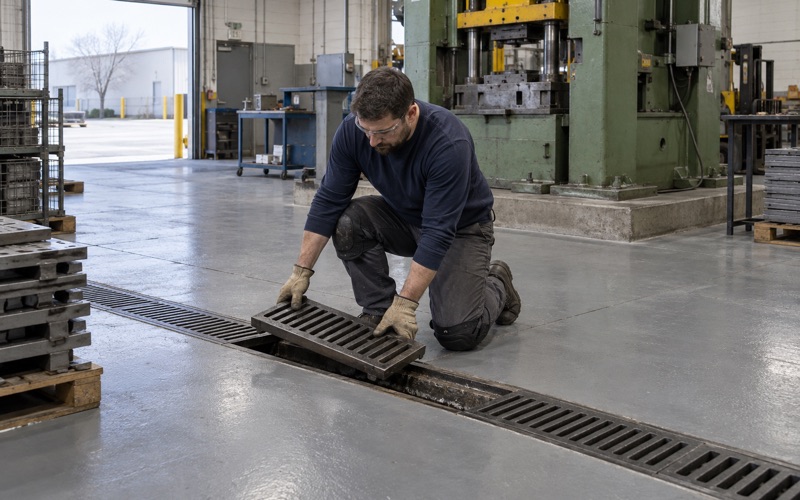
Basement floors bring their own pockets. We coat around the sump pit, the floor drain and the overhead sewer line rather than over them, and we finish the edges at each one cleanly so a broken glass does not leave slivers in a ragged lip. Before any of that, a moisture test goes into the written scope, because a coating that lifts off a damp slab opens new edges of its own.
Whether a slab from that era sits on a vapor retarder is not recorded anywhere we can look up, so we test rather than assume, using ASTM F2170 in-situ relative humidity probes or an ASTM F1869 calcium chloride test. Moisture is also the first exclusion we name when we explain what the coating warranty leaves out.
Village Paperwork Before We Book
Illinois has no state flooring license, so the village’s own rules are the ones that bind. Burr Ridge licenses every contractor and subcontractor on a permitted job, with a $10,000 surety bond naming the village and at least $1,000,000 in liability insurance listing it as additional insured. We check which of those rules a job triggers before we put it on the calendar.
The village permit page exempts finish work such as painting and hardwood refinishing, while new garages, patio replacement and work that impacts a foundation need a permit, so a slab repair can change the answer. On a home job over the state threshold, you also get a written contract and the Home Repair: Know Your Consumer Rights pamphlet before any grinding starts.
- 20+ Years on Concrete
- Moisture Tested First
- Free Written Estimates