Skokie Epoxy Flooring has spent more than 20 years on epoxy flooring in Brookfield and across the near west suburbs, and the first question we ask about any older floor is not which color the owner wants. It is what is already stuck to the concrete. A coating is only as sound as the surface it grips, and on an older building that surface is often a layer of resilient tile and the adhesive beneath it.
That is why our scope starts with a look at the floor rather than a grinder. We map cracks, spalls and old coverings before we price anything, and when a slab still carries tile we say plainly that it has to be identified before anyone opens it up. A moisture test is written into the same scope, so the proposal reflects the slab as it actually is.
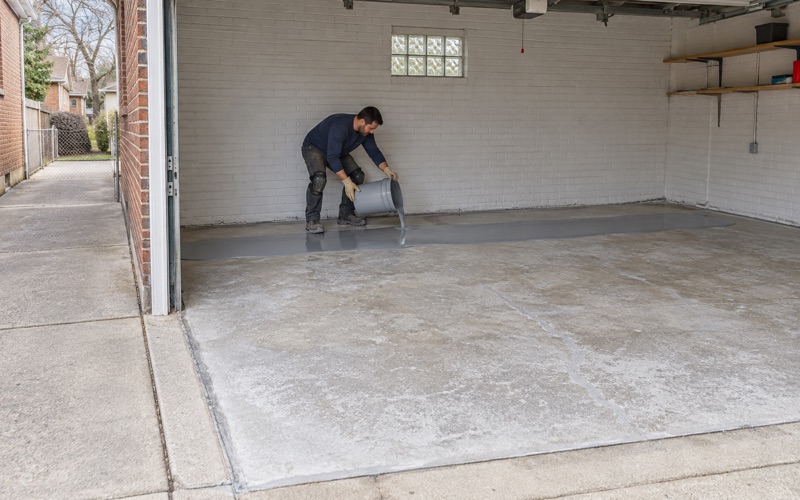
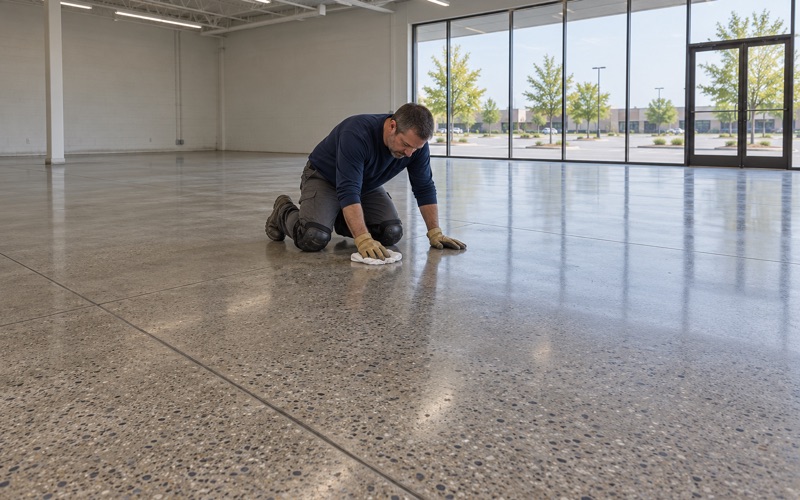
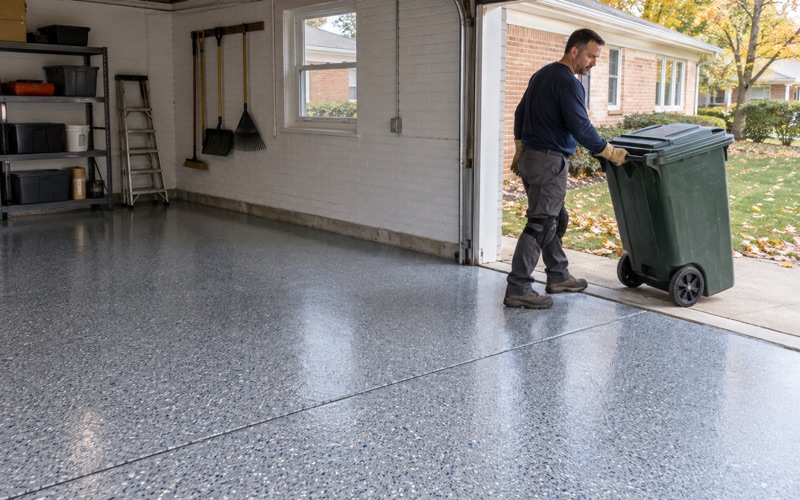
Once the floor is cleared for work, every slab is opened by diamond grinding or shot blasting, never by acid etching, so the coating has a measurable profile to bond to. The written proposal names the product line, the number of coats and the finished thickness, which gives the owner something concrete to check the result against.
St. Barbara School, From Classrooms to 23 Apartments
A Parish School With a Long Pause
Brookfield is a village in Cook County about 13 miles west of downtown Chicago, with a population of 19,476 at the 2020 census. On its Lyons Township side, at 8900 Windemere Avenue, stands the former St. Barbara School, which closed its doors in 2012. It then housed religious education and served as an emergency overnight shelter for BEDS Plus until its heating plant failed in late 2019 and left the building uninhabitable.
In October 2023 The Windemere LLC proposed turning it into 23 two- and three-bedroom apartments while keeping the original structure and exterior. The first- and second-floor classrooms become units largely on their existing layout, and the open lower level is reconfigured to match. The village approved the adaptive reuse in November 2023.
What the Parish Said About the Floors
When the school and its convent went up for sale together in 2020, the Rev. Denis Condon, pastor of Holy Guardian Angels Parish, told the Riverside-Brookfield Landmark that both buildings ‘contain lots of asbestos tile’ and would cost too much for the parish to rehab. That statement is the only evidence on the public record we have read. No lab result was published with it, and nothing we have read says whether the tile is still in place.
We have no connection to the developer, the parish or the archdiocese, and we are not describing work at that address. We use it because it states plainly the condition that can sit under an older floor, and because a pastor’s warning about tile is exactly the kind of remark that should change how a floor job begins.
Why a Conversion Starts at the Floor
A school becoming apartments is a change of use, and the floors are where it shows first. Classrooms of that era were commonly finished in resilient tile glued to the slab, and new apartments usually want a different floor on top or in its place. Every one of those choices touches the old tile or its adhesive, which is why the floor question comes before the finish question.
The order matters for anyone planning a similar project, from a church hall to a former office. A designer who specifies a polished or coated concrete floor before the existing tile is identified has built the budget on a step that may not be allowed, and the schedule slips the day someone finally asks.
Looking for epoxy-flooring closer to La Grange Park? See La Grange Park Epoxy-Flooring.
Asbestos Tile and What OSHA Presumes About Old Floors
Installed by 1980 Means Presumed
The federal construction asbestos standard, 29 CFR 1926.1101, does not wait for proof. Asphalt and vinyl flooring installed by 1980 must be treated as asbestos-containing unless the employer shows otherwise. The presumption covers the work crew, which means it binds any flooring contractor who walks onto that slab with a machine.
The presumption can be rebutted, but only on evidence. Bulk samples taken by an accredited inspector or certified industrial hygienist and analyzed by a proficient lab can show a floor is asbestos-free, and the standard lets an industrial hygienist clear the tile together with its mastic and backing. Until that happens, the floor is handled as if the answer were yes.
Flooring Is Never Sanded
The standard’s work practices for flooring are blunt. ‘Flooring or its backing shall not be sanded.’ Residual adhesive is scraped wet, dry sweeping is out, and mechanical chipping is allowed only inside a negative-pressure enclosure. None of those practices leaves room for a quick test pass with a grinder to see what is underneath.
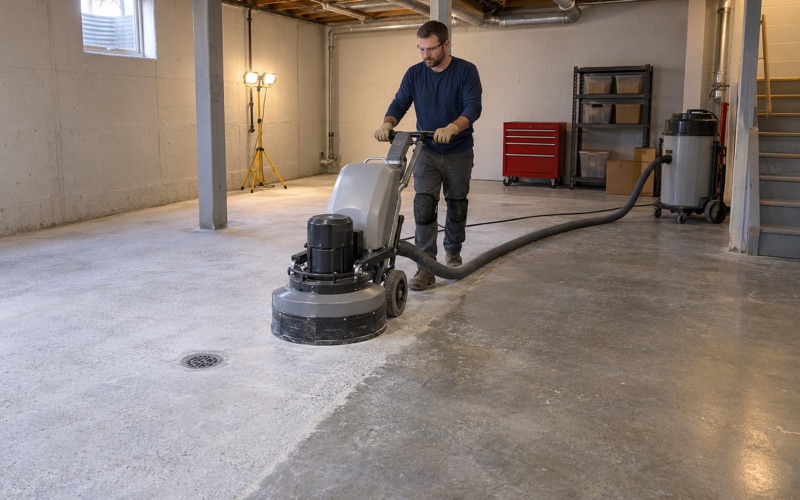
Read that list next to how a coating job normally begins and the conflict is obvious. Our standard preparation is diamond grinding or shot blasting, both of which abrade the surface hard enough to cut through tile, mastic and the top of the slab. On a floor still under the 1980 presumption, that is precisely the step that cannot go first.
What a Coating Is Not
A floor coating is not a way around any of this. Epoxy poured over old tile does not count as encapsulation or removal unless a licensed abatement design calls for it, and we do not sell it as one. We are a coating contractor, not an abatement firm, so when the tile has to come up, that work belongs to people licensed to do it.
The same honesty applies to the rest of what a floor coating can and cannot do. We never present one as radon reduction, waterproofing or flood protection, and the exclusions in a coating warranty are explained before the job is sold. Moisture is the first exclusion we name, and on a slab that has spent years under tile it is often the one that matters.
Sample First, Then Settle the Mastic
Bulk Sampling Before Any Surface Preparation
On an older floor with resilient tile, our first site visit ends with a recommendation, not a grinding date. If the tile could predate 1980 and nobody has paperwork showing it was tested, we ask the owner to have bulk samples of the tile and the adhesive taken and analyzed before we schedule any preparation. The cost of a lab result is small next to the cost of disturbing a floor that should not have been touched.
Sampling the mastic separately matters. A tile can come back clean while the adhesive under it does not, or the other way around, and the coating plan depends on both answers. The result also tells us whether a grinder or shot blaster can touch the slab at all.
Abate or Leave in Place
A positive or presumed floor leaves two honest paths. The tile can be removed by a licensed abatement contractor under the asbestos rules, which opens the slab for a full coating system, or it can be left undisturbed and covered with a new floor that needs no cutting, sanding or grinding of the old one. Which path fits depends on the result, the budget and what the room is going to be.
The second path is usually not an epoxy job, because a bonded resin system needs a profiled concrete surface it cannot get through intact tile. We say so at the estimate rather than quoting a coating that would have to be laid over a surface we are not allowed to prepare.
Mastic Under Old Tile Decides the Coating
When the tile does come up, the slab underneath is rarely bare. It usually carries a film of old adhesive, and under the federal work practices that residue comes off by wet methods, not by dry grinding. Only once the residue is handled that way, and the floor is cleared for normal work, does our own preparation start.
That residue is also a bond problem in its own right. Epoxy laid over leftover adhesive is bonding to the adhesive, not the concrete, and it will lift when the adhesive lets go. We grind or blast to the ICRI concrete surface profile the product calls for, then check that the surface is clean concrete before the first coat of 100% solids epoxy goes down.
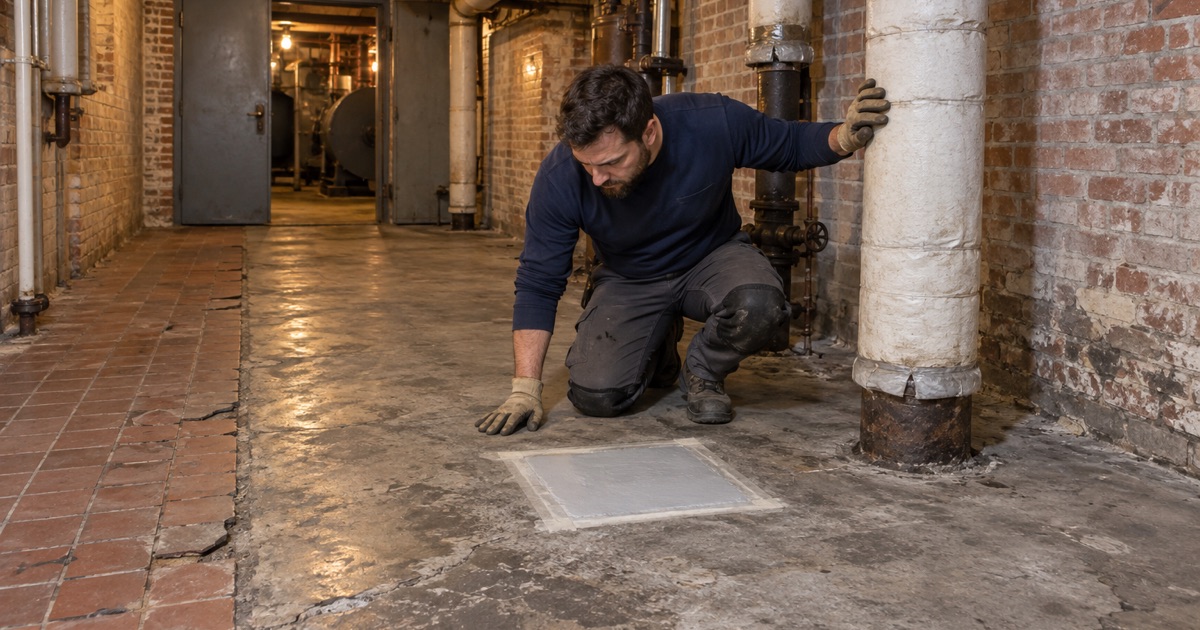
Old Resilient Tile in Brookfield Basements
The Same Question at Home
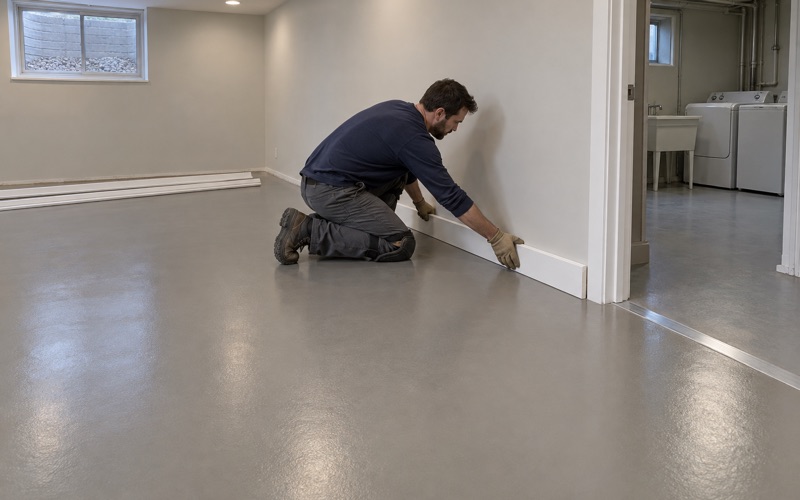
The St. Barbara case is a large building, but the same question turns up on a much smaller scale. Brookfield is mostly owner-occupied single-family homes, and an older basement floor in one of them may still carry square resilient tile laid decades ago, sometimes under carpet or a later floating floor.
Homeowners rarely know when that tile went down. If there is no record showing it was installed after 1980, we treat it the way the federal standard does and recommend sampling before we price a ground and coated floor. Pulling a few loose tiles or scraping at the adhesive to check is exactly the dry disturbance the rules are written to prevent.
When the Floor Is Cleared
Once a basement slab is clean concrete, the work follows our normal sequence. We coat around the sump pit, the floor drain and the overhead sewer line rather than over them, so each stays reachable. Grinding dust is pulled into a vacuum at the machine instead of being rinsed toward the drain.
A slab that has been sealed under tile for decades can also hold moisture the tile was hiding. We run an ASTM F2170 in-situ relative humidity test or an ASTM F1869 calcium chloride test before the price is final, and if the reading calls for it, a moisture-mitigation primer goes into the scope rather than into a warranty dispute later.
Paperwork Before the First Pass
Illinois has no state flooring license, so we confirm each village’s own rules before booking. In Brookfield that means a Village of Brookfield Contractor License, typically $150, backed by a $10,000 License and Permit Bond. Home jobs above the state threshold also get a written contract and the Home Repair: Know Your Consumer Rights pamphlet before any grinding starts.
On a floor with old tile, one more document joins that file: the sampling result, or the abatement contractor’s closeout, showing the surface is cleared. We would rather wait a week for that paper than start a machine on a floor nobody has identified. It also gives the owner a clean record to hand the next buyer or contractor who asks what is under the coating.
- 20+ Years on Concrete
- Moisture Tested First
- Free Written Estimates