Skokie Epoxy Flooring brings more than 20 years of coating work to epoxy-flooring in Bridgeview, and the floors we think hardest about are the ones that take spills nobody can stop. A pastry counter, a dessert kitchen or a sweets case drips sugar every hour it is open, and that sugar behaves differently on concrete than water or grease does.
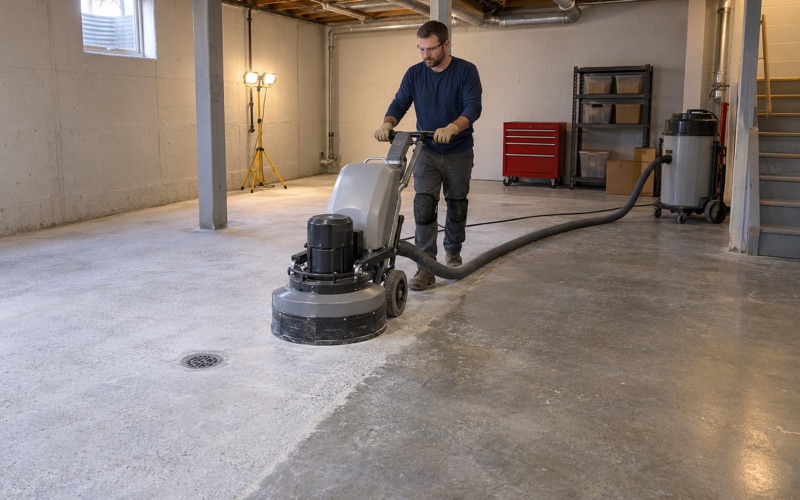
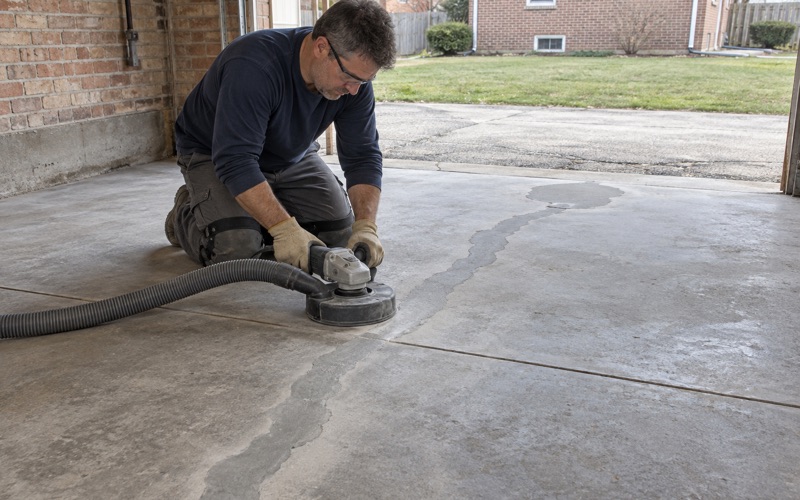
Our approach starts with the slab itself. We open every floor with a diamond grinder or a shot blaster rather than an acid etch, map the cracks, spalls and old coatings before we price anything, and tell an owner plainly when a slab needs repair or replacement before it should carry a coating at all. That is the part of the job a customer never sees, and it decides how long the floor lasts.
Before any job is sold, we explain what a coating warranty leaves out, and moisture coming up through the slab is the first exclusion we name. The written proposal names the product line, the number of coats and the finished thickness, which gives an owner a way to check the floor against the quote once the work is done.
Knafeh and Baklava on Harlem Avenue
A Sweets Counter Between 83rd and 84th Streets
Harlem Avenue in Bridgeview carries a district of Arab-American businesses, with groceries, Middle Eastern bakeries, candy shops and restaurants along the corridor. Nablus Sweets, a Palestinian-owned shop at 8320 S. Harlem Avenue between 83rd and 84th Streets, sells baklava and other pastries and draws lines on weekends. The shop sits on the west side of Harlem Avenue, in the Lyons Township part of the village.
The shop is known for knafeh: white cheese under shredded phyllo, topped with crushed pistachios and soaked in sweet syrup, served warm from a pan at the counter. A dessert built that way is not a dry pastry handed across in a box. It comes out of the pan warm, and syrup travels with every portion.
Late Hours, Steady Drips
According to its Time Out listing, Nablus Sweets is open from 10:00 a.m. to 10:00 p.m. Monday through Thursday and until 11:00 p.m. Friday through Sunday. Those are listed hours rather than ones we confirmed with the shop, but they describe a counter that serves for twelve or thirteen hours a day.
We have never worked on that shop’s floor and have not seen it, so nothing here describes it. The point is general: any business plating syrup-soaked desserts from morning until 10:00 or 11:00 p.m. puts sugar on the floor in small amounts, all day, and much of it lands where people stand and walk the most.
Where the Syrup Lands
Behind a dessert counter, the worst of it gathers in a few predictable spots: the floor in front of the warming pans, the path between the counter and the dish area, and the stretch where trays are carried out to the tables. Those are also the areas with the heaviest foot traffic, so sugar and wear arrive at the same place.
That overlap is why we treat a food floor as a set of zones rather than one square footage. The heaviest build goes where syrup and traffic meet, and the quote shows the thickness for each zone separately, so an owner is not paying for a counter-grade system in a corner that sees a crumb a week.
Looking for epoxy-flooring closer to Lake Zurich? See Epoxy-Flooring Services in Lake Zurich.
Syrup, Bare Concrete and Footing
What Sugar Does to an Unsealed Slab
Bare concrete is porous, and a syrup spill does not simply sit on top of it. Sugar dissolved in water wicks into the surface, dries there and is wetted again by the next spill or the next mopping. Over time, that cycle works on the cement paste at the top of the slab.
Coating makers writing about sugar mills describe raw sugar and moisture creating an erosive environment over the concrete surface until it spalls, and a soft-drink syrup room account describes syrup attacking the cement under loosened tile. Those are trade case studies, not lab measurements, and sugar is not an acid. No source puts a rate on the damage, but the direction is consistent: sugar left on worn concrete makes it worse.
Tacky Film and Tracked Grit
The more immediate problem is underfoot. When a syrup spill dries, it leaves a film that is slick while wet and tacky once it sets, and that tacky layer holds onto whatever lands on it. Sand and grit tracked in from Harlem Avenue stick to the sugar instead of being swept away. A floor that looks clean at a glance can still feel sticky underfoot.
That mix of sugar and grit is abrasive under shoes and carts, and it changes how a floor grips. Staff behind a counter pivot, carry hot pans and step backward without looking, and a surface that is slippery in one spot and sticky a step later is harder to move across safely than one that is simply wet.
Worn Coatings Hold Sugar Too
A floor that was coated years ago is not automatically protected. Once a thin coating wears through in a traffic lane or lifts at a crack, syrup reaches the concrete underneath and gets trapped under the coating’s edges, where no mop reaches it. Sugar under a lifted edge keeps working long after the visible spill is mopped, and the gap tends to grow.
That is why our survey of a food floor looks for every place the old coating has let go. Loose film comes off under the grinder, damaged concrete is patched, and where the slab itself is too far gone, the honest answer is repair first and coating second.
Sealed, Seamless and Textured
No Pores for Syrup to Enter
The answer to sugar is a floor with nothing for it to soak into. A sealed resin system such as 100% solids epoxy or urethane cement closes the concrete’s pores completely, so a spill stays on the surface where hot water can lift it. The coating takes the abuse, and the slab underneath stays dry and clean.
Bond comes before everything else. A kitchen slab gets a moisture test as part of the written scope, using an ASTM F2170 in-situ relative humidity probe or an ASTM F1869 calcium chloride test, because vapor pushing up from below can lift a coating that syrup never touched. The ground profile is checked against the ICRI CSP range the product calls for.
Seamless at the Edges
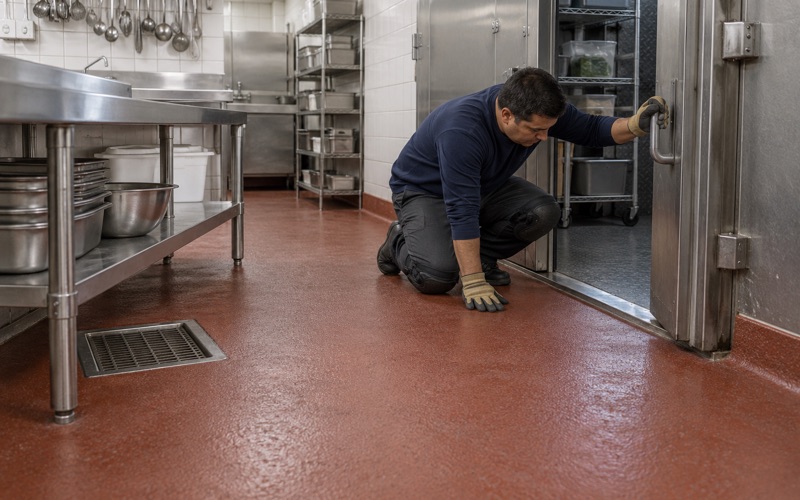
Sugar finds seams. Tile grout, saw cuts and the joint where the floor meets the wall are the places syrup collects and stays, so a sweets kitchen floor is best poured as one continuous surface. Control joints are filled, and the coating can turn up the wall as an integral cove so there is no corner for residue to pack into.
FDA Food Code 6-201.13 addresses coved, closed floor and wall junctures in food establishments, and a resin cove answers that in one material. For a food business west of Harlem Avenue, food permits and inspections come from the Cook County Department of Public Health, and that department, not the installer, decides whether a finished kitchen passes.
Texture That Grips Through a Film
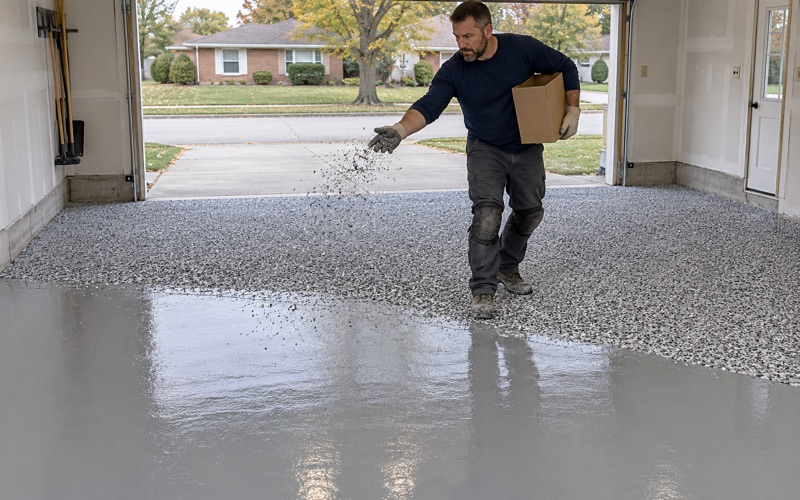
A smooth, glossy coating is easy to wipe but turns treacherous under a skim of syrup. Broadcasting quartz aggregate into the base coat and locking it under the topcoat gives the surface peaks that stand above a thin film, so a shoe still finds something to bite on. The aggregate size sets how aggressive that bite is.
The tradeoff is cleanability, since a coarse texture holds more residue than a fine one. We usually grade it, with a heavier broadcast behind the counter and at the pan station and a finer one in customer areas. The FDA Food Code 6-201.11 antislip exception allows slip-resistant floor applications where safety calls for them, even though food areas otherwise need smooth, easily cleanable floors.
Cleaning After an 11:00 p.m. Close
Hot Water Lifts Sugar
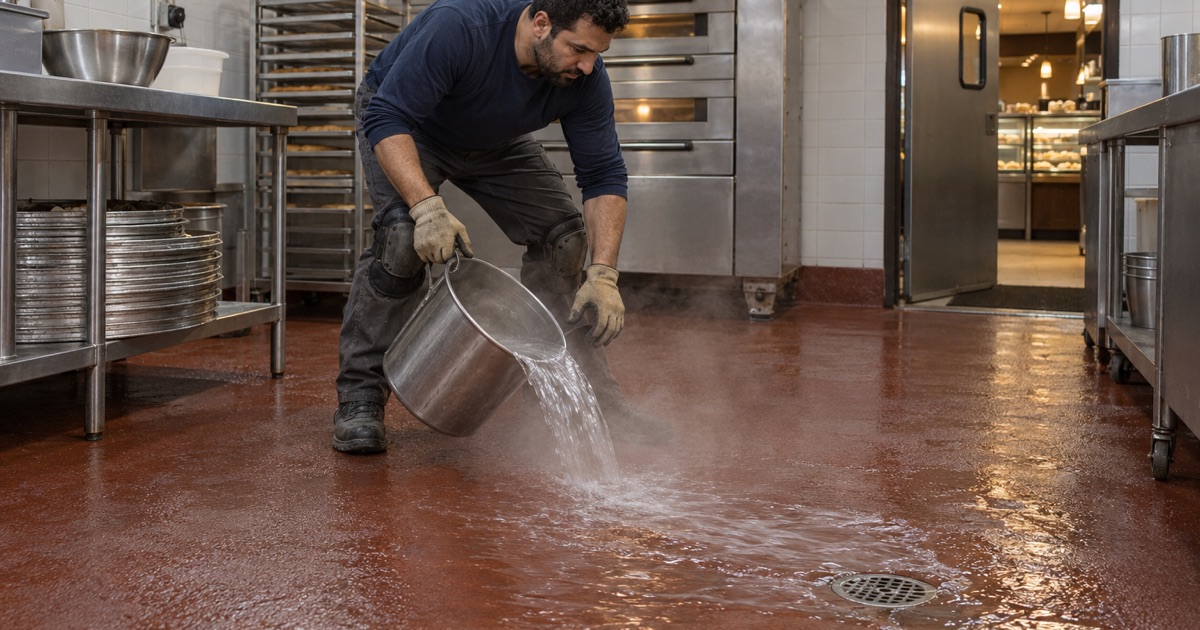
Sugar dissolves in hot water, which makes it one of the easier residues to remove from a sealed floor. After a late close, a hot-water scrub with a neutral cleaner and a squeegee to the drain clears dried syrup without the scraping that bare concrete needs. On an unsealed slab, the same rinse only carries dissolved sugar deeper into the pores.
We match the topcoat to that routine. A polyaspartic or urethane topcoat chosen for hot-water cleaning keeps its finish under nightly scrubbing, as long as the cleaning products stay inside what the coating’s maker lists as compatible. Harsh degreasers and solvent cleaners are a common cause of a dull, softened topcoat.
Working Around Opening Hours
A shop open until 11:00 p.m. on weekends has a short window between close and the next morning, and a full system rarely fits inside one night. We phase a kitchen in sections, coating one zone while the counter keeps serving from another, and pick products whose cure fits the closed hours rather than forcing the schedule. Customers on the other side of the counter never walk on fresh resin.
Cure depends on slab temperature and the dew point spread at the surface, not the clock. We read both before each coat, because a topcoat laid on a slab near its dew point can develop amine blush or lose gloss, and that is a poor trade for opening a few hours sooner.
Permits and Paperwork in Bridgeview
Where a floor project needs a permit in Bridgeview, it goes through the Village of Bridgeview Building Department at 7500 S. Oketo Avenue. A permit there needs drawings, the contractor’s license, a $10,000 surety bond and a certificate of insurance, and Illinois licenses no flooring or coatings contractor, so the village contractor license and bond are what count.
We check those requirements before a job is booked, not after. Products are chosen inside the Illinois VOC limits for floor and industrial coatings under 35 Ill. Adm. Code Part 223, which matters in a shop that stays occupied, and the grinding dust is captured at the machine by vacuum rather than washed toward a floor drain. Neither step is visible in the finished floor, but both are part of what an owner is buying.
- 20+ Years on Concrete
- Moisture Tested First
- Free Written Estimates