Skokie Epoxy Flooring has spent more than 20 years on epoxy flooring in Bensenville and the surrounding suburbs, and this page is written for the shops that cut, weld and polish metal. A fabrication bay, a machining room and a home garage with a grinder on the bench share one problem: the slab underneath is part of what settles on the work.
A bare concrete floor never stops shedding. Traffic wears the surface into fine dust, steel offcuts and grinding swarf work into the pores, and a broom sends all of it back into the air. Where the product is stainless steel bound for food or pharmaceutical machinery, that loose mix is more than a cleaning chore.
Our approach starts the same way on every slab: we open it with a diamond grinder or a shot blaster, never acid, and we capture the dust at the machine. Below we explain why that matters in a stainless shop, how we schedule prep around finished parts, and what a sealed floor can and cannot do.
Stainless Fabrication for Food and Pharma Machines on Thomas Drive
One Fabricator, Two Bensenville Addresses
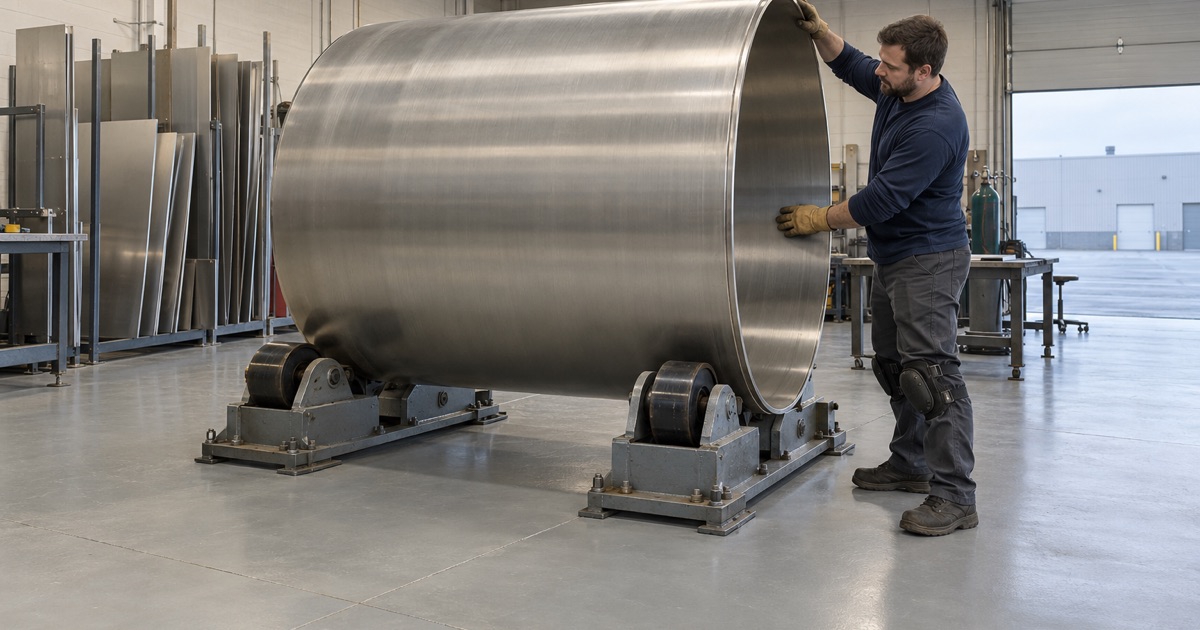
Ace Metal Crafts runs its Fabrication Division at 484 Thomas Drive, an address that sits inside the village in Addison Township, DuPage County, and a Machining Division at 205 Park Street. The company welds, forms, rolls, cuts and polishes stainless steel, and machines it on CNC mills and lathes.
Its customers are OEMs, mostly in food processing, food packaging, pharmaceutical and environmental equipment. That customer list is the point for this page. A frame or hopper built for a food or drug line is judged on its surface, and a surface finished in Bensenville has to arrive at the customer the way it left the polisher.
What ASTM A380 Counts as Contamination
ASTM A380 covers the cleaning and descaling of stainless steel parts, equipment and systems. Its scope lists the contaminants that can affect the metallurgical or sanitary condition of a stainless surface, and free iron, oxide scale, rust, particles, metal chips and dirt are all on that list. We read it as a fabrication standard, not a flooring one, but its list explains why a stainless shop cares what its floor sheds.
The standard also treats surface condition as something decided across the whole job, from design and fabrication methods through cleaning, and it names protection to prevent recontamination as part of that work. A part cleaned on Monday and dusted with grit on Tuesday is a part that needs cleaning again.
An Industrial Village That Spans Two Counties
Bensenville borders the southwest corner of O’Hare International Airport, is home to over 1,500 businesses and has one of the largest industrial parks in Illinois. The village also crosses a county line, with a portion in Leyden Township, Cook County, so we confirm which side a property sits on before quoting anything that depends on local rules.
For a stainless fabricator in that setting, the floor question is narrower than durability. Load ratings and chemical charts still count, but the first test is whether the surface adds iron, grit or dust to a room where finished parts are trying to stay clean. That is the question the rest of this page answers.
Looking for epoxy-flooring closer to Northlake? See Epoxy-Flooring Services in Northlake.
Free Iron and the Floor Underneath It
How Stainless Picks Up Rust It Did Not Make
Stainless resists corrosion because of a thin chromium-rich film on its surface. When particles of ordinary carbon steel get pressed or dropped onto that surface, they rust on their own schedule, and the result looks like the stainless itself is rusting. That is free iron, and it is why rust spots on stainless so often trace back to the shop rather than the alloy.
This is the reason stainless fabricators keep separate carbon-steel tooling: a wire brush or grinding disc that has touched mild steel carries its particles to the next part. The same logic reaches past the workbench to anything that sheds iron in the room. Floor dust is harder to segregate than a brush, because it moves every time someone walks or sweeps.
A Bare Slab as One More Iron Source
An uncoated floor in a metal shop collects iron from every direction. Grinding swarf, saw chips and weld spatter fall on it, cart wheels grind them into the surface, and the concrete itself dusts as its top layer wears. A slab that was once shot blasted and left bare is open and rough, and it holds that debris in its texture.
Rust stains on old concrete are another source, since they are iron oxide sitting right where sheets get set down. Every sweep lifts some of that load into the air, and some of it settles on whatever stainless is nearby. A slab that has been patched with steel plates or has rebar showing at a spall adds still more.
Sheets, Carts and Dropped Parts
In a stainless shop the floor touches the work more often than people expect. A sheet slid off a rack, a blank that slips off a table, a part set down for a minute between operations: each one picks up whatever is on the concrete. Cart and pallet wheels track the same grit from the cutting area to the polishing area.
None of that means a shop is doing anything wrong. It means the floor belongs in the same housekeeping plan as tool segregation and covered storage, and a floor that will not dust and wipes clean is easier to keep inside that plan. Sealing the slab does not replace any of those habits; it takes the floor off the list of things that undo them.
Sealed Floors and Keeping Prep Dust Off Finished Work
Opening the Slab Without Spreading It
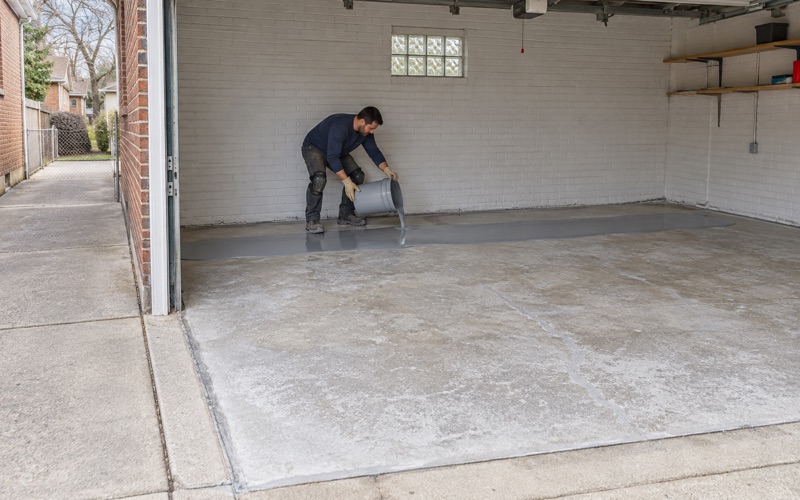
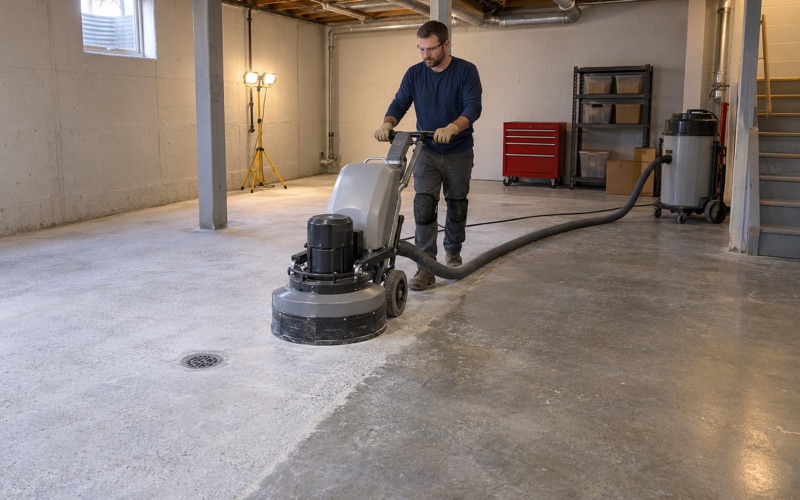
We open every slab mechanically, with a diamond grinder or a shot blaster, so the coating has a real profile to grip. Acid etching is off the table for us anywhere, and in a stainless shop it would mean pooling acid and rinse water on a floor next to finished parts. Shot blasting also leaves a coarser profile, which suits a thicker system such as urethane cement.
Mechanical prep makes dust, so we capture it at the machine with a vacuum instead of washing it toward a floor drain. We grind to the ICRI concrete surface profile the chosen system calls for, and old coatings, cracks and spalls are mapped before any machine runs. Where a slab needs repair or replacement before it should be coated, we say so in writing rather than coating over the problem.
Scheduling Prep Around Finished Stainless
Even captured dust is not zero dust, so the order of work matters as much as the equipment. We plan grinding and blasting for days or zones when finished stainless is out of the room, wrapped or behind a barrier, and we clean up before that area goes back into use.
Shop floors are phased around the hours a building has to keep running, which in a fabrication shop usually means one bay at a time. The proposal shows the sequence along with the product line, the number of coats and the finished thickness, so the floor can be checked against the quote.
A Surface That Sweeps and Scrubs Clean
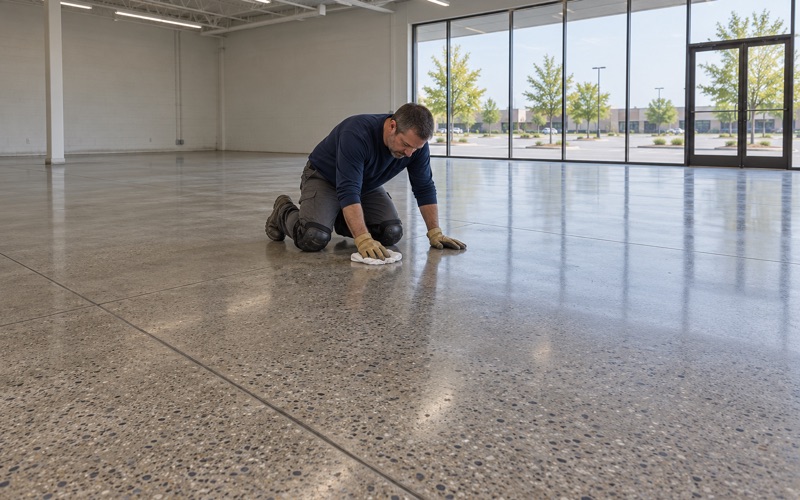
For a shop floor that has to stay clean, we usually look at 100% solids epoxy under a polyaspartic topcoat, or urethane cement where hot work, washdown or heavy impact calls for it. A smooth or lightly textured finish lets swarf be swept and scrubbed up instead of hiding in the surface. Vinyl flake broadcast hides dust well in a garage, which is exactly why we steer a stainless shop toward a solid color where debris shows up and gets cleaned.
Texture is a trade-off we talk through. A quartz aggregate broadcast adds grip where oil or coolant reaches the floor, but every bit of texture is also a place for fines to sit, so we keep it to the walkways and wet zones that need it. A cove at the wall base, where the system allows it, also closes the joint where dust likes to collect.
Keeping Metal Dust Off Stored Equipment in Bensenville Shops and Garages
Rust Staining in Home Shops
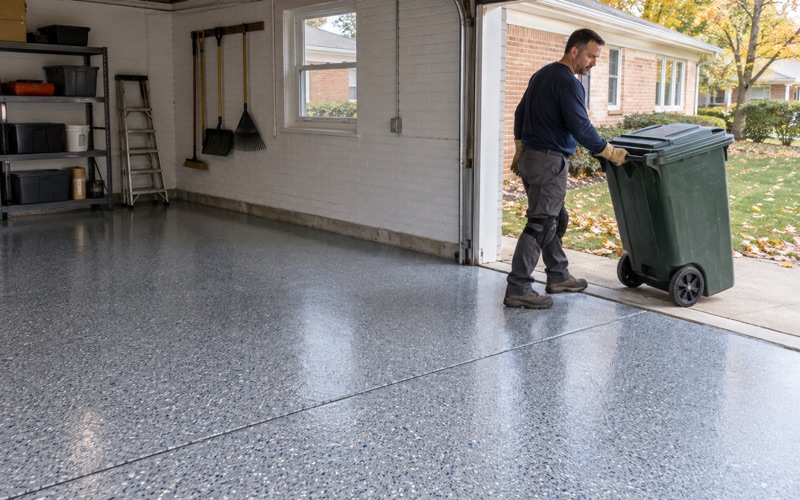
The same problem shows up on a smaller scale in Bensenville garages. Of the village’s housing units, 73.8 percent were built before 1980, and an older slab that has been ground on and swept for decades tends to dust and stain. Grinding dust from a bench grinder lands on the floor, rusts in the first damp week, and leaves orange freckles on the concrete and anything stored low.
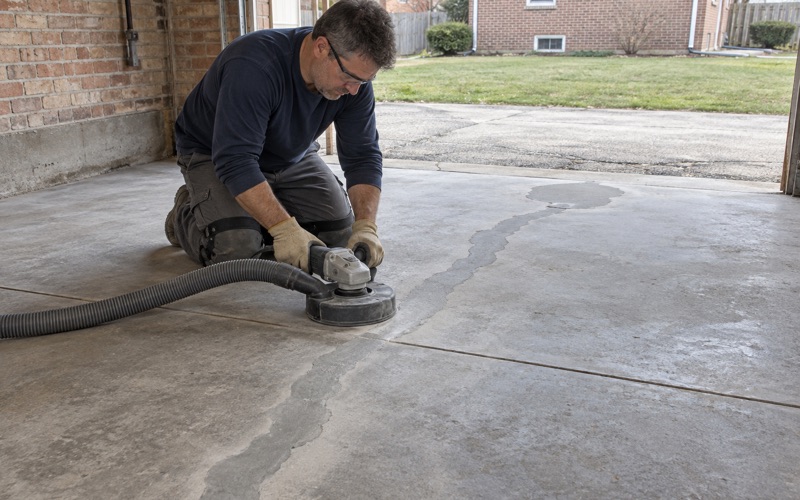
A hobbyist with a stainless exhaust, a polished toolbox or a boat trailer sees the same rust spots a fabricator would. A sealed floor keeps that dust on top where a shop vacuum can pick it up, and the stains stop soaking in. We still open a garage slab the same way we open a shop floor, with the dust vacuumed at the grinder, so the prep does not leave a fresh layer of grit on the shelves.
Moisture, Salt and Cure Timing
A moisture test is in the written scope before we finalize a price, on a garage slab as much as a shop floor. We use ASTM F1869 calcium chloride tests or ASTM F2170 in-situ relative humidity probes depending on the slab, and moisture is the first exclusion we explain when we go through what the coating warranty leaves out. A dry-looking slab can still push vapor, and a coating over it is the first thing to fail.
Garage systems are picked to stand up to the brine and rock salt that ride in on tires all winter. Cure follows slab temperature and the dew point spread at the surface rather than the calendar, so an unheated detached garage in deep winter is told to wait for warmer weather. Amine blush and hot tire pickup are the usual results of rushing that, and both are avoidable.
Paperwork and Plain Limits
Illinois has no state flooring license, so we check Bensenville’s own contractor registration and insurance requirements before a job is booked. Home jobs over the state threshold get a written contract and the Home Repair: Know Your Consumer Rights pamphlet before any grinding starts, and every product is chosen inside the Illinois VOC limits for floor and industrial coatings.
We are also plain about limits. A coating does nothing to the stainless itself and is no substitute for cleaning the metal; it removes one source of iron and grit from the room, while the finishing of the parts stays with the fabricator. It is not sold as waterproofing or flood protection either.
- 20+ Years on Concrete
- Moisture Tested First
- Free Written Estimates